
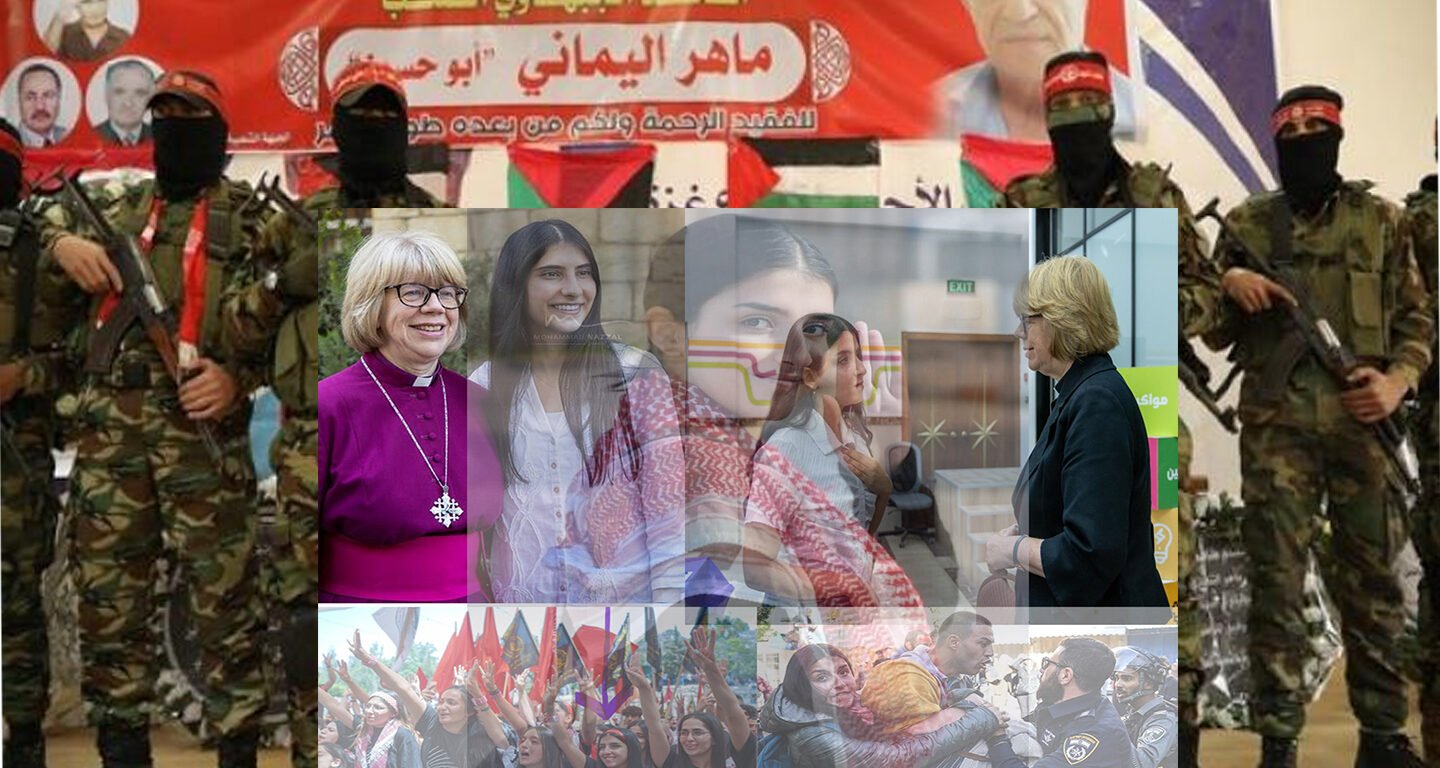
I will keep this as brief as possible. Following my article on the Archbishop of Canterbury meeting with two women with a history of PFLP affiliation, several people contacted me with a variation of the same response: “So what?”
It is hard to believe that, after October 7, there are still people with so little understanding of the Popular Front for the Liberation of Palestine (PFLP), what it stands for, and the central role it plays within the Palestinian “resistance” camp.
Some naively imagine that October 7 was a Hamas operation with a supporting role played by Palestinian Islamic Jihad. Others assume that because the PFLP is a Marxist-Leninist organisation, it must somehow stand apart from the Islamist groups.
That fundamentally misunderstands the Palestinian armed factions and the reality of the alliances that developed first through violent opposition to the Oslo peace process and later under Palestinian rule after 2006. Whatever their ideological differences, when it comes to fighting Israel and killing Jews, the PFLP and Hamas are brothers in arms.
Nor has the PFLP ever been shy about its position. It openly announced its mobilisation on October 7 and participated in the atrocities that followed. This is the official statement (translated) published on the PFLP website at 10:25am on October 7, 2023.
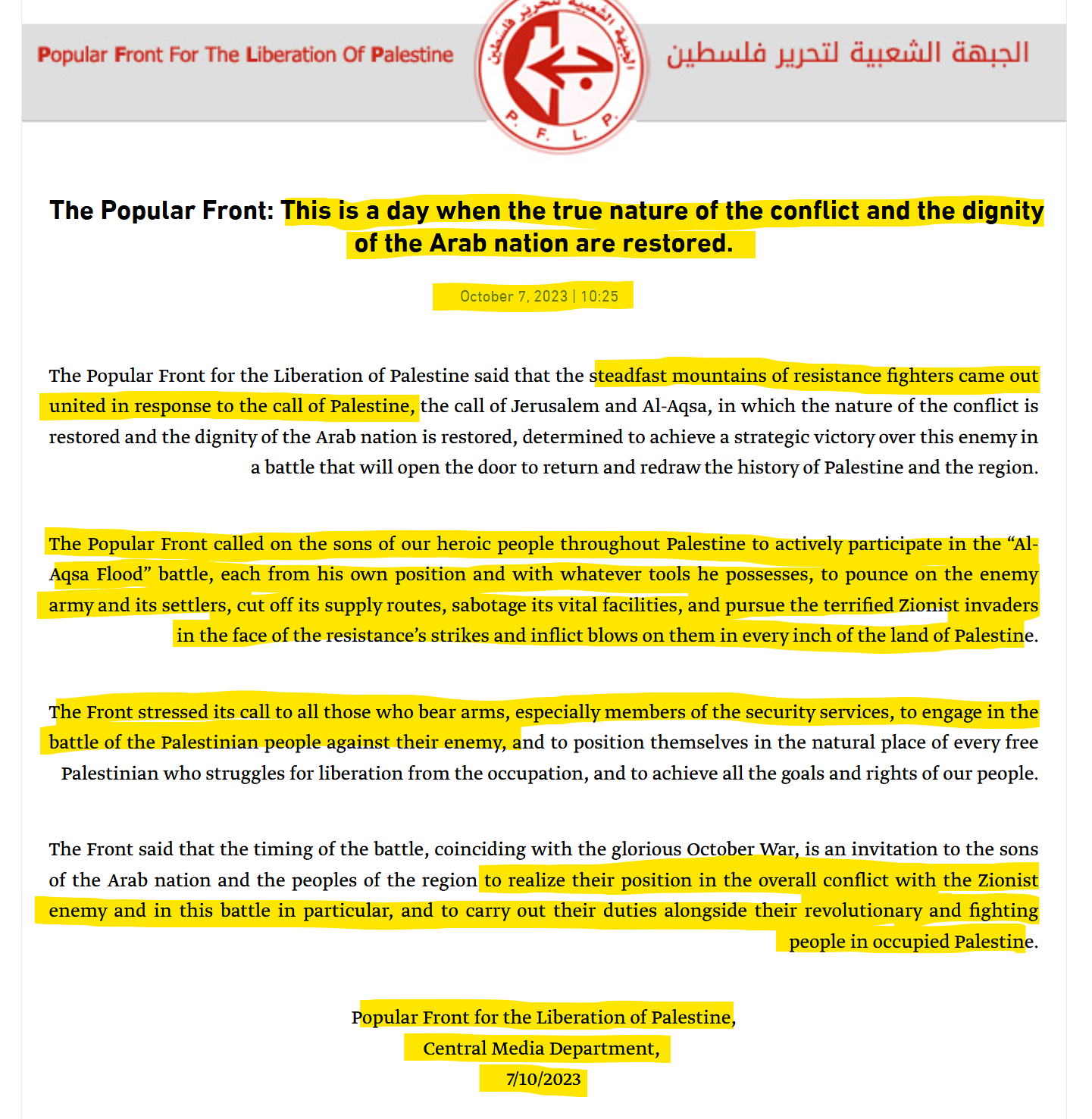
Officially, the PFLP celebrated the October 7 attack, called for participation in “Al-Aqsa Flood”, urged attacks on the “terrified Zionist invaders”, and encouraged Palestinians to join the fight. PFLP members live-streamed their activities during the assault, while the organisation issued a second statement less than two hours later celebrating the operation.
According to the 7 October Parliamentary Commission Report:
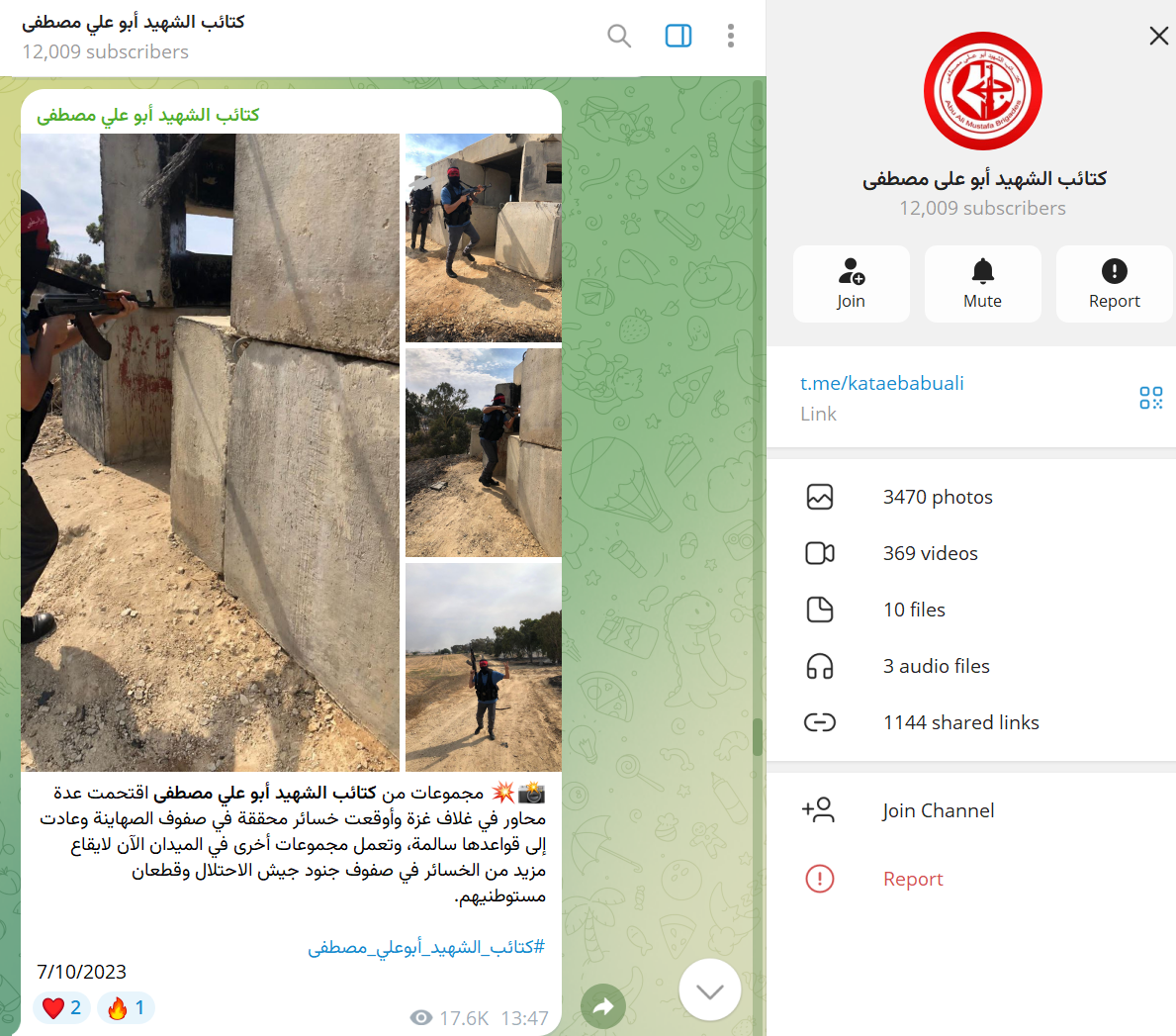
On the official Abu Ali Mustafa Brigades Telegram, PFLP posted several photos showing terrorists in action, with accompanying text that said: “Cells of the martyr Abu Ali Mustafa Brigades stormed several [military] points in the Gaza envelope and have inflicted verified losses in the Zionist ranks.”
The report also notes the close relationship between the PFLP, its Abu Ali Mustafa Brigades military wing, and Iran.
Nor was the PFLP merely cheering from the sidelines. As one of the factions that crossed into Israel on October 7, it participated in both hostage-taking and hostage-holding. Israeli officials believe that, at one stage, the Bibas children may have been held by PFLP terrorists.
This October 7 post from a PFLP Telegram channel boasts of its fighters “storming” into Israel and continuing operations to inflict further losses on both soldiers and “herds of settlers.”
None of this should come as a surprise. The PFLP is often viewed through the lens of Leila Khaled and the era of aircraft hijackings, a period that has been so heavily romanticised that many have lost sight of what the organisation actually is.
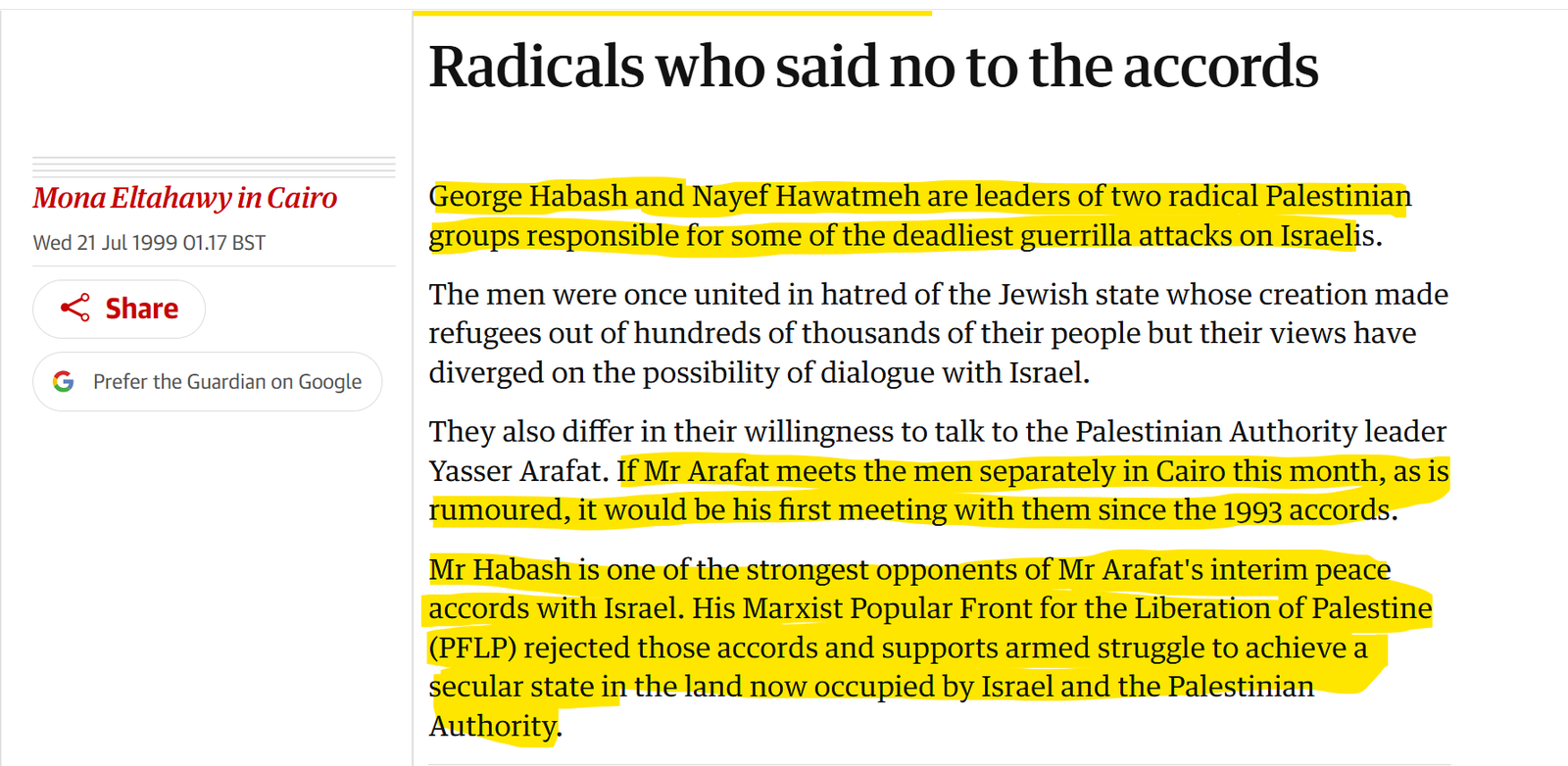
The PFLP was never an official stakeholder in the Oslo peace process. The PFLP did not merely criticise Oslo. It rejected the accords outright, resigned from the PLO in protest, and spent much of the 1990s working alongside other rejectionist factions to undermine the peace process. A Guardian article from July 1999 noted that six years into the peace process, the leader of the PFLP was still regarded as one of its “strongest opponents”:
Although the group moved closer to the PLO again in late 1999, this came during the final stages of a negotiation Arafat never intended to complete, and the PFLP leader George Habash did not even bother attending the reconciliation meeting.
The outbreak of the Second Intifada was less than a year away. Throughout this Oslo period, the PFLP deepened its ties with Hamas and Iran, and it was during this period that the PFLP evolved into something very different from the movement many in the West still imagine it to be. Despite their ideological differences, they all found common cause in armed struggle against Israel.
During the Second Intifada, the PFLP played an active part in the violence, even taking responsibility for suicide attacks in Ariel, Netanya, Kfar Saba and in the Jordan Valley. Strategically, following the UN’s Durban conference in 2001, the PFLP also became the key bridge with western left wing movements, through a network of NGOs that would bring them both funds and influence. They had access and reach which the Islamist groups could never match.
This NGO trail is important. Israel has acted against a number of PFLP-linked NGOs – part of a terrorist funding-and-influence network which is poorly understood in the UK.
One example of this network is Samidoun. The NGO describes itself as an “international network of organizers and activists” advocating for the release of Palestinian prisoners, but multiple governments have identified it as a PFLP-linked support network that helps to legitimise and support a terrorist organisation.
In October 2024, the U.S. and Canada both targeted Samidoun. Samidoun was also banned in Germany in 2024.
While the PFLP’s strategy on the international stage focused on spreading its influence through NGO activity, the acts of terrorism against civilians in Israel did not stop either.
In November 2014 the PFLP published a notice calling for attacks against Israel to be escalated. One week later two PFLP terrorists entered a synagogue in Jerusalem armed with a gun and meat cleavers and butchered four Rabbis. They also murdered a policeman before eventually being shot by Israeli security. One of the four Rabbis, Avraham Shmuel Goldberg, was a dual British citizen.
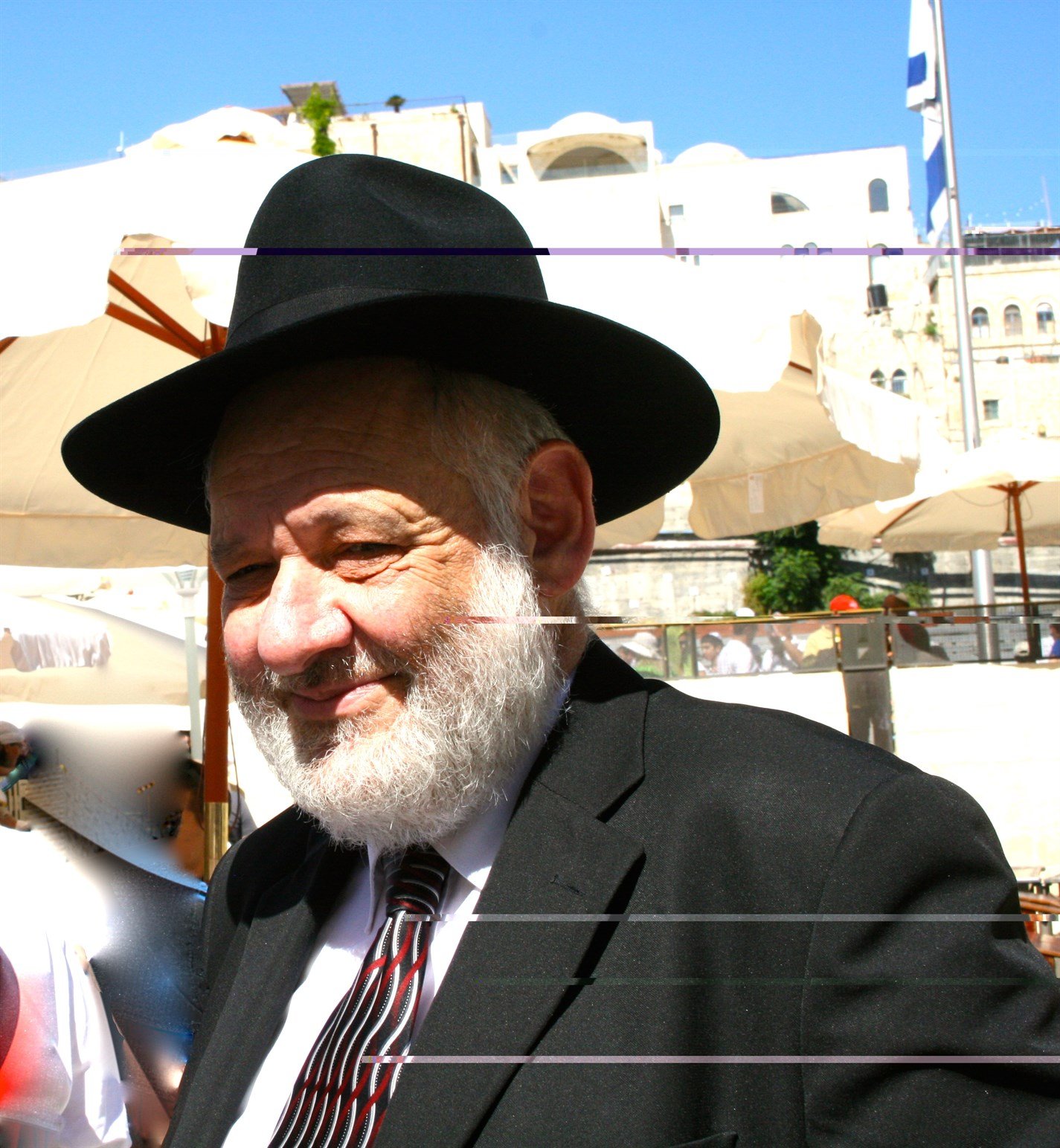
In 2019 Israeli forces raided a large PFLP network in the Ramallah area, which was believed to be responsible for a string of deadly attacks. This included the August 23 bombing which killed 17-year-old Rina Shnerb.
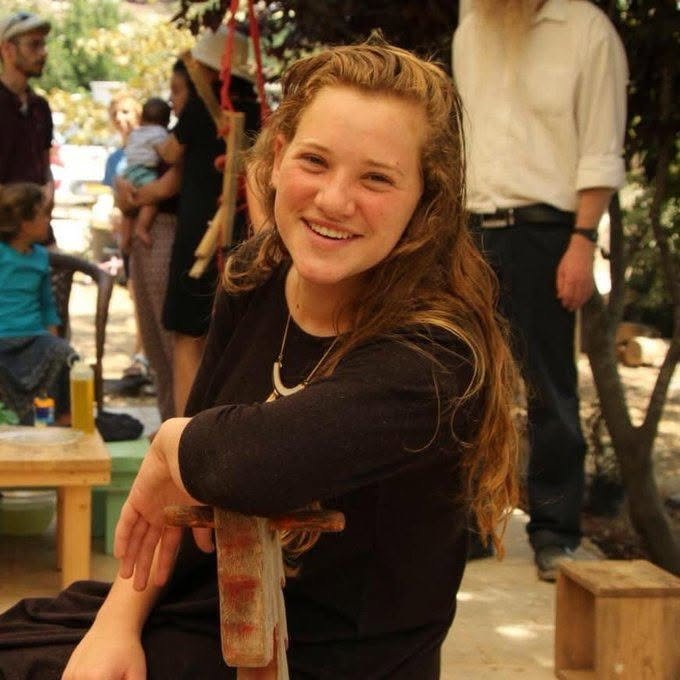
Samer Mina Salim Arbid, a PFLP official, was the leader of the cell that carried out the attack which killed Rina Shnerb. Here is an image of Zeina Barbar, one of the two women the Archbishop met, holding up an official PFLP poster in support of the terrorist who murdered Rina.
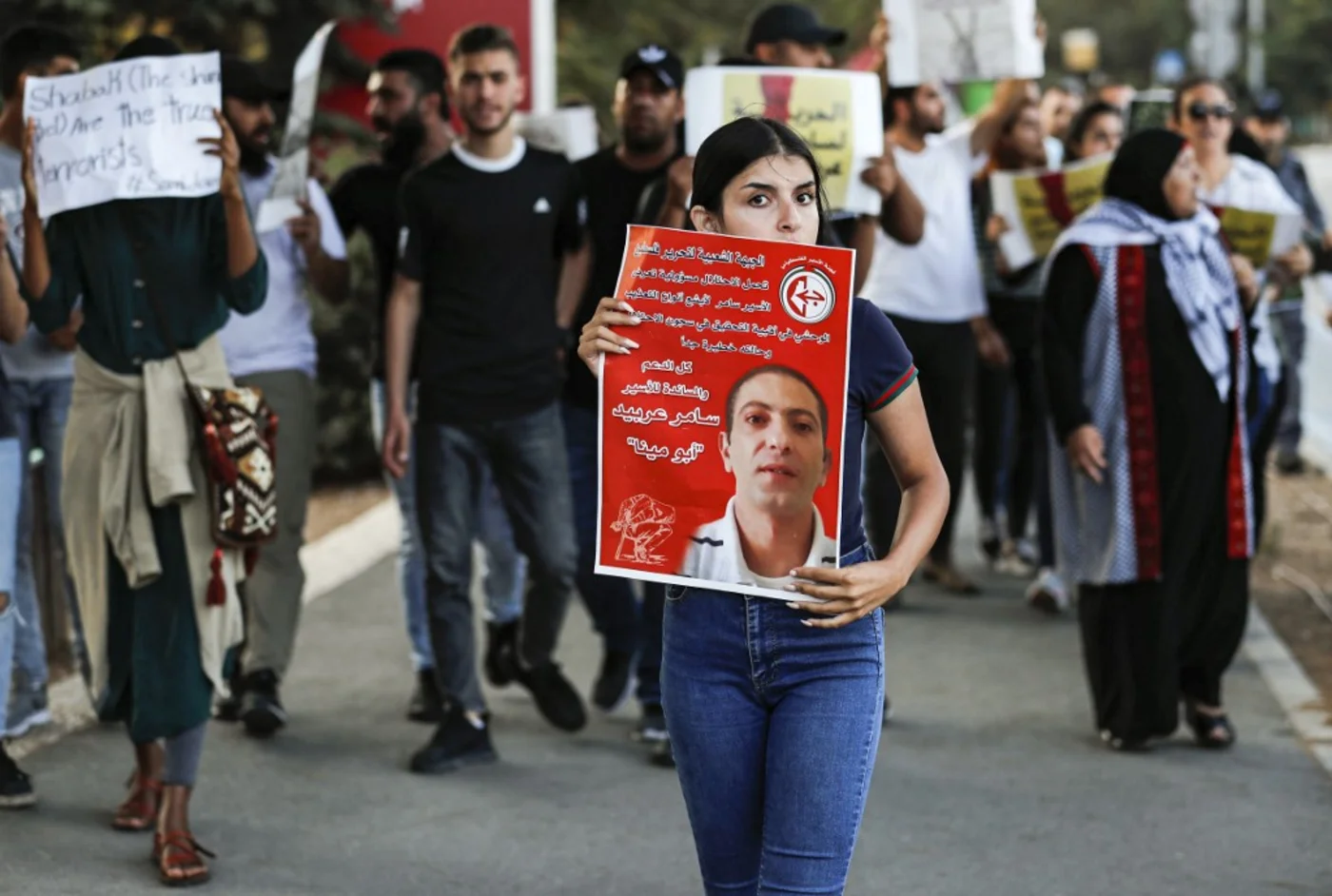
The other woman the Archbishop met also publicly showed support for the PFLP. This is a post from Layan Nasir, in which she aligns with both the PFLP student bloc (the Pole) and the PFLP itself.
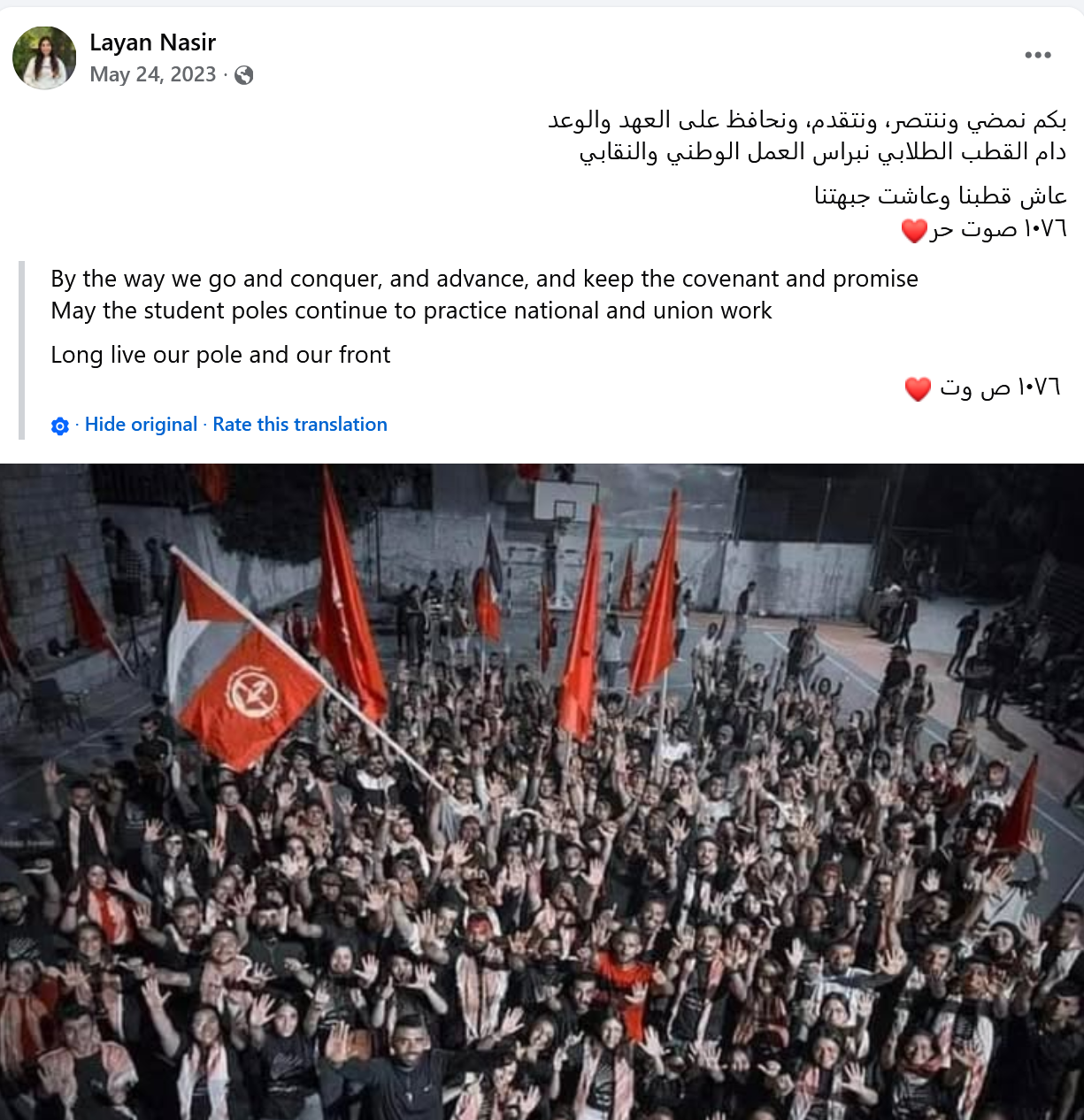
Both of the women have distinguished family members, giving their clan influential weight on the Palestinian street. Given the visible support for the PFLP, and their documented activities for the group on campus, it makes it entirely plausible that Israel possessed intelligence relating to the activities that led to their arrests. There is certainly enough evidence to consider that possibility. A pertinent question arises here: even if we were to accept the Archbishop should be meeting PFLP activists – which we should not – on what grounds can the Archbishop call them innocent – let alone suggest they were oppressed by Israel?
As an anti-peace and anti-normalisation group that has always permitted violence as a means of achieving its maximalist demands, the PFLP has never supported the two-state solution as a final end to the conflict. This is the face of the PFLP in 2021, as its spokesperson Abu Jamal declares solidarity with the group’s blood brothers in Iran:
Whether we accept the PA / Fatah at their word or not, on paper they have at least indicated support for a negotiated two-state settlement. Like Hamas, the PFLP has only toyed with accepting the 1967 lines as a transitional stage, but they have never given up their Marxist one-state position.
The official position of the PFLP remains a single state across all of “historic Palestine” and the non-negotiable destruction of the State of Israel.
In this they staunchly and violently oppose the UK’s own political position, which makes it even more absurd for the most senior cleric in the Church of England to meet them and thereby give the impression she supports their methods and their goals.
For context they are ideologically in the same camp as the Revolutionary Communist Group (RCG) that marches through the streets of the UK with their “victory to the Intifada” banners, although as far as I am aware, the Archbishop has yet to meet with any RCG activists. Unlike the RCG, they are also armed, actively engaged in armed violence and have recently murdered Israelis.
Israel is not alone in designating the PFLP as a terrorist organisation. The group is designated as a terrorist organisation by the United States, the European Union and Canada. In other words, the Archbishop chose to engage with activists aligned with an organisation officially designated as terrorist by many of the UK’s closest allies.
How anyone can justify that – or pretend it is not a serious failure of judgment by someone in her position – is unfathomable.
Help Me Fight Back Against Antisemitism and Misinformation
For over a decade – and for many years before that behind the scenes – I’ve been researching, documenting, and exposing antisemitism, historical revisionism, and the distortion of truth. My work is hard-hitting, fact-based, and unapologetically independent.
I don’t answer to any organisation or political backer. This website – and everything I produce – is 100% community funded. That independence is what allows me to keep speaking out, without compromise.
If you value this work and want to help me keep going, please consider making a donation. Your support makes it possible.
You can donate via PayPal using the button below:
Or by using my Paypal.,me account.
If you wish to provide regular monthly support you can also do this via my Patreon page
Every contribution is truly appreciated – thank you for standing with me.




@~David collier – thanks for digging into this. It feels especially appalling to me that the Archbishop visited the Nova exhibition, and then made her choice to go direct to meet the terrorists who celebrated this slaughter.
But beyond this callousness, I think her visit is more significant and more problematic than most people realise. I have been trying to understand the very strained relationship between Christians and Jews in the West Bank and I think this trip by the archbishop feeds into this. On the one hand, there is very sadly clear evidence of Jewish attacks against Christians in the West Bank are real, and I read that it is now very common for Christian priests to be routinely spat at. I noted that in the Huckabee interview with Tucker Carlson, he entirely rejected this, although he said three things of relevance:
“I know there are instances where Christians get heckled… it shouldn’t happen… but it’s very limited. It’s very, very isolated.”
“I’ve never had an experience where I felt uncomfortable… and I’ve been coming here for 53 years.”
He claimed “every thinking person” in the Israeli government would refuse to defend it.
I’d hope that the Israeli government would make spitting on Christians a specifically prosecuted offence (it is already a penal code felony under Article 378,); to insist on the protection of Christian school budgets (I note that Christian schools in Jerusalem are currently striking over”humiliation permits” and funding cuts); and to demand armed protection of Christian sites including cemeteries.
But I wanted to dig further to see where this apparent hostility to Christians is coming from
It’s clear from my reading that there is a deep-seated and significant Arab Christian allegiance to the Palestinian cause in the West Bank. I have been reading about the Kairos movement, which I now understand is the dominant voice of organized Christian institutions in the West Bank. It is not a fringe movement; it represents the collective leadership of the Greek Orthodox, Roman Catholic (Latin), Lutheran, and Anglican churches. Its original 2009 Manifesto effectively provided the theological framework for the BDS movement, and its latest Nov 2025 Congress document, “A Moment of Truth: Faith in a Time of Genocide,” really strengthens this upsetting alliance. The paper explicitly affirms the “right of a people under occupation to resist their occupier” as a religious calling.
Note the title of their Nov 2025 Congress: “A Moment of Truth: Faith in a Time of _Genocide_ ”. The paper explicitly affirms the “right of a people under occupation to resist their occupier” as a religious calling. “Kairos Palestine II,” is not just a 2025 update of their 2009 manifesto – it shows a radicalization of both language and stance and if you look at the tone, it is clearly a shift from “peace and hope” to a call for “resistance and absolute rejection. Again, this appears to be mainstream Christian doctrine in the West Bank.
https://www.kairosresponse.org/kairos_palestine_2.html
Please read their manifesto below, which was published after your report came out.
https://www.kairospalestine.ps/index.php/about-kairos/kairos-palestine-document
Kairos influence has extended well beyond Israel. Since the 2009 Kairos Palestine declaration, it has been actively promoted through Kairos USA and has been adopted for study or cited in debates within several major US Protestant denominations, including the US Presbyterian Church, the United Church of Christ and parts of the United Methodist Church, where it has helped shape support for divestment and BDS-related initiatives.
Then you have Rev. Munther Isaac, the Lutheran pastor in Bethlehem who gave his famous “Christ in the Rubble” sermon (which of course went a viral on social media) and said that Oct 7th was a “natural response” to the siege of Gaza. He specifically praised the “strength of the Palestinian man who defied his siege,” framing the attacks as an act of human dignity and defiance – precisely the narrative pushed by the Palestinian Authority; Christian institutions are the third largest employer in the West Bank so inherently central to the PA’s diplomatic infrastructure, and they seem to have reached full alignment. I think this institutional hostility towards Israel could explain some of the Jewish resentment of Christian groups in the West Bank?
I’ve tried to see whether all this Christian siding with “resistance” is a contemporary phenomenon since Oct 7th, but it appears to be historically mainstream. The “Godfathers” of militant Palestinian Marxism were almost entirely Christians. George Habash (Greek Orthodox) founded the PFLP and pioneered international aircraft hijackings. Nayef Hawatmeh, a Christian Jordanian led the Democratic Front for the Liberation of Palestine which has let numerous armed attacks against Israelis. Wadie Haddad was Christian and the key PFLP strategist that masterminded the 1976 Entebbe hijacking where Bibi’s brother was murdered… I expect that the Archbishop was aware of this and that engaging with the PFLP was calculated to enrage Netanyahu in particular.
Yes, anti-Christian harassment is unacceptable and also short sited given how important Evangelical Christian support for Israel is in America. These harassers, who are likely mostly Hill Top Youth fanatics that see the sign of the cross to be idolatry should be prosecuted. But if we are trying to understand why relations have deteriorated so badly, I think we should examine whether Palestinian Christian institutions have themselves adopted an increasingly confrontational theological and political posture towards Israel.
It seems to me that parts of Palestinian Christian theology have become an effective bridge between Western progressive activism and Palestinian nationalism. Because the message comes from Christian clergy rather than Islamist organisations, it is often far more persuasive to Western churches than the arguments coming from Hamas or the Muslim Brotherhood… and it seems that our Archbishop has called for this rhetoric.
That is a very well stated and researched post that actually discerns the alliance between anti-Israel Arab factions both Moslem and Christian. My own conclusion is that they are virtually indistinguishable and many Arab Christians ;or should that be most Arab Christians that still remain, fully support the PA and many would also justify October 7th.
In the UK I have personally witnessed in both an Anglican and a Methodist Church, a talk given by an Arab Christian about life in Palestine under occupation and a film given under a similar heading the main factor they had in common was dissing Israelis, totally misrepresenting the historical facts and seeking partnership and funding for their Arab Christian brethren undergoing such hardship and persecution.
I stayed and had coffee after the film at the Methodist Church and initially just moved around listening to some fairly animated support for everything that they watched and not a single word of criticism. Eventually I opened my mouth and cut across the drivel with some facts and personal experiences in Israel.
The thing that got me angry wasn’t just the gullibility of these people who were seemed decent and well-meaning, it was the concerted effort coming out of Christian organisations in Judea and Samaria to influence Christians in churches across the UK, something that has probably quietly influenced tens of thousands of Christians/Church-goers.
It is a subtle and wicked strategy that should have been exposed over 20 years ago.
Thanks James – my only pushback would be on your suggestion most Arab Christians support the PA. We need to be careful here. Some certainly do, but those aligned with extremist factions such as the PFLP, most certainly do not. While many of us over here see Fatah and the PA as extreme, in many parts of the Palestinian street they are considered traitors even for talking to Israel. These Christians the Archbishop met are likely to openly protest the PA – considering them too close to Israel. That is how insane the Palestinian street is these days.
David – you are right. When you dig into who the Archbishop actually met in the West Bank, and I think there is an important point that isn’t immediately obvious:
The visit was not simply to “Palestinian Christians”. It was largely conducted through one particular current of Palestinian Christianity that overlaps extensively with the Kairos Palestine movement, as I tried to explain above. For example, the Tent of Nations (Daoud Nassar family) was on her agenda, a group that has been repeatedly promoted by Kairos. The Anglican Diocese of Jerusalem is not formally a Kairos organisation, but it shares many of the same relationships and theological themes around occupation, resistance and international advocacy. And the local ecumenical leadership in Bethlehem, Birzeit and Jerusalem who she met, has historically been one of Kairos Palestine’s strongest constituencies.
The relevance is that Kairos is not by any means a peace movement. Its 2025 manifesto, “Kairos Palestine II: A Moment of Truth, Faith in a Time of Genocide” that I linked above, explicitly rejects Oslo, states that Palestinians have a right to resist occupation, and as you say, argues that the Abbas and the Palestinian political leadership has lost the confidence of its own people. It is as you suggest, highly critical of Israel, and also of Fatah.
Historically, Kairos may not be directly descended from the PFLP, but both emerged from the same Palestinian Christian nationalist group that produced figures such as George Habash and Wadie Haddad, Greek Orthodox Christians who founded and led the PFLP, including the organisation responsible for the Entebbe hijacking in which Netanyahu’s brother was killed. Kairos is a more theological expression of Palestinian nationalism, using churches and theology rather than armed struggle, but the underlying political themes are the same: anti-colonialism, occupation etc. In that light, you can see why Kairos consistently contextualised October 7 as the inevitable product of occupation, and while not not justifying the killing of civilians, Kairos still stopped short of condemning Hamas or calling them terrorists. The 2025 Kairos Palestine II document says: “Israel commits these crimes while invoking the events of October 7, 2023… forgetting that the Hamas attack of that day was itself born out of decades of injustice…”
So in my view the Archbishop’s visit was far from neutral tour of Arab Christians leaders. It engaged with one of the most activist and internationally connected currents within Palestinian Christianity, a movement that rejects Oslo, is deeply critical of the Palestinian Authority, and has become one of the principal theological advocates of the Palestinian national cause. It’s hard for any of us, but especially for Netanyahu to view this as a pastoral pilgrimage given his family’s history with the PFLP.
For public figures such as the Archbishop, ignorance is bliss: it is this ignorance that allows them to prance on the world stage — unknowingly engaging with the worst of the worst — whilst simultaneously feeling so relevant and so virtuous.
Looking to the future, it is infinitely more virtuous to show a measure of humility and politely turn down all requests to speak in the midst of conflicts of which you know naught. Being momentarily seduced by the propaganda proffered by wily sirens abroad will inevitably backfire, because evidence from the other side is sure to come to light.
Haw many intelligent people do you know who give a monkey’s fart about what Anglican prelates have to say about anything at all?
Half the time they – and their subordinates in ill-attended churches – are yelling and gibbering about gay rights in the UK or the sufferings endured by “transkids” – a species of humanity successfully hidden from sight while i was growing up.
I wish I could agree, but I don’t think that’s how politics works. People rarely move opinion one by one, they move in organised blocs. The OIC and the Non-Aligned Movement are obvious examples at the UN. Neo-marxists liberal progressives at Universities, activist networks have had their impact. Religious institutions also shape large constituencies. The Archbishop isn’t just one individual expressing a view, she speaks from within one of the world’s largest Christian denominations, and that carries influence far beyond the diminishing number of people sitting in Anglican pews. In this new era, unanchored from truth, these blocs manufacture false narratives that no longer just criticise Israeli policy, but collectively attack the legitimacy of Israel itself.