
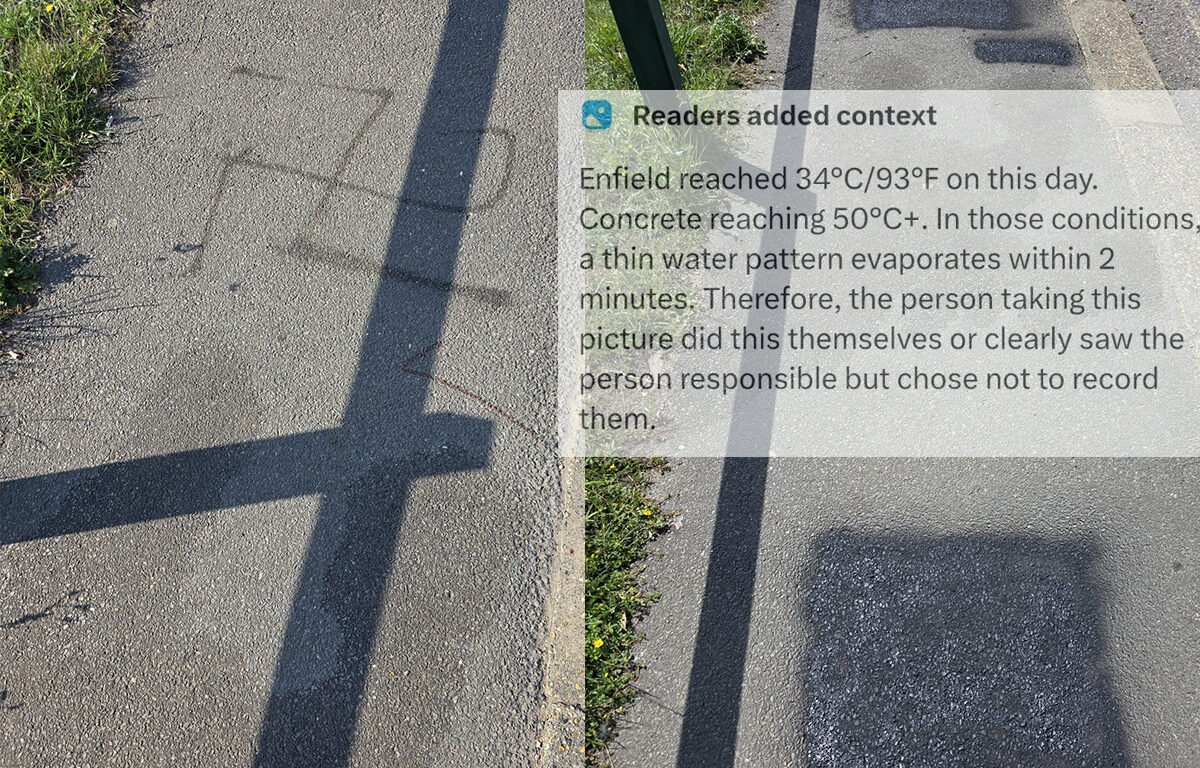
A young Jewish man in Enfield, North London, is out for an evening walk in his local park. He notices antisemitic graffiti on the ground and sends photographs to his father. Seeing it as a sign of the times, his father posts one of the images on social media. Within two days, the post has been viewed more than a million times. This is not, however, a story about growing awareness of anti-Jewish racism. It is a story about how an antisemitic conspiracy theory was elevated into an approved Community Note on X, turning a photograph of antisemitism into “evidence” used to attack the very Jewish family that documented it.
The Swastika and the Photo
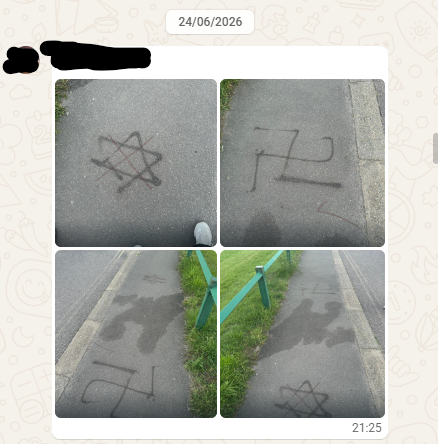
At 21:25 on 24 June, I received four images from a family member who had been out for an evening walk in Trent Park, their local park in Enfield, North London.
The images showed two symbols drawn on the ground: a crudely drawn swastika and a Star of David. The message was unmistakable. A large “X” had been drawn through the Star of David, while the swastika was accompanied by a large tick.
I posted the image of the swastika on social media. Taking care to protect my family, I was deliberately vague about who had been on the walk and who had taken the photograph. The post was published at 21:57 on 24 June.
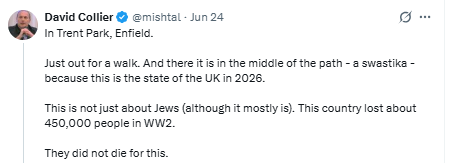
It was posted as a simple “for the record” moment. I returned to my research and gave the matter no further thought.
Then the post exploded.
The Viral Conspiracy Theory Becomes a Community Note
After Elon Musk purchased Twitter, he introduced an innovative system of “Community Notes” as a means of countering disinformation. The idea is simple: members of the X community can add context to posts they believe are misleading or inaccurate. If enough contributors from across the platform rate the note as helpful, it becomes permanently visible beneath the post.
This case demonstrates that when the target is a minority group such as the Jews, the system can go badly wrong.
I am an investigative journalist, not a social media influencer. It is not unusual for me to spend time immersed in research without paying much attention to what is happening on social media.
While I was busy working, the image became the focus of a viral conspiracy theory. People began claiming that the image was a false flag operation and that I had either drawn the graffiti myself or had been present while somebody else did.
This accusation was rooted in familiar antisemitic tropes portraying Jews as inherently deceitful and manipulative, including the claim that Jews fabricate incidents of antisemitism in order to “play the victim” and influence public opinion.
Then the conspiracy theory received something far more significant than a few social media posts.
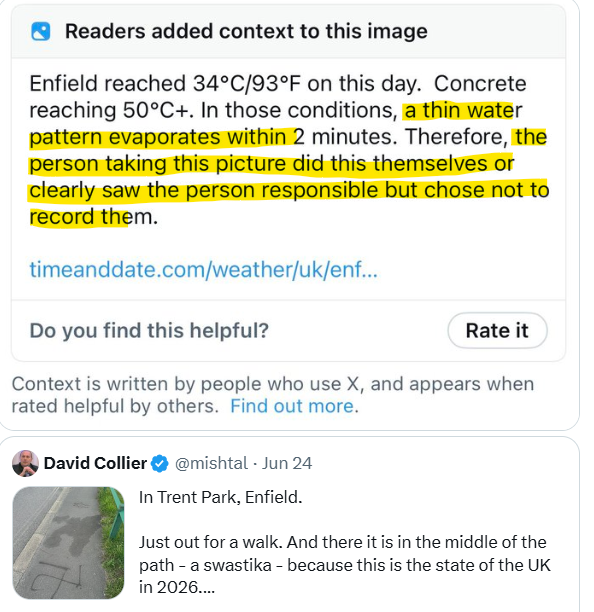
An approved Community Note had been attached to my image.
The Logical Fallacy and the Abuse That Followed
The Community Note illustrates how easily unsupported accusations can acquire the appearance of legitimacy. It relied on a series of assumptions presented as though they were evidence.
The note referred to the day’s temperature and the substance allegedly used to draw the swastika. It then treated those details as though they were undisputed facts pointing to only one possible conclusion. Yet the reasoning does not withstand scrutiny. The note offered no basis for concluding that water had been used to draw the graffiti. Although the day’s high temperature may have reached 34°C, it was not 34°C at around 21:20 when the photographs were taken. More importantly, even if every claim in the note had been correct, none of it established that the graffiti had been staged. Other perfectly plausible explanations remained.
In no reasonable system should such a weakly argued accusation be elevated into an approved Community Note.
Yet that is exactly what happened.
Some of the consequences were entirely predictable. A torrent of antisemitic abuse was directed at a Jewish family whose only involvement had been documenting an antisemitic incident. The approved Community Note transformed the post into a viral accusation. With more than 1.4 million views, the abuse was toxic and relentless. Countless responses poured in. Almost every notification signalled another attack.
The torrent of abuse would subside. The more serious damage, however, was reputational. I have spent years building a reputation for accuracy. An approved Community Note accusing me of staging a “false flag” operation threatened to undermine my reputation instantly. As one respondent pointed out, every future post I made could be met with the same accusation, with the Community Note cited as “proof” that I was manipulative and deceitful:
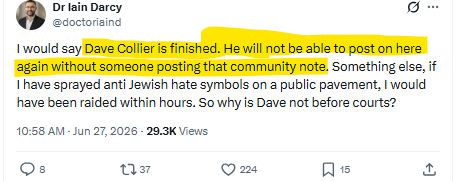
The risk of long-term reputational damage needed to be addressed. I went back to the site where the graffiti had been drawn. Several days had passed, and I had no idea what I would find. The graffiti itself had gone, but two freshly painted patches on the pavement were immediately visible. Someone had covered it over. It was a relief. I may have been fighting a nonsensical conspiracy claim, but the approved Community Note had given the allegation the appearance of official endorsement.
I posted footage of the covered-up graffiti on X and requested a review of the Community Note. Thankfully, that was enough for the note to lose its approved status. It wasn’t, however, enough to stop the abuse or silence the conspiracy theorists.
There was one more thing I could do to close this case completely.
The FOI Request That Closes the Case
If park staff had painted over the graffiti, there should be a record of it. Because Trent Park is managed by Enfield Council, that record would be obtainable under the Freedom of Information Act.
On Saturday 27 June, attaching the photographs in my possession, I submitted the request.
I have now received the response.
As the brilliant fictional detective Adrian Monk would say at this point in the investigation: “Here’s what happened.”
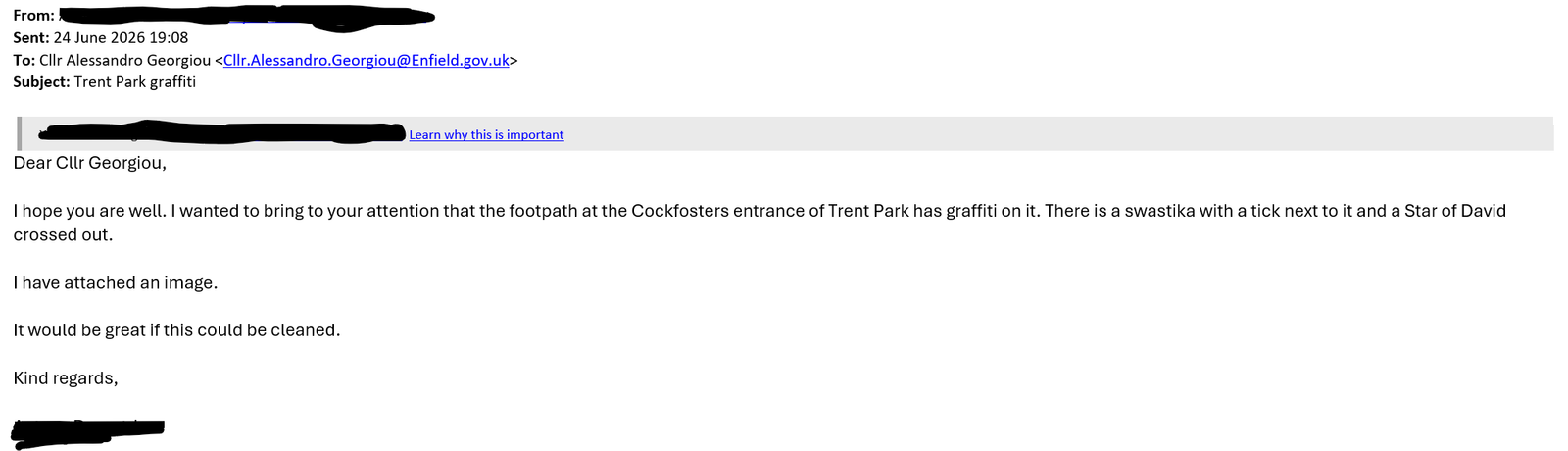
On 24 June at 19:08, just over two hours before members of my family walked through the park, a concerned citizen sent an email to Councillor Alessandro Georgiou, the Conservative councillor of Cockfosters ward and leader of Enfield Council. The email is explicit in its detail, mentioning both the swastika and the Star of David.
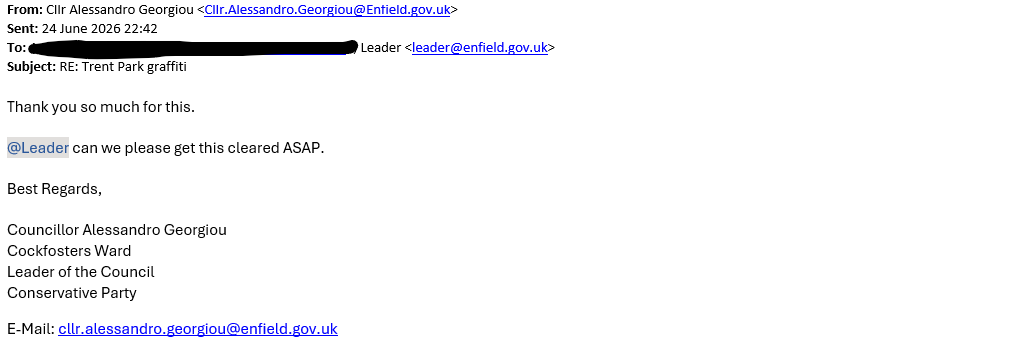
To his credit, at 22:42 that night, Cllr Georgiou sent a response, thanking the sender, and copying in an official council account, asking for the graffiti to be cleared “ASAP.”
At 10:35 on 25 June, Lisa Smart, Head of Urban Green Spaces at Enfield Council, responded that the council aims to remove offensive graffiti within 24 hours and that she would instruct officers to deal with it.

I was also provided with timestamped images, showing that the council workers had arrived to deal with the graffiti within that 24-hour window, at just after 8:00 on the morning of 26 June.
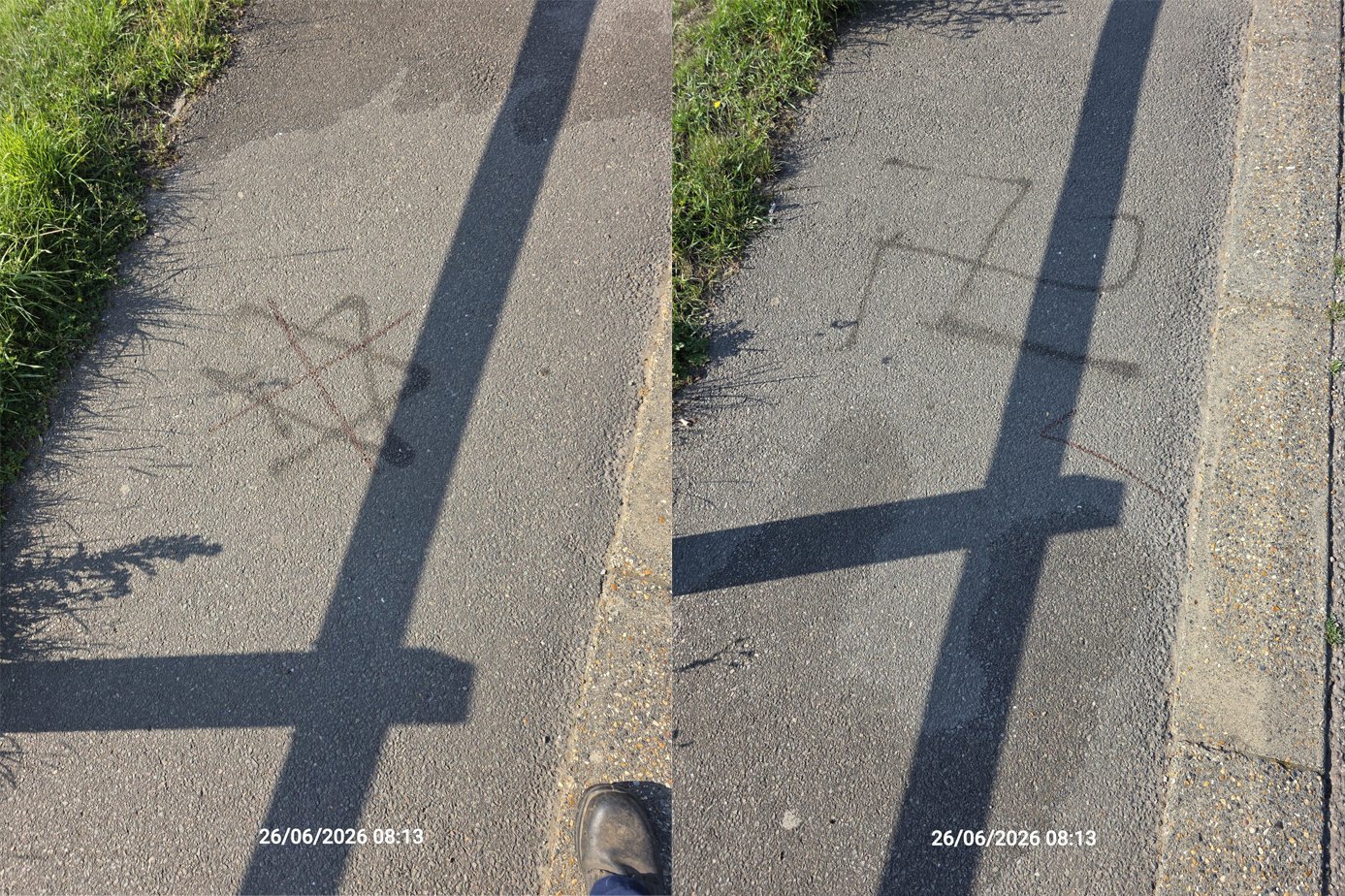
The timestamps show the graffiti thirty-five hours after my photograph had been taken. Both the swastika and the crossed-out Star of David remain clearly visible, along with the stain in the centre of the pavement. So much for the claim that the markings had simply been drawn in water. According to the council’s account, the combination of the heat and the way the graffiti had embedded itself into the surface meant officers eventually had to paint over it, as the photographs show:
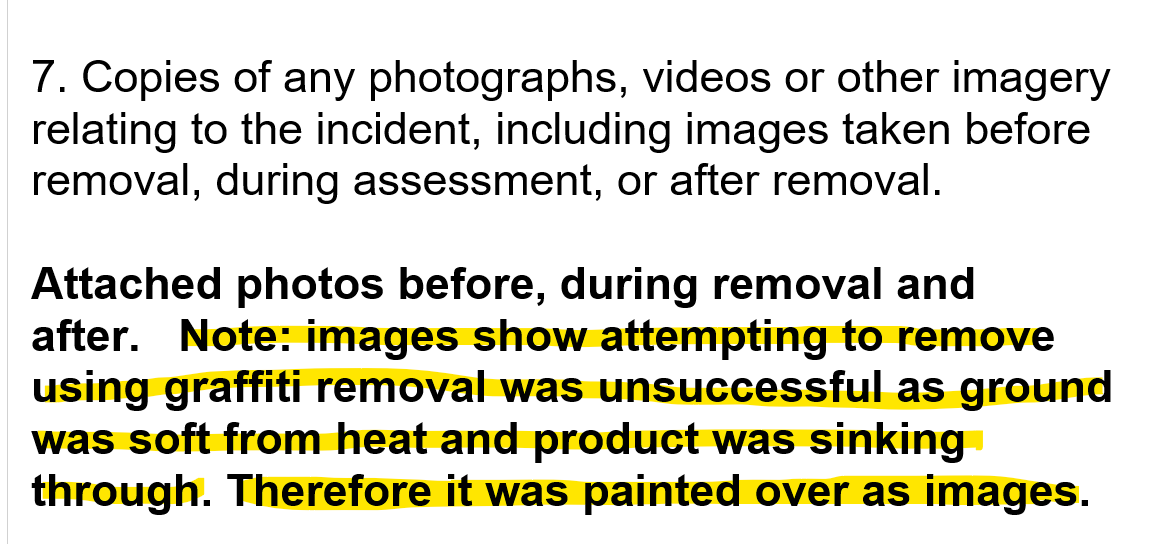
By 11:44 on 26 June, the graffiti had been covered over.
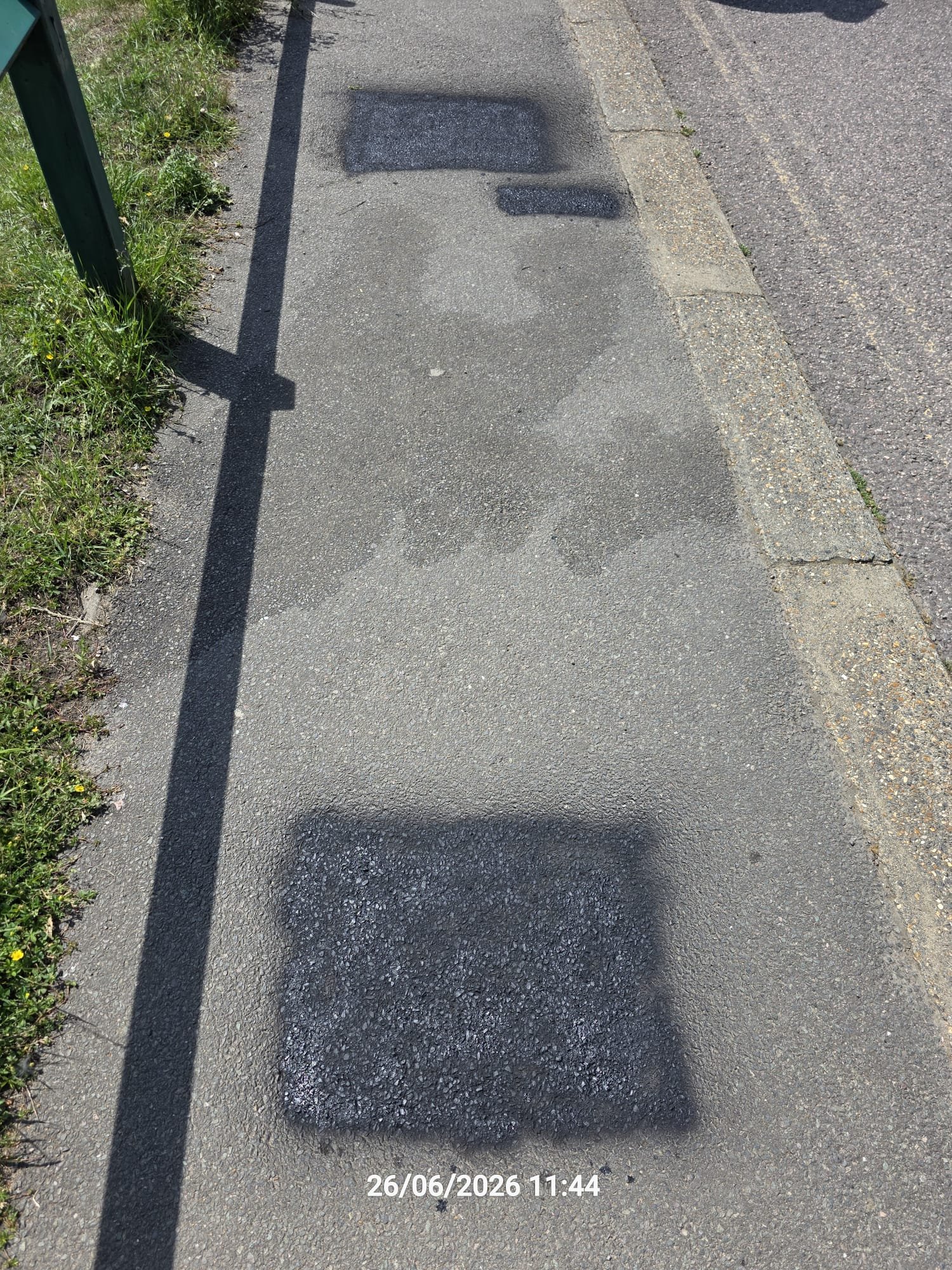
The following day, I returned to the site and filmed the footage I posted on X.
Case closed.
The Bigger Lesson
The disturbing aspect of this story is that a system intended to combat misinformation elevated a conspiracy theory into an apparently authoritative statement with real-world consequences.
The burden was then reversed. Those making the accusation produced no evidence. The Jewish target had to spend weeks obtaining official records simply to restore the presumption of innocence.
This time, documentary evidence happened to exist. Had the graffiti been removed some other way, the Community Note would likely still be there today, giving permanent credibility to a baseless accusation.
Systems that determine “truth” are vulnerable to organised falsehoods, popular prejudice and institutional bias. When the subject is Jews or Israel – where hostile narratives already circulate widely – that vulnerability becomes especially dangerous.
Help Me Fight Back Against Antisemitism and Misinformation
For over a decade – and for many years before that behind the scenes – I’ve been researching, documenting, and exposing antisemitism, historical revisionism, and the distortion of truth. My work is hard-hitting, fact-based, and unapologetically independent.
I don’t answer to any organisation or political backer. This website – and everything I produce – is 100% community funded. That independence is what allows me to keep speaking out, without compromise.
If you value this work and want to help me keep going, please consider making a donation. Your support makes it possible.
You can donate via PayPal using the button below:
Or by using my Paypal.me account.
If you wish to provide regular monthly support you can also do this via my Patreon page
Every contribution is truly appreciated – thank you for standing with me.




What amazing work you do!!!
Thank you David…
That Iain Darcy chap must be regretting his words now…. Great work, David.
GENOCIDAL-ISLAMIC MAMDANI’S STUNT.
Islamo socialist Mamdani knew he couldn’t “arrest”, Bibi, but as a fascistic hater, he is, consumed with disgust. So thirsty for his venomous demonization Jihad, that he wanted one more public chance to hurl the Pallyweid G slur [a ritual]. He is fully aware full well [just like UN’s Goebbels Francesca Albanese and her ilk], his buddies, the Gaza genocidal government uses civilians to maximize deaths [the ‘Dead Baby Strategy’]. It is why it has prevented humane-IDF urgent pleas for evacuations; had attacked aid distributions and had used even hospitals for its murderous actions. (Refusing to call for Hamas disarm) Mamdani is a perfect enabler of “Palestine” routine of the diabolical tactics to use its people as cannon fodders.
It’s all a cynical criminal game by these “activists.”
Mamdani is also upset about the sexual crimes ICC’s head Karim Khan has been accused of, ‘timely’ linked to his rush to issue an “arrest,” at the time.
Yet, he publicly lied. Truth is, the ICC did not rule a “genocide.” In fact, even pressed by another Islamic bigot, Mehdi Hasan, Khan still refused to (May/2026).
https://thatthingtoo.blogspot.com/2026/07/genocidal-islamic-mamdanis-stunt.html
Unbelievable. Thank you for all you do, from across the pond.