
I do not often discuss Israeli politics, but the reason I am writing this is simple. Many people are interested in what is happening, but much of the commentary in the West has been superficial, one-dimensional and written by people who do not understand the complexities of the Israeli electorate, its political system and the competing interests of those involved.
Before beginning, let me put my political cards on the table.
I am unapologetically of the political right.
That wasn’t always the case. I was actively involved in peace initiatives during the Oslo years. But experience, unfolding events, personal loss, realities on the ground, and copious amounts of historical research fundamentally changed my understanding of the conflict, and with it, my politics.
I state this upfront because I have no interest in petty squabbles over bias. I write because too much of what passes for informed analysis in mainstream Western media displays a remarkably poor understanding of Israeli politics. Frankly, some of the commentary has been abysmal.
All I intend to do here is describe some of the pieces on this very complex chessboard.
A Word of Caution
Israeli politics contains numerous hidden variables. Undisclosed intentions and regional developments could fundamentally change the situation overnight. Imagine Netanyahu has every intention of standing down in 12 months, or is aware there will be a strike on Iran in 10 days. These things would dramatically shift the negotiating stance of many of the actors involved – and disrupt any discussions that were taking place.
That being said, there are still fundamental factors that commentators are ignoring – mostly because they simply want the end of Netanyahu’s reign – almost at any cost.
Understanding the Results
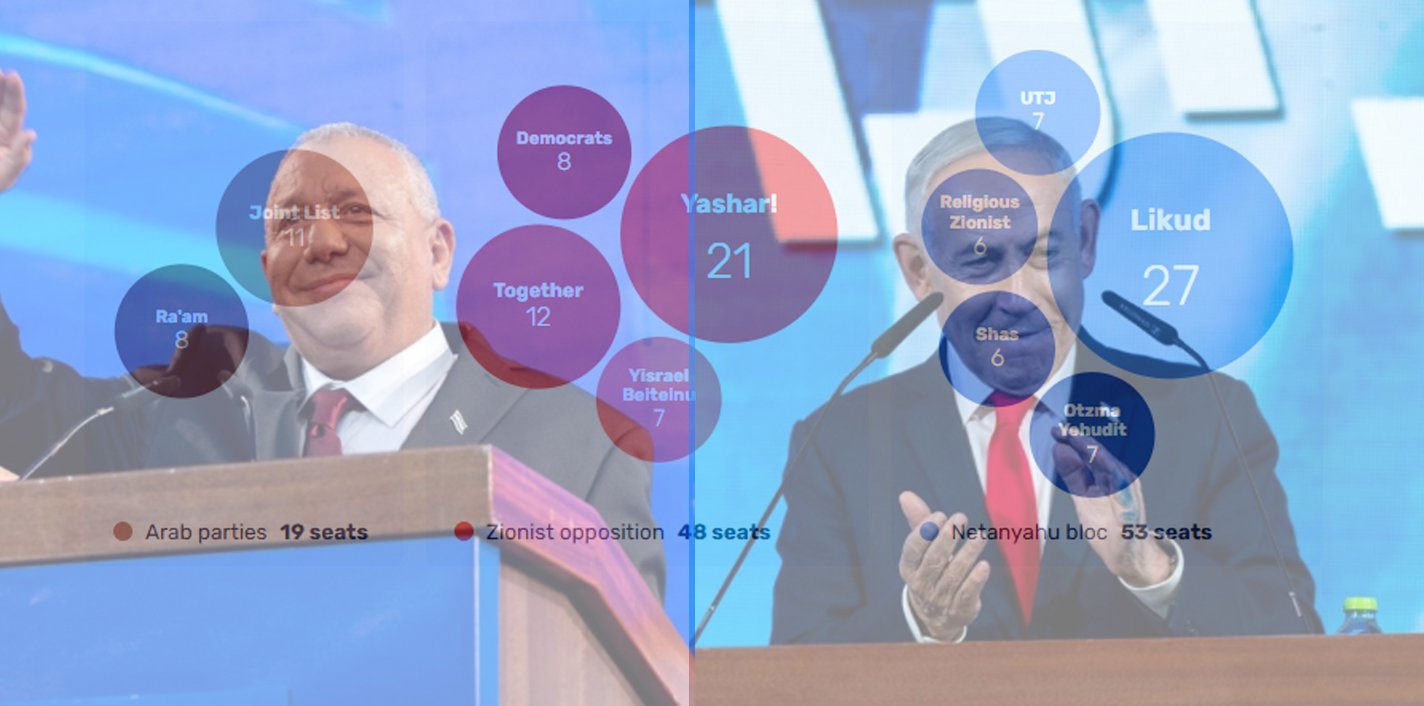
Everyone can see that the election produced a mixed result. Netanyahu’s bloc secured 53 seats, Eisenkot’s 48, and the Arab parties a record 19. On paper, the anti-Netanyahu parties could assemble 67 seats. In practice, forming a stable coalition is far more difficult than just adding numbers.
Mostly because while Israel’s right is a somewhat cohesive unit – the only thing uniting the 67 seats in opposition to Netanyahu is opposition to Netanyahu.
Traditionally, opposition to Likud was centred on the Labour Party, alongside Meretz, a progressive party to Labour’s left. Both still exist, now merged into the Democrats, but represent a fraction of their former political strength – a decline closely linked to the collapse of the Oslo peace paradigm. Most of today’s centrist parties are not natural ideological opponents of Likud, but rather political creations of a system unable to unseat Netanyahu.
First, we need to challenge the idea that this election was a catastrophic defeat for Netanyahu.
His previous parliamentary majority benefited from unusually favourable electoral arithmetic. In 2022, both Balad and Meretz failed to cross the electoral threshold, wasting left-wing votes and helping the right secure an unexpectedly large majority.
This time, the dynamics were reversed. Right-wing parties failed to cross the threshold, while Arab turnout surged. Meretz united with the Labour Party to avoid any repetition of the 2022 failure.
The result was a substantial loss of seats for Netanyahu’s bloc, but that does not necessarily translate into an equivalent collapse in its underlying electoral support.
There is another uncomfortable reality for the anti-Netanyahu camp.
Despite years of negative polling for Netanyahu, a highly mobilised Arab electorate and favourable threshold effects, the opposition still failed to secure a governing majority without the Arab parties.
A best-case scenario was not good enough for them.
This matters enormously when considering what happens next.
The Problem for Eisenkot
Israeli opposition politics has repeatedly seen leaders emerge as potential alternatives to Netanyahu, only for the political landscape to shift when they failed to deliver. Benny Gantz and the rise and fragmentation of the Blue and White Party offer a useful example.
Eisenkot must therefore consider what another election could mean for his own leadership. The vultures will circle. For him, this is as good as it is going to get.
This creates a fundamental imbalance in the negotiations.
Seeking to avoid another election at almost any cost, Eisenkot has the strongest incentive to form a government. But doing so may require compromises that contradict his campaign commitments, particularly over cooperation with Arab parties.
Bennett and Lieberman face VERY different calculations.
Both have publicly opposed governing with Arab parties. If negotiations collapse over that issue, they can argue that they supported replacing Netanyahu but refused to abandon their principles.
Another election would also reopen the competition for leadership of the anti-Netanyahu camp.
Meanwhile, the Democrats and Arab parties have emerged from this election with significant parliamentary influence. They too have reasons to preserve their gains rather than risk another unpredictable contest.
In other words, the parties required to construct an alternative government do not necessarily share the same interests.
Some have powerful incentives to reach an agreement. Others have political reasons to resist the compromises required.
This is why Lieberman is already undermining coalition discussions. He has more to gain from watching Eisenkot fail – and then branding himself as the centrist politician of integrity.
As this manoeuvre becomes clear, it is likely Bennett will do the same.
Every man with eyes on the next election rather than this one.
Who Gets the First Mandate?
This is where the negotiations become particularly interesting.
Bennett and Lieberman still have a strategic incentive to recommend Eisenkot to President Herzog.
Why? Because recommending someone to form a government is not the same as agreeing to join that government.
They will support Eisenkot receiving the mandate while leaving him to confront the difficult question of Arab-party cooperation and coalition negotiations.
Eisenkot’s Dilemma
When Eisenkot receives the first mandate, his options are limited.
Without Arab-party support, his existing bloc falls well short of a majority. Cooperation with the ultra-Orthodox parties would create another set of conflicts over military conscription – and still would not be enough.
And why would the ultra-Orthodox parties break the long-standing union with the Likud for a government that just does not look as if it has a long shelf life?
A minority government dependent on Arab-party support is theoretically possible, but politically contentious, particularly in the aftermath of October 7.
He could also explore a unity arrangement with Netanyahu, although that would contradict explicit campaign commitments.
If Eisenkot fails to form a government, the political balance changes again.
Netanyahu’s Different Calculation
Netanyahu could then have an opportunity to negotiate from a different position.
He could approach Eisenkot with a straightforward argument: neither of us can govern alone, and another election carries risks for both. Why not reach an agreement?
But Netanyahu’s assessment of those risks would be very different.
He could reasonably look at the electoral threshold effects, the opposition’s difficulties and the possibility of another contest and conclude that returning to the polls is an acceptable alternative to making substantial concessions.
Would the tens of thousands who flew in especially to help unseat him – want to repeat the exercise again in a few months? Would the Arabs, having seen the futility of a large turnout, simply stay at home next time?
Eisenkot, by contrast, would have to consider the political damage of failed negotiations, particularly if they involved controversial discussions with Arab parties.
That creates an asymmetry: one leader may feel greater pressure to reach an agreement than the other.
The Succession Question
There is another dynamic that deserves attention.
Netanyahu cannot lead the Israeli right forever. Whenever his departure comes, a struggle for succession will follow.
And there is no undisputed heir.
Both Bennett and Lieberman emerged from the political right. Their ambitions may extend beyond replacing Netanyahu as prime minister through an opposition coalition.
They may also see opportunities in the eventual contest to lead the post-Netanyahu right.
Do not dismiss this just because it seems unlikely today. Gideon Sa’ar was also an ex-Likudnik sitting in the anti-Bibi camp. He made the move first, returning to the fold, probably with an eye to future leadership positions. Lieberman is an ex-Likudnik too. Bennett was once leader of a party to the right of the Likud. In Israeli politics – everything is possible.
This adds another layer to negotiations already shaped by competing interests and political calculations.
What Happens Next?
The central mistake in much of the analysis is to treat Israel’s coalition negotiations as a simple mathematical exercise.
They are nothing of the sort.
Bennett and Lieberman can support his candidacy while rejecting the compromises he may need to make.
Looking at the weakness of the camp, they may both favour another election. It is likely Lieberman does. That would reduce Eisenkot’s problematic 48 seats to an impossible 41.
And behind all of this lies the unresolved question of who eventually succeeds Netanyahu.
To understand what happens next, we need to stop asking only who has enough seats to form a government.
We also need to ask who has the most to gain if they fail.
By my calculations, the majority of seats (right wing 53, Lieberman 7 and some of Bennett’s 12 = up to 72 seats) may well prefer another election.
And if this is the case, we can expect another election in Israel in the spring.
Help Me Fight Back Against Antisemitism and Misinformation
For over a decade – and for many years before that behind the scenes – I’ve been researching, documenting, and exposing antisemitism, historical revisionism, and the distortion of truth. My work is hard-hitting, fact-based, and unapologetically independent.
I don’t answer to any organisation or political backer. This website – and everything I produce – is 100% community funded. That independence is what allows me to keep speaking out, without compromise.
If you value this work and want to help me keep going, please consider making a donation. Your support makes it possible.
You can donate via PayPal using the button below:
Or by using my PayPal.me account.
If you wish to provide regular monthly support you can also do this via my Patreon page.




Reading your piece,especially in regard to foreign MSM and commentators, makes perfect sense. Add to that their ‘anyone but Netanyahu’ sentiment, and you end up with a perfect storm of pre-conceived ideas and utopian wishful thinking.
An excellent article’
David, thank you for your well informed and constructed piece.
Whilst the Arab parties have done ever so well, there are concerns about their views on Hamas and October 7. A Zionist coalition, with the Netanyahu and Eisenkot at its core seems the best option for Israel.
With Trump’s term ending in 2 years it would be excellent succession planning if Bibi led for 2 years as PM, then handed over to Eisenkot (& yes I know Bibi did the dirty on Gantz in a previous coalition). The Haredi need to be drafted in to the IDF