
A few months ago, when the Archbishop of Canterbury visited Christian holy sites in Israel, she used the occasion to mount an anti-Israel propaganda campaign. As was uncovered by this research, she even met several PFLP activists – and disgracefully presented their encounters with Israeli security as evidence of Israel’s alleged persecution of Christians.
I highlighted the hypocrisy of the head of the Anglican Church seeking to portray Israel as an enemy of Christians while ignoring the many places around the world where Christians face genuine and often brutal persecution.
At the time, I attributed it to Lambeth Palace’s longstanding demonisation and hatred of the Jewish state.
That was until now.
The 2026 Lambeth Awards
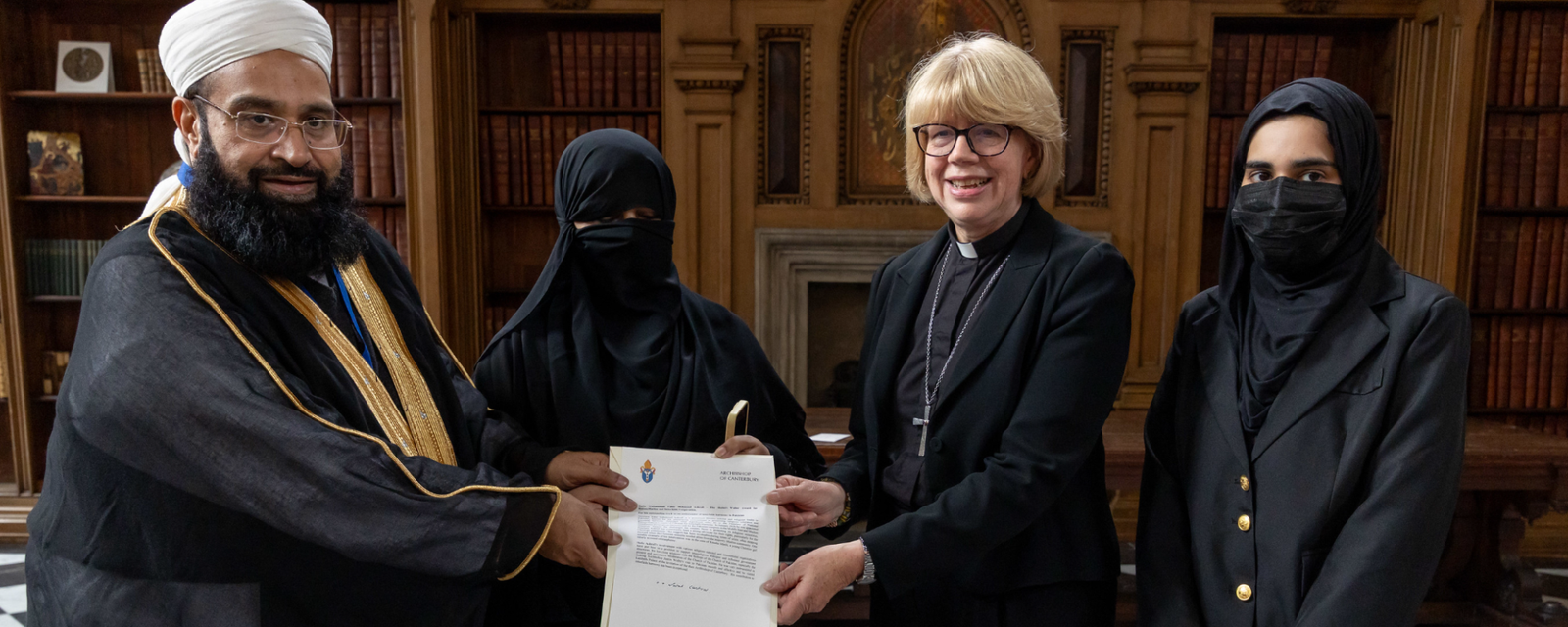
On Friday 11 September 2026, Lambeth Palace hosted the Lambeth Awards, which are awarded by the Archbishop of Canterbury to recognise extraordinary contributions to the Church of England, the worldwide Anglican Communion and wider society. The awards have existed in their current form since 2016, and this was Archbishop Sarah Mullally’s first Lambeth Awards ceremony. Previous recipients across the various categories have included Queen Elizabeth II and Pope Francis.
This year, twenty-seven people were honoured across five categories, recognising service to the Church of England, the Anglican Communion and local communities, as well as contributions to education, scholarship, reconciliation and interfaith cooperation.
While scanning the list, one name stood out in particular: Hafiz Muhammad Tahir Mehmood Ashrafi, chairman of the Pakistan Ulema Council, who received the Hubert Walter Award for Reconciliation and Interfaith Cooperation.
I found no concrete reasons presented by Lambeth Palace explaining what exactly Tahir Ashrafi had done to deserve the award – so I went looking for evidence myself.
Here is what I found:
Interfaith in Pakistan
Before examining the recipient, it is worth providing a little context to consider the grim reality behind any award celebrating “interfaith cooperation” in Pakistan. Pakistan is an Islamic republic in which roughly 96 per cent of the population is Muslim, and religious discrimination is embedded within both its legal system and its institutions.
Christians, Hindus, Ahmadis and other minorities live under the constant threat of notoriously abusive blasphemy laws. A single unsubstantiated accusation can bring imprisonment or a death sentence, while also provoking mob violence or murder. In Jaranwala in August 2023, for example, a blasphemy allegation was followed by a Muslim mob attacking Christian neighbourhoods, ransacking homes and burning churches. Christian and Hindu girls are abducted, forcibly converted and married to Muslim men, while police and courts repeatedly fail to protect the victims or return them to their families.
Pakistan is recognised as one of the world’s most dangerous environments in which to live openly as a Christian.
Against that background, presenting a senior Pakistani cleric with an international award for “Reconciliation and Interfaith Cooperation” should require compelling evidence that he has consistently confronted the laws, institutions and religious forces responsible for this persecution.
That is not what I found at all.
Meet Tahir Ashrafi
Hafiz Muhammad Tahir Mehmood Ashrafi is chairman of the Pakistan Ulema Council, an umbrella body representing Islamic scholars and clerics. The Council is deeply embedded within the Pakistani establishment, and Ashrafi has repeatedly combined its chairmanship with government appointments.
In January 2026, for example, Prime Minister Shehbaz Sharif appointed him “Coordinator for Religious Harmony and the Pakistani Diaspora in the Muslim World.” The title referred to religious harmony, but only among Muslims. There was no mention of Pakistan’s persecuted non-Muslim minorities.
When searching the history of a man presented with an award by Lambeth Palace, I had not expected to find signs of support for terrorism – yet in 2007, after Salman Rushdie received a knighthood, the Pakistan Ulema Council responded by conferring the title Saifullah, meaning “Sword of Allah”, upon Osama bin Laden.
If a blasphemer can be given the title ‘Sir’ by the West despite the fact he’s hurt the feelings of Muslims, then a mujahid who has been fighting for Islam against the Russians, Americans and British must be given the lofty title of Islam, Saifullah.
It creates a twisted irony that on the 25th anniversary of the 9/11 attacks, the Archbishop of Canterbury bestowed an award on a man who had honoured Bin Laden.
There was more. In 2013, Ashrafi was even reported as saying that suicide attacks were permissible. He denied making the remarks, although one of his responses was notably narrower: “I’ve never supported suicide attacks that cause civilian casualties in Afghanistan.”
Invisible Interfaith
But his award was not for “opposing terrorism,” it was for “interfaith cooperation,” and his record here was even worse. His position on Ahmadis, one of Pakistan’s most relentlessly persecuted religious minorities, is exceptionally harsh. In 2013, Reuters reported on a 72-year-old British Ahmadi doctor who had been imprisoned for “posing as a Muslim.” Ashrafi’s response was not to defend the doctor’s freedom to practise his faith. Instead, he said:
We would not have a problem with them if they did not use the name of Islam and the symbols of Islam.
That statement goes to the heart of Islamic persecution of Ahmadis. His position on the forced conversion of Christian and Hindu girls follows a similar pattern. In December 2020, Associated Press reported that approximately 1,000 minority girls were being forcibly converted to Islam every year. Ashrafi dismissed the report as “rubbish and baseless.” He claimed that no such cases had been found during the previous two months and declared that Pakistan was “far safer for minorities than many developed countries”.
For context, in that same year, Pakistan was ranked fifth on the Open Doors World Watch List of the countries in which Christians faced the most extreme persecution.
It is not just Ahmadis, Christians and Hindus who face his discrimination. In 2018, while discussing conspiratorial narratives threatening Mecca, he suggested that the “Jewish and Safavid lobby have jointly begun such propaganda that it would cause every Muslim concern.”
Geo-political Hatred
His position on geo-political issues only causes further concern. Earlier this year, at a conference in March, he claimed that “under cover of Iran, the target of the Jews and Christians is nuclear-armed Pakistan.” He went on to praise Iran’s “mujahideen,” saying they were “standing like a wall of lead against Jews and Christians.”
A month earlier, following Modi’s arrival in Israel to meet Netanyahu, Ashrafi attacked both countries. He described Israel as the “Zionist Israeli entity” and India as the “Hindu Indian entity”, presented both as enemies of the Muslim ummah, and portrayed their cooperation as part of a wider conspiracy. In accompanying material featuring Modi and Netanyahu, he called them “devils” allied with wicked accomplices, declared that their destruction was approaching, and characterised them as bloodthirsty criminals.
Are these the signs of “reconciliation” for which Ashrafi received the award?
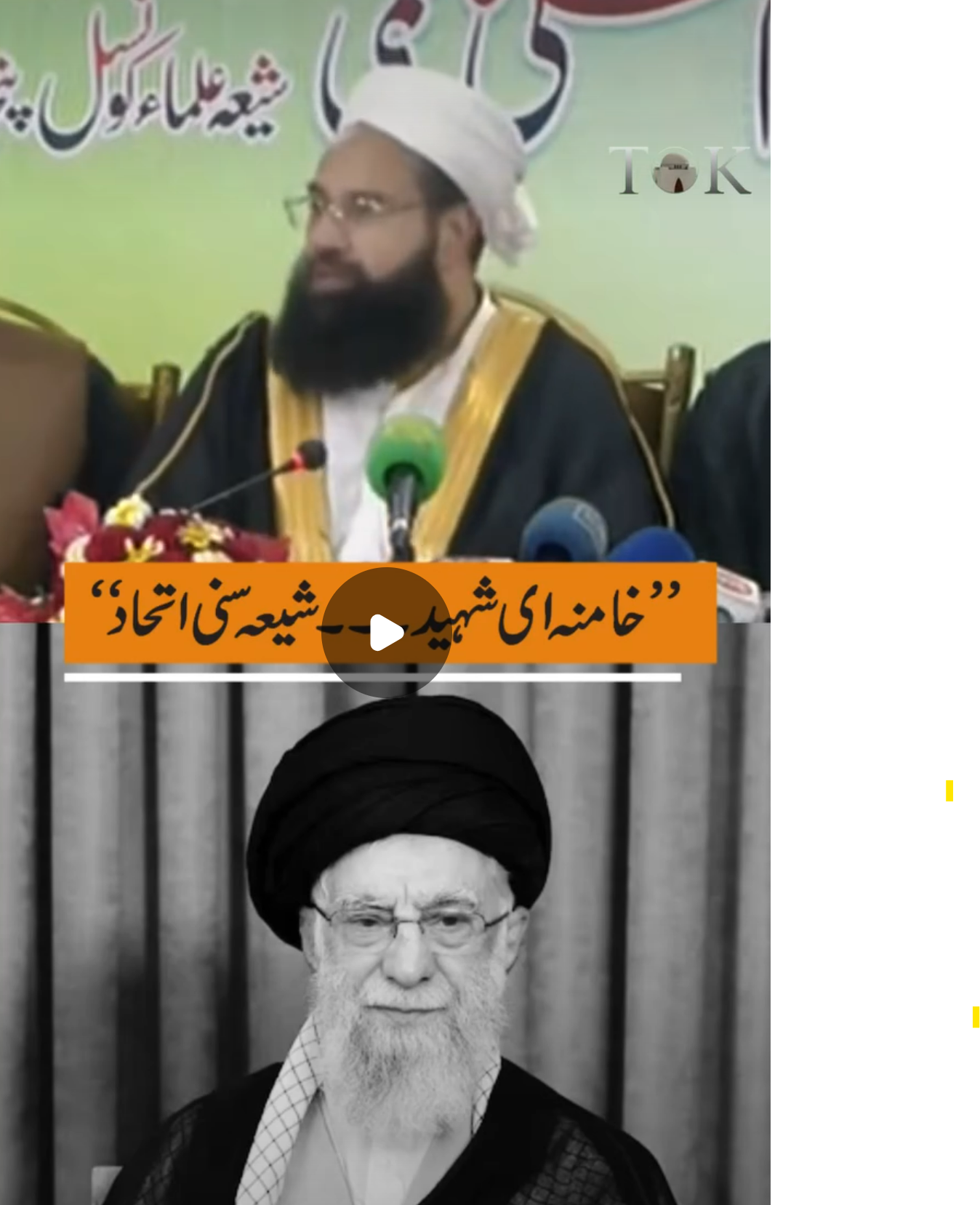
It should therefore come as no surprise that he honoured Ayatollah Khamenei and called him a “martyr” (h/t Habibi).
The Iron Wall of Blasphemy Law
And then there are Pakistan’s blasphemy laws, one of the central instruments through which its religious minorities are controlled and persecuted. Ashrafi has consistently opposed changes to those laws.
Just eleven days before receiving the Lambeth Award, Ashrafi published what was described as his “clear and unequivocal position” on the issue. He claimed that Pakistan’s blasphemy laws were “not being misused”, that “over the past several years, not a single proven case of the misuse of these laws has come to light”, and that allegations to the contrary were “baseless propaganda.” He went on to state that the blasphemy laws are “untouchable.”
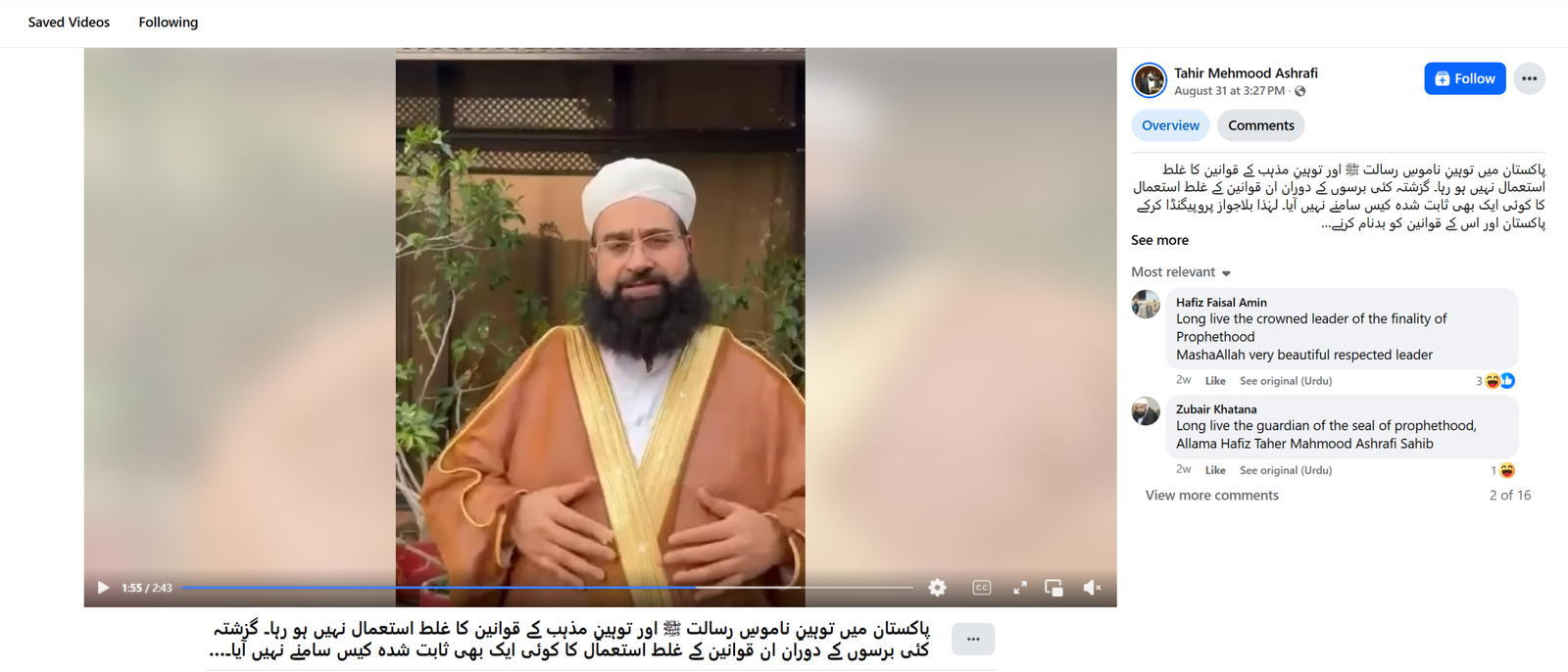
This video was published on 31 August 2026, while preparations for the Lambeth Awards ceremony must already have been well underway. Eleven days later, the Archbishop of Canterbury honoured him for “Reconciliation and Interfaith Cooperation.”
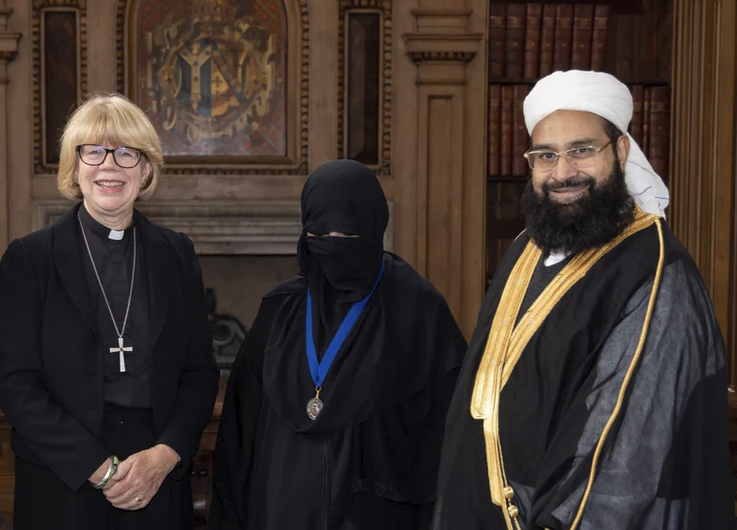
The photographs also appear to show Ashrafi’s wife wearing the medal, rather than Ashrafi himself. Whether this reflected his unwillingness to receive it directly from a female Archbishop is unclear, but Lambeth Palace should be asked to explain what happened.
There is no excuse for any of this. The award represents something far uglier than institutional ignorance. It becomes an act of anticipatory submission – proleptic dhimmitude. The Anglican Church has become a Christian establishment so fearful of excluding or offending powerful Islamic representatives that it bends before them, conferring honour and legitimacy while asking almost nothing about the treatment of Christians in the societies from which they come. It is a grotesque moral inversion, through which persecuted Christians are rendered invisible, while a prominent figure from the religious establishment within which they suffer is celebrated as an architect of reconciliation.
The true horror is that we are no longer shocked by any of this. Why not just raise the Islamic flag over Lambeth Palace and be done with it?
Help Me Fight Back Against Antisemitism and Misinformation
For over a decade – and for many years before that behind the scenes – I’ve been researching, documenting, and exposing antisemitism, historical revisionism, and the distortion of truth. My work is hard-hitting, fact-based, and unapologetically independent.
I don’t answer to any organisation or political backer. This website – and everything I produce – is entirely community-funded. That independence is what allows me to speak freely and without compromise.
If you value this work and want to help me continue, please consider making a donation. Your support genuinely makes this possible.
You can donate via PayPal using the button below:
Alternatively, you can donate via my PayPal.me account or support my work through my Patreon page.
Independent work survives only because people choose to support it. Thank you for standing with me.




Thank you for exposing this. The CofE leadership needs to change. They should not have engaged in this debacle. Repentance and change required throughout the church.
Keep up your excellent work, Mr Collier.
Don’t these people understand that no amount of self-abasement and appeasement will be enough?
The CoE revoked the award yesterday when details emerged of the cleric’s support for Al Quaeda and other unseemly entities. Clearly the process has sidestepped any form of due diligence and taken things on faith !!
The replacement theology of the CoE cannot hide its innate loathing of Judaism for being the original monotheistic religion. As such it will dance with the devil to further its cause.
Sometimes you can just look at a photo of a woman and know that the person doesn’t know what she’s doing. Such is the case with the Archbishop of Canterbury, Sarah Mullally. “Out of her depth” doesn’t even begin to describe the situation.