
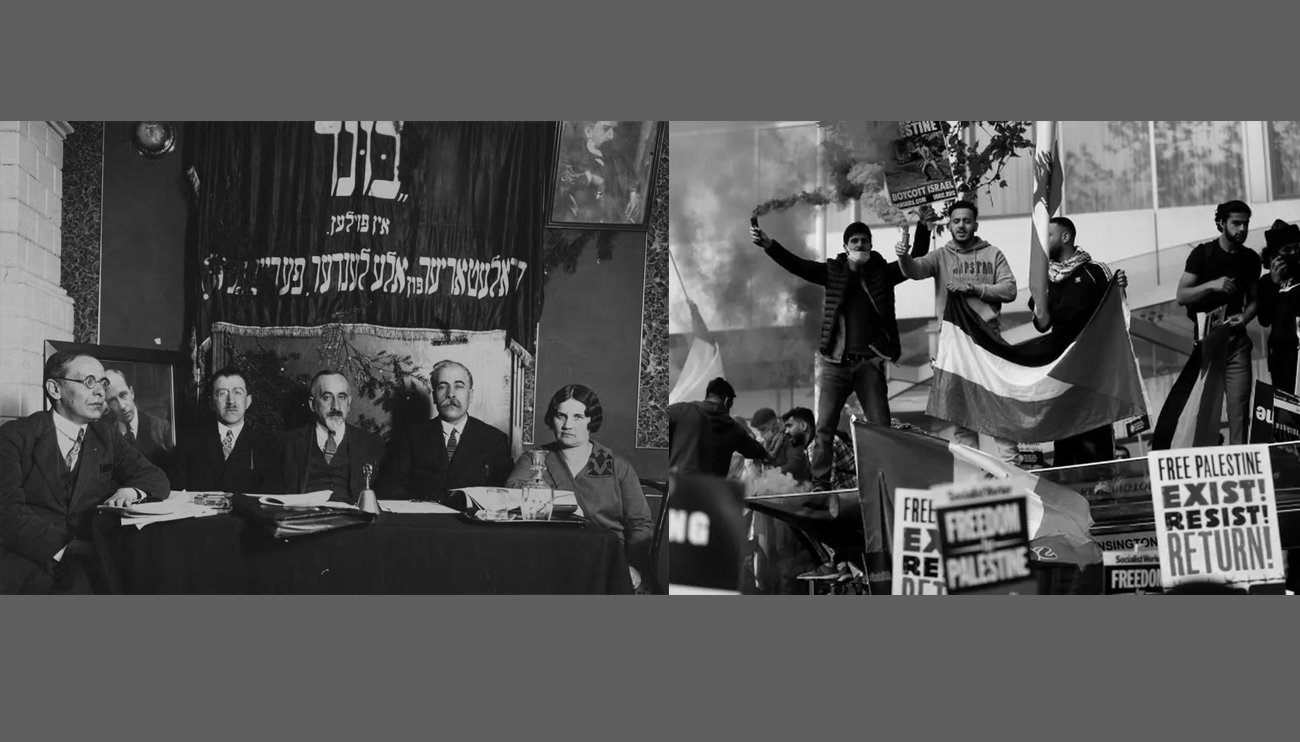
Tens of thousands march through our cities while chanting “From the river to the sea…”
This is routinely presented in our media as a human rights movement, yet stripped of slogans, the political demand is straightforward – the replacement of one state with another across the entire territory – all while waving the flag of the proposed national replacement.
That is not anti-nationalism. It is nationalism, by its flag and on its face.
It is not even defensive nationalism, but an exclusionary territorial nationalism that requires the dismantling or surrender of an existing sovereign state inhabited by millions of people.
Historical anti-Zionism and modern antizionism are not the same thing. Yet the two are deliberately conflated to provide the unacceptable with a veneer of legitimacy.
To describe this movement as merely “anti-Zionist” is historical revisionism. It launders a violent nationalist struggle in the moral legitimacy of an earlier and entirely different political debate.
Genuine Anti-Zionism
Before the founding of the State of Israel, arguments over Zionism referred to an internal Jewish debate about the need for Jewish statehood and the nature of Jewish identity.
It is also true, as anti-Israel activists continually remind everyone, that Zionism remained a minority Jewish opinion for much of the early twentieth century and faced fierce anti-Zionist opposition.
The cruellest of histories would change that.
Poland was home to the largest anti-Zionist group, the Bundists. They believed Jews could survive as a protected cultural minority where they already lived – a philosophy known as “doikayt” or “hereness.”
Like many Jewish assimilationists and Marxists of the era, they believed Europe was ultimately their home.
Auschwitz destroyed that faith far more thoroughly than Zionist argument ever could.
As rising Arab nationalism also chased out the long-standing Jewish communities in Muslim-majority nations, the argument was settled definitively.
Zionism became the majority Jewish political expression of collective survival.
And once millions of Jews were born into Israel, opposition to Zionism no longer referred to a theoretical debate about state creation. It became entangled with the reality of an already existing nation and the rights of the people living within it.
Not The Only Game in Town
It is historically misleading to describe the Islamists and pan-Arab nationalists of the 1930s and 1940s as “anti-Zionist.”
The regional struggle was not against a theory of Jewish identity, but over sovereignty, territory, and the future political order of the region.
Nor were they united. Islamists pursued religious frameworks that often clashed with semi-secular Arab nationalism. These tensions within Palestinian society are still visible today in the Fatah-Hamas divide.
This distinction matters.
Jewish anti-Zionism was an argument about whether Jews should become a sovereign nation.
Arab opposition to the Jewish presence in the British Mandate of Palestine was a competing nationalist ideology confronting another emerging nationalism in the same land.
Over time, these very different traditions were gradually collapsed into a single category – allowing modern anti-Israel activism to borrow the intellectual legitimacy of earlier Jewish anti-Zionist debates while obscuring the religious-nationalist ambitions that lay underneath.
From Anti-Zionism to Antizionism
With Israel now in existence, anti-Zionism no longer occupies the same political or moral space. Objecting to planting a seed is not the same as uprooting a tree. It is the difference between arguing against a pregnancy and arguing against the continued existence of a living child.
That is not to claim that anti-Zionism is entirely redundant. A Jew in America or Europe who does not personally feel Jews need a state of their own is closer to an anti-Zionist in the classic sense. They may even believe that Israel was historically a mistake. But they have no need to oppose Jewish sovereignty for the millions of Jews already living there. The only flag they would ever wave is the flag of the nation they already live in.
This raises a serious question: If the tens of thousands marching through our cities are not actually promoting anti-Zionism, then what exactly are they promoting?
Naming the Beast
If crowds marched through Western capitals demanding the abolition of any other UN member state and its replacement with a different national project, the ideological extremism of the movement would be immediately recognised. Yet in the Palestinian case, Western progressives have absorbed a moral vocabulary that disguises a violent religious nationalism as progressive universalism. This is antizionism.
The goals of modern antizionism are not the goals of anti-Zionism. Instead, they align closely with the demands of Arab nationalism historically rooted in the mandate-era struggle, now dressed in Palestinian nationalist or radical Islamic colours.
This is an eliminationist ideology. The very same battle-cry to destroy Israel that was heard from the Arab armies in 1948 is now sung in the streets of Western cities.
What becomes of the seven million Jews who live there is a secondary consideration upon which there is remarkably little agreement. The more radical amongst them say the Jews must leave. Others say they can stay.
But importantly, it is an Arab national flag that flies in this new, free “Palestine.”
Antizionism Manifest
Antizionism is a religious-nationalist movement seeking to destroy the State of Israel and replace it with another Muslim-majority state in the Middle East.
A mistitled movement is inherently dishonest. To mask antizionism’s real objectives, “Zionism” has been transformed into a global evil – presented as all-powerful and deeply malignant.
Apartheid. Genocide. Ethnic Cleansing. These libels are repeated relentlessly to construct the image of a state unlike any other. Meanwhile, actual mass slaughter elsewhere in the world – Sudan or the Congo – never provokes the same obsession.
The vocabulary continues to expand. New “-cides” are constantly coined and deployed to reinforce the idea that Israel represents a monstrous force in human affairs: Ecocide, Scholasticide, Domicide, Medicide, Journacide.
Once a society accepts the idea of a uniquely evil state, ordinary moral restraints begin to collapse. Actions once considered indefensible become recast as legitimate “resistance.” Islamist terrorism directed at Israeli civilians is reframed as understandable, contextual, even morally justified.
Just this week in Britain, activists imprisoned for violent crimes committed in the name of “freeing Palestine” were elevated into moral heroes. One left a police officer with catastrophic spinal injuries. Yet supporters responded not with revulsion, but with campaigns designed to humanise the perpetrators and redirect sympathy back toward the cause itself.
When an ideology convinces itself that it is confronting absolute evil, every moral boundary begins to erode.
The Moral Collapse
One of the most disturbing political developments in the modern West is watching self-described progressive universalists adopt one of the most aggressive nationalist movements on the planet while failing to recognise it as nationalism at all.
That contradiction is the beating heart of antizionism.
Antizionism presents itself as opposition to nationalism while marching beneath a national flag. It speaks the language of universal human rights while denying Jews the very national rights it demands for others. And because the movement refuses to recognise itself for what it is, it increasingly treats opposition not as disagreement, but as complicity with evil.
Spurred on by Islamist rhetoric, fed by decades of Soviet-era propaganda, and radicalised inside social media echo chambers, modern antizionism draws much of its energy from antisemitism – a prejudice far older than the State of Israel itself.
And that is what makes the movement so dangerous: The moral certainty with which it carries itself. The belief that any action, slogan, intimidation, or even violence can become justified once directed against the world’s designated evil: Israel.
And the most unsettling part of all?
They believe they are the good guys.
Stop using the hyphen. Antizionism is a modern hate movement.
(this article was co/written and cross-posted with Rachel Feldman)
Help Me Fight Back Against Antisemitism and Misinformation
For over a decade – and for many years before that behind the scenes – I’ve been researching, documenting, and exposing antisemitism, historical revisionism, and the distortion of truth. My work is hard-hitting, fact-based, and unapologetically independent.
I don’t answer to any organisation or political backer. This website – and everything I produce – is entirely community funded. That independence is what allows me to speak freely and without compromise.
If you value this work and want to help me continue, please consider making a donation. Your support genuinely makes this possible.
You can donate via PayPal using the button below:
Alternatively, you can donate via my PayPal.me account or support my work through my Patreon page.
Independent work survives only because people choose to support it. Thank you for standing with me.




Palestine was already peopled.
PALLYWEID
Historically, the first “Palestinian” Arab leader to accuse with the supposed “genocide” thing was PLO’s Farouk Qaddoumi In May 1974 [reported on 5/19/74 in SMH] when Israel began responding to the “Palestinian” horrific May/15 Ma’alot massacre. He, who on a December 7, 2013 [RT] interview admitted the Arab-Palestinians supported the Nazis, because they both opposed Zionism.
Next up was “Palestinian” Arab neo-Nazi Issa Nakhleh in a Holocaust denial IHR Nov. 1981. While infamous dreadful Holocaust denying group has always refused to define the Holocaust events as genocide, they had Makhleh as a featured speaker blabbing about a zionist so called “genocide.”
Note the confirmation bias by those (Amnesty intl; HRW under Omar Shakir; B’tselem; Omer Bartov, etc.) who, already, earlier peddled the “apartheid” lie.
The first “apartheid” accuser was Ahmad Shukeiri on Oct 17, 1961. He who admitted in his 1969 book on Arab-Palestinians: “our sympathies were with with the Axis powers being led by Hitler”; had justified the Holocaust together with Jamal Husseini soon after it occurred (as reported in B’nai B’rith on July 12, 1946); in the UN, he had promoted neo-Nazi Tacuara on Nov 30, 1962 and had revealed Arab leadership true genocidal intentions: ‘none of them will survive’ on June 1, 1967.
The current “genocide” campaign began immediately after genocidal Palestinian Oct 7 onslaught, led by genocidal Hamas – as in its charter and expressions throughout. (The Atlantic, 10/10/23: “Understanding Hamas’s Genocidal Ideology”; ISGAP, 2/7/24: “What Hamas Leaders Actually Want – In Their Own Words”) with the aims to ‘kill as many as possible’ (Telegraph, 10/14/23: “Hamas planned killing of young children, secret documents reveal. Terrorists aimed to specifically target young people and ‘kill as many’ Israelis as possible”).
Weeks later, Hamas vowed to repeat the October 7 attacks “again and again” until Israel is completely destroyed. (JPost, 11/1/23: “‘We will repeat October 7 again and again’ – Hamas official”).
The accusation campaign, was thus an engineered diversion and projection.
Clearly the war [was and is] aimed at Gaza Hamas government while Israel has been risking soldiers lives in urban warfare with extraordinary comparable success in minimizing civilian casualties (Experts: A. Fox in JPost, 11/6/25: “Western militaries can’t afford to boycott IDF’s battle-tested Gaza tactics – analysis”; J. Spencer on X 1/28/26: “The irony is that even when relying on Hamas’s own false or unverified numbers, Israel’s combatant-to-civilian casualty ratio remains historically low by any serious comparison to urban warfare. The data, stripped of manipulation and advocacy, does not support claims of indiscriminate or unlawful conduct. It demonstrates the opposite”) and urging Gazan civilians evacuations while Hamas prevents and uses them as human shields (HJS, 5/4/25: “Hamas’s Human Shield Strategy in Gaza”) as its strategy to increase casualties (WSJ, 6/17/24: “The Brutal Calculation of Hamas’s Leader”).
Quoting one line at moment of anger [Oct/2023] while omitting immediate clarification that it means only Hamas, is a gross error. Worse is citing anyone not part of War Cabinet by Netanyahu.
UN: UNRWA vastly involvement in Oct 7 atrocities has been exposed. Dubbed modern Goebbels – Francesca Albanese’s dreadful hate record (see UNWatch) is infamous since her 2014 hateful tweets. Or C.O.I. Miloon Kothari’s “Jewish control” 2022 trope.
Most Western nations clearly oppose this accusation. While 127 fake $30 “experts” (IAGS) support, at least 537 history and genocide real experts opposed it. (TimesOfIsrael, 9/9/25:
“More than 500 experts sign demand that genocide ‘scholars’ group retract accusation against Israel”).