
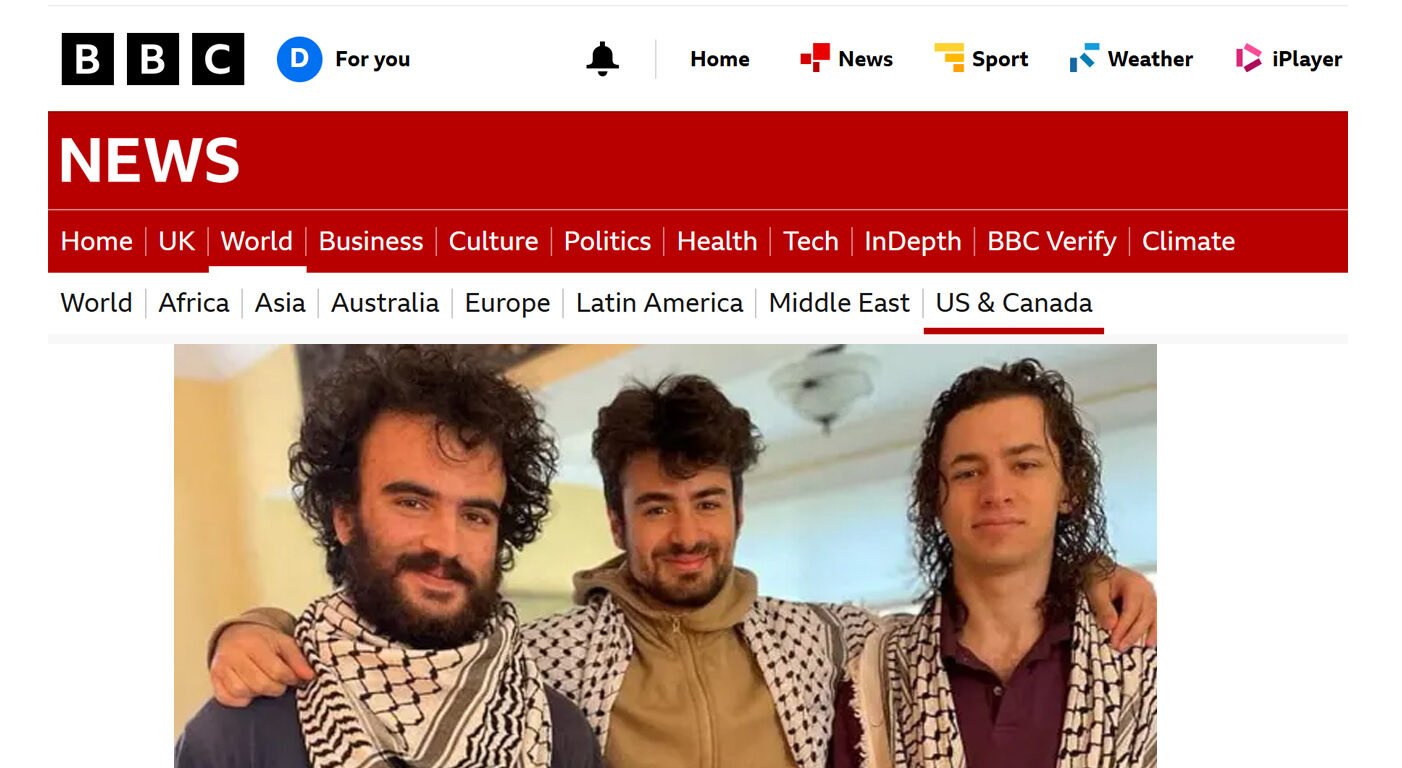
There is something insidious about BBC reporting. The facts of the story of the shooting of three students in Vermont did not fit the narrative that the British state broadcaster wanted to tell.
But that did not stop them.
Instead, the publicly funded BBC simply pretended that they did – and wrote the story they wanted to tell anyway.
The Shooting of the Three Students
This is a story I covered in detail in December 2025, alongside Vermont-based investigative journalist Rachel Feldman, when members of Vermont’s congressional delegation tried to weaponise the tragedy by presenting it as a targeted hate crime – despite the evidence failing to support any such motive.
The core details are as follows. On November 25, 2023, three students were shot on North Prospect Street in Burlington, Vermont. Burlington is relatively small by American standards, but is the largest city in Vermont. The three college students were visiting family in town for the Thanksgiving break.
The shooter, Jason Eaton, left his property, immediately encountered the three students and opened fire. As the students were of Palestinian heritage, and two were reportedly wearing keffiyehs at the time, there were immediate attempts to ascribe a motive to the attack. That narrative soon ran into serious problems as more details emerged – including Eaton’s own recent expressions of support for the Palestinian cause.
Eaton eventually went to trial in September 2026, attempting to rely on an insanity defense. The jury rejected it and found him guilty of the underlying three counts of attempted second-degree murder.
Crucially, no hate-crime enhancement was added to the charges. Despite years of investigation, there was no evidence to establish an “anti-Palestinian” motive.
None.
The BBC Gets Creative
The verdict should have left the BBC with a simple reporting task. Yet what followed shows just how lost BBC journalism has become.
On 21 September, BBC News reported the conviction of Jason Eaton, but apparently decided that the facts established in court were not enough.
The report suddenly invents an entirely different narrative:
“The shooting occurred the month after the start of the Israel-Gaza war and amid a rise in Islamophobia and antisemitism in the US.”

None of that has anything to do with any motive established for the shooting. The BBC is inserting its own narrative into the story. And when you look even closer – it gets even worse.
The hyperlink provided by the BBC to support its claim of “a rise in Islamophobia and antisemitism in the US” is all about a rise in antisemitism – the article makes no mention of a “rise in Islamophobia” at all:
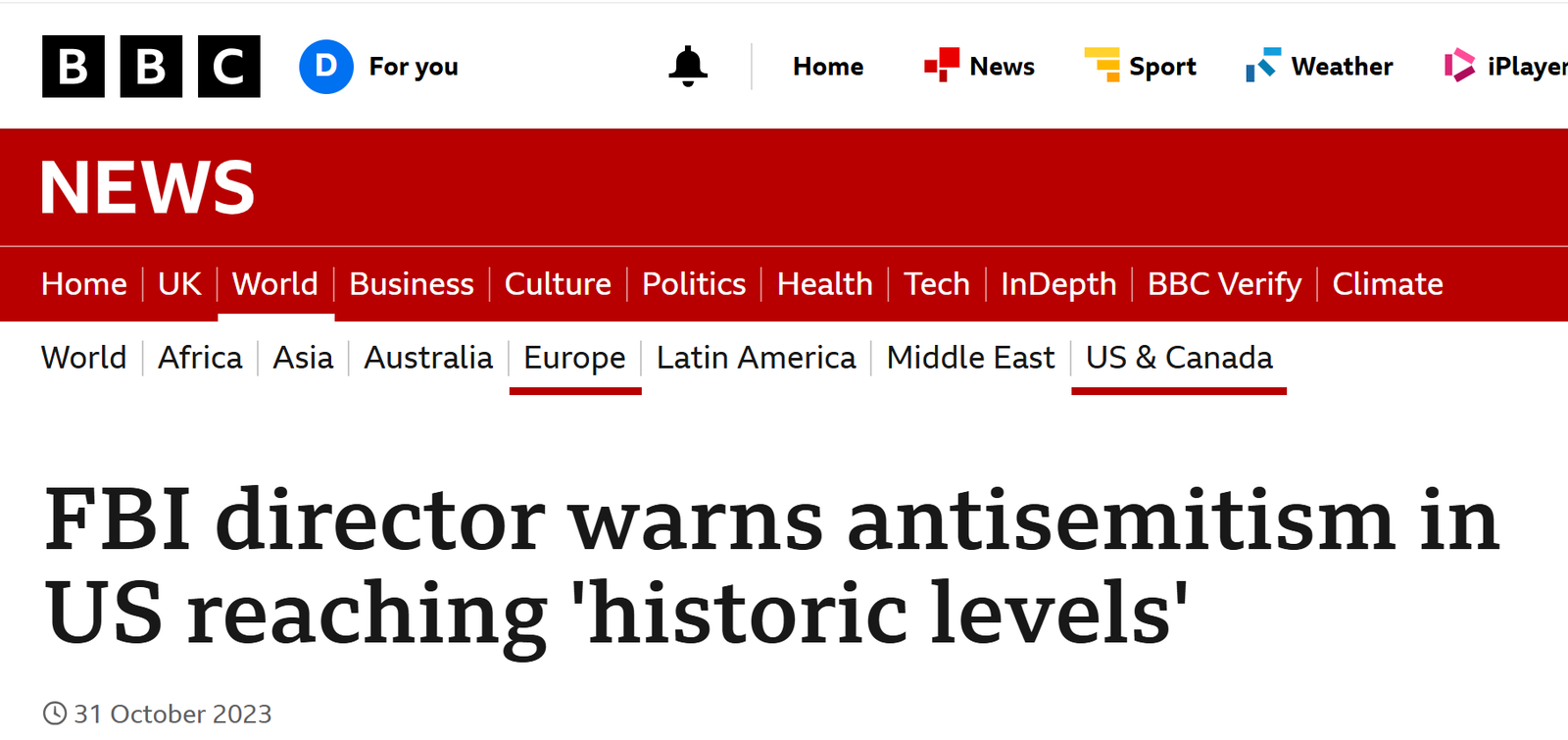
The link is provided as a red herring to imply a documented rise in anti-Muslim bigotry without providing any evidence of such.
And note too – the BBC journalist places Islamophobia first, pushing antisemitism into second place, before linking to an article that is all about “historic levels” of antisemitism.
Is nobody paying attention?
And They Had Not Finished Yet
In the very next paragraph, the BBC tells readers that the three victims were walking near Eaton’s home, “speaking a mix of Arabic and English and wearing traditional Palestinian scarves known as keffiyehs.”
In isolation, these may be legitimate details to report – and in a properly reported account, their inclusion may well be justified. But that is not what the BBC has done. It has already introduced Islamophobia and the Israel-Gaza war into a story where no such motive was established. It then immediately tells readers that the victims were speaking Arabic and wearing keffiyehs.
Their placement creates an unmistakable impression. The BBC has painted a picture that readers can hardly be expected to ignore.
This is disgraceful advocacy journalism – and it has entirely skewed the story.
For anyone who has not yet grasped the depth of the misdirection, the BBC even tagged this story in its Gaza War section – as if this shooting and these victims are somehow part of the Gaza War story. So if someone browses the BBC’s “Gaza War” section, this Vermont shooting is one of the stories they will find.
This is shoddy and unacceptable. This is more like student activism than reporting.
The Pen Behind the Sword
The journalist Brandon Drenon is not new to me. I first wrote about his BBC reporting more than two years ago, raising concerns about the way he framed Israel-related stories. Since then, the media watchdog CAMERA has also challenged his reporting on several occasions. In April 2024, Drenon falsely told BBC readers that the International Court of Justice had found the accusation of genocide against Israel “plausible.” It had not. Following a complaint, the BBC amended the article.
But there is a broader pattern worth noting. Drenon has repeatedly produced sympathetic human-interest reporting centred on Palestinians and pro-Palestinian activism. Just a few examples:
- October 2023: ’I wake up and check if my family in Gaza is still alive,’ says Palestinian American
- November 2023: Palestinian-Americans struggling with “survivors’ guilt”
- May 2024: US campus protests: ‘Student arrests will be my final college memory’
- April 2025: Anxiety at US colleges as foreign students are detained and visas revoked
- October 2025: US campus activists relieved – and anxious – after Gaza ceasefire deal
I looked for the other side. I could find no comparable standalone feature from him centred on Jewish or Israeli-American experiences of October 7, the hostage crisis or the subsequent surge in antisemitism.
Nothing.
Perhaps this should not come as a surprise. When I last reported on Drenon I noted he came from a social justice background, and had married a Syrian-Palestinian from a family of anti-Israel activists.
And now we have his coverage of the shooting in Vermont.
Once again, the problem is not simply what Drenon reports, but the story he invents beyond the facts. His article introduces the Gaza war, Islamophobia, Arabic and keffiyehs in quick succession – leading readers to assume a motive that the evidence never established.
We Should Not Have to Pay for This
The BBC’s motive seems considerably clearer than Jason Eaton’s. We know Eaton shot three young men on a dark street in a peaceful city. Nearly three years later, we still do not know why.
What we can see clearly is what the BBC has done with that uncertainty.
This was a local shooting in which nobody was killed. Would BBC News have reported the conviction of an American who shot and wounded three strangers in Vermont nearly three years earlier if the victims had not been Palestinian?
But having chosen to report it, the BBC then supplied the missing narrative itself: Gaza, Islamophobia, Arabic and keffiyehs – all pointing the reader towards an anti-Palestinian motive that was never established.
But the bottom line is this. I do not actually care if BBC News wants to employ activist journalists who produce one-sided, skewed and misleading coverage.
There are plenty of dreadful media outlets in the world. One more will make little difference.
But here is the crunch: if the BBC has abandoned impartial journalism for student-level activism, then there is no justification for forcing the British public to pay for it.
Help Me Fight Back Against Antisemitism and Misinformation
For over a decade I’ve been researching, documenting and exposing antisemitism, historical revisionism and the distortion of truth. My work is hard-hitting, fact-based and unapologetically independent.
I don’t answer to any organisation or political backer. This website – and everything I produce – is entirely community-funded.
If you value this work and want to help me continue, please consider making a donation. Your support genuinely makes this work possible.
You can donate via PayPal using the button below:
Alternatively, you can donate via my PayPal.me account or support my work through my Patreon page.
Independent work survives because people choose to support it. Thank you for standing with me.




Have you complained to the BBC or indeed to OFCOM?
The case of Arab Palestinian born Muhammad Hussain El-Farra, serving as Jordan’s ambassador to the U.N
From Author Nathan A. Kurz, ‘From Antisemitism to “Zionism Is Racism.” In: Jewish Internationalism and Human Rights after the Holocaust. Human Rights in History,’ in Oct 1960:
‘Jordanian Ambassador Muhammad Hussain El-Farra began the General Assembly debate by saying that any consideration of global antisemitism had to be tempered by the ‘practices adopted against the Arab minority in Palestine by the very people complaining of antisemitic demonstrations.’
Karameh.
Operation Karameh took place on March 21, 1968, three days after a land-mine attack destroyed an Israeli school bus, killing two people and injuring 28. Israeli forces crossed into Jordan to attack Fatah infrastructure at Karameh, which contemporary Israeli and later historical sources described as a major Palestinian armed-group base. The evidence indicates that civilians were warned before the operation through leaflets. Sources also report that much of Karameh’s civilian population had already left and that some young local men had reportedly been forcibly recruited by Palestinian organizations.
According to Israeli operational documents and accounts (confirmed in 2011), commanders instructed troops not to kill women, children, or elderly civilians and to distinguish civilians and unarmed Fatah members from armed personnel offering resistance. These instructions establish the intended rules of engagement. The fighting involved Israeli forces, Fatah and other Palestinian fighters, and the Jordanian Army, which intervened directly; Israeli forces subsequently withdrew after taking control of much of Karameh. The operation damaged Fatah’s infrastructure but did not end Palestinian armed activity in Jordan, and Fatah subsequently shifted important concentrations toward the Salt area, where Israeli forces later conducted air strikes against reported headquarters, training facilities, and other military infrastructure.
The accusations
On March 22, 1968, el-Farrah accused Israel of so-called “genocide.”
By May, he had followed in Shukeiri’s 1961 propaganda by invoking the “apartheid” analogy.
Following the August 4 operation on Salt, Voice of Fatah followed el-Farrah with the “genocide” accusation as it was announcing that it will target civilians (AP, Aug 7: “Arab Guerillas Warn Of Strikes Against Civilians”), as if it had not already been doing so up to that point.
Research by this poster::
___
Op. Karameh: Israeli Orders to Spare Civilians, Warning Civilians to Leave, and the Targeting of Fatah Terrorists in 1968 – El-Farrah championing false “genocide” accusation.
https://justsayingitoutloloud.blogspot.com/2026/09/operation-karameh-israeli-orders.html
Nithya Raman: “progressive” propaganda. Sep 29, 2026
Earlier, “progressive” LA mayoral candidate Nithya Raman used the “genocide” slur with Hasan Piker. Appearing on Sep 29, 2026 in a Jewish forum by the Jewish Federation, Raman was asked whether she would appear with someone who was anti-Christian or anti-Muslim, as she had appeared with the antisemitic Hasan Piker. She said yes, explaining that “we need to hear a wide variety of opinions.” So she was asked about her use of the word “genocide.” She answered, “I’m not an expert on this term, but I’ve seen experts calling it a genocide. I looked it up, and I’ve seen experts use it.” She then added that she had condemned October 7—but she did not apply the “G-word” to October 7.
_
Reminder about the “experts.” Which was widely cited. The IAGS last year.
Want To Be A Renowned Genocide Scholar? Pay $30 – i24NEWS
https://www.i24news.tv/en/news/israel/diplomacy/artc-want-to-be-a-renowned-genocide-scholar-pay-30
Rahm Emanuel says Democrats must ‘prove we can bring change’ amid ‘brand problem’: Full interview.
NBC News. Oct 4, 2026.
[…]
KRISTEN WELKER:
…Michigan Senate candidate Abdul El-Sayed, who said he believes the Israeli government is committing a genocide[SIC] of Palestinians in Gaza. Do you see what is happening in Gaza as a genocide[SIC]?
RAHM EMANUEL:
…I happen to also know, to the core of your question, the question of genocide is a historic question, going all the way back to Professor Lemkin in 1942, all the way back to the Nuremberg Trials. If you’re going to use that term, we have to have a conversation about Sudan. We have to have a conversation about Ukraine. We have to have a conversation about the Ukrainians and Cambodia. You are politicizing a term that has huge and historic moral obligations. I have no problem having that conversation, but the fact that a questioner ignores Sudan that’s happening today, ignores Ukraine that’s happening today, tells me more about the questioner than what the answer will reveal…
https://www.youtube.com/watch?v=IluLnr28EfE
Masks and tricks of a typical vile hater from hell
Oct 8, 2026.
The Haverford case exposes a pattern that deserves far more scrutiny:
1. Publicly hide behind “anti-Israel” or “anti-Zionist” rhetoric—and even blame Israel for antisemitism.
2. Wrap yourself in the language of “Free Palestine.”
3. Operate behind multiple aliases and anonymous accounts.
Then, the mask comes off: explicit antisemitic threats, Nazi references, Holocaust rhetoric, and threats directed at a Jewish victim and his family.
The Guangtian Ha case is a particularly stark example of what prosecutors allege happened when the anonymity came off.
The question is not whether criticism of Israel is legitimate—it obviously can be. The question is what someone’s rhetoric reveals when they stop talking about a state and start targeting Jews.
US religion professor charged with posting anonymous antisemitic threats online.
Guangtian Ha of Haverford University in Pennsylvania allegedly used right-wing language to threaten victim and his family
By Luke Tress.
Times of Israel, Oct 7, 2026.
[https://www.timesofisrael.com/us-religion-professor-charged-with-posting-anonymous-antisemitic-threats-online/]
Haverford professor charged with cyberstalking and antisemitic harassment of colleague. Dana Munro, Inquirer, Oct. 7, 2026
[https://www.inquirer.com/education/guangtian-ha-haverford-college-arrested-20261007.html]
‘Hitler Was Right[sic] All Along’: Haverford Professor Charged With Stalking Jewish Coworker Has Long History of Threatening ‘Jew Rats[sic]’ Praising Nazis in Suspended Posts.
The posts, which went offline when X suspended the account this spring, were nakedly antisemitic, calling for the torture and murder of Jews.
Jon Levine, Washington Free Beacon,
October 7, 2026
[https://freebeacon.com/campus/hitler-was-right-all-along-haverford-professor-charged-with-stalking-jewish-coworker-has-long-history-of-threatening-jew-rats-praising-nazis-in-suspended-posts/]
https://thatpointtoo.blogspot.com/2026/10/masks-and-tricks-of-typical-vile-hater.html