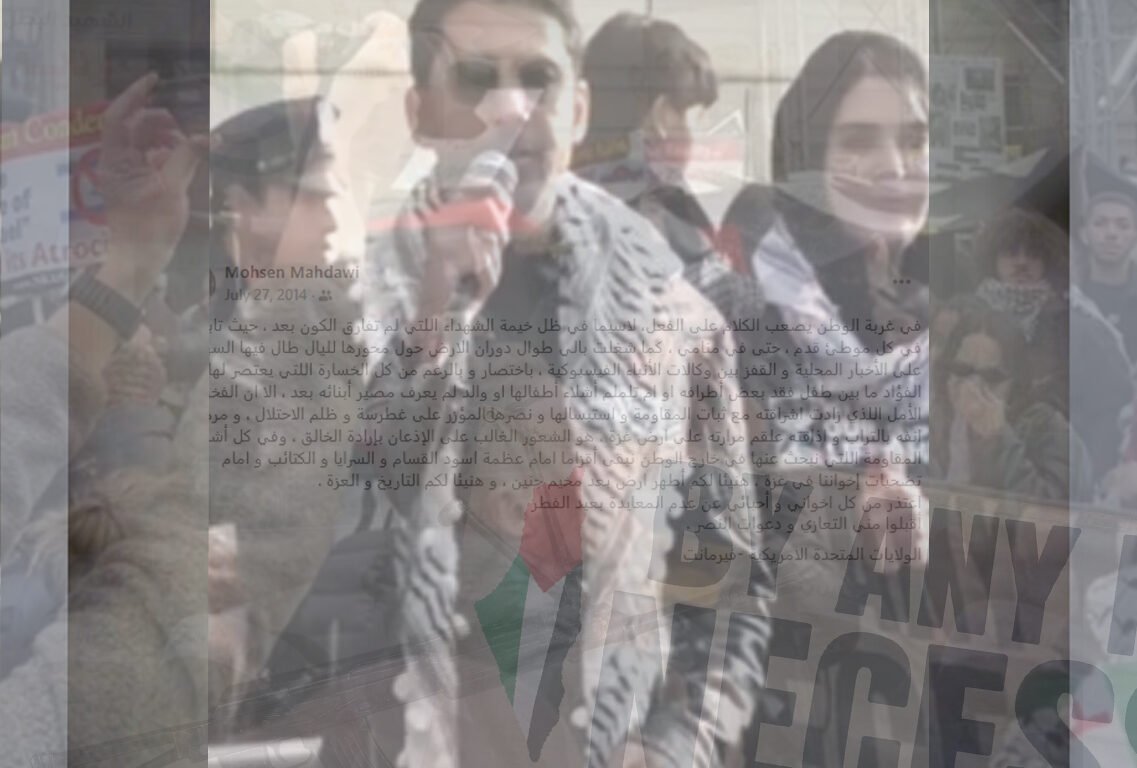
Published today, Mohsen Mahdawi: A Timeline of Support for Terrorism is the result of months of research into Mahdawi’s history, political activity and the public narrative that has developed around him.
A link to download the full report is at the bottom of this article.

“Let’s for once be shrewd and politically astute, and let’s play skillfully with their minds; act meek until we gain the upper hand, and after that there will be plenty of ways to deal with it. Mohsen Mahdawi, 2014
Almost everybody who encounters Mohsen Mahdawi’s story is presented with the same compelling arc. A child grows up amid violence in a Palestinian refugee camp. His younger brother dies. His best friend is shot dead in front of him. Consumed by thoughts of revenge, he sits beside their graves until a beloved uncle intervenes and teaches him that education, not violence, is the answer. Mahdawi eventually reaches America, embraces dialogue and non-violence, builds relationships with Jews and Israelis, and dedicates himself to peace.
It is an extraordinary story, delivered by a man with presence and charisma. As his ex-wife noted in her 2025 witness statement, Mahdawi has incredible people skills. But after months of research, it is also a story that is simply not sustained by the evidence.
The findings are extensive. Previously unpublished material includes Mahdawi promising the “annihilation of the Jews”, praising the leaders and armed wings of terrorist organisations, honouring dead terrorists from several Palestinian factions, and continuing to express support for armed “resistance” after arriving in the United States. The investigation also uncovers serious contradictions in the personal story that became central to Mahdawi’s reputation as a peace activist.
Mahdawi has spent years engaging with certain Jewish audiences and has formed relationships with people within those communities. That much is not in dispute.
What we have not found is evidence that the message of dialogue and mutual understanding Mahdawi presents to certain progressive Jewish audiences has ever operated with the same force in the other direction. His support for armed Palestinian “resistance”, meanwhile, remains clear. He asks Jewish audiences to listen, understand and trust him, while simultaneously expressing support for groups engaged in an armed struggle against the Jewish state.
Mahdawi would describe himself as simply seeking “justice”, while standing in front of Within Our Lifetime banners declaring “BY ANY MEANS NECESSARY” at an event where protesters sang about “globalising the Intifada”.
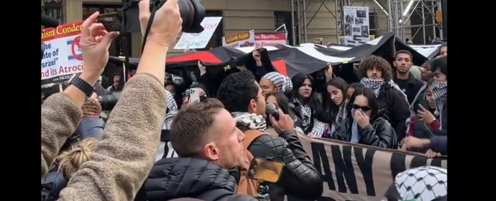
It is why we cited the Desiderius Erasmus quote at the beginning of this report: “There are no vices more dangerous than those which simulate virtue.”
Long before Columbia, the Arabic-language record shows Mahdawi repeatedly venerating men and organisations associated with terrorism and armed struggle. Ahmed Yassin and Fathi al-Shiqaqi are honoured. Armed factions are praised. His militant uncle Thaer is remembered not merely as the gentle mentor of his later American accounts, but as the man who taught him “the first bullets and the first love”. Even after Mahdawi reached Vermont, this language did not disappear.
That last point matters. A simple redemption story would be easier to understand. People change. A young man raised amid conflict may abandon ideas he once held, and evidence of that transformation should be taken seriously. Had the record shown Mahdawi encountering new ideas in America and subsequently repudiating his earlier support for violence, this report would have had a very different conclusion. But that is not what we found.
Instead, the two strands repeatedly overlap. The public image of a peace-builder develops while expressions of solidarity with armed “resistance” continue. And in one particularly revealing 2015 tribute to Thaer, Mahdawi appears almost to provide the vocabulary necessary to understand the transition himself. Having invoked the uncle who taught him “the first bullets”, he writes that “even if the form has changed”, his commitment to his homeland remains.
Nine years later, the meaning of that distinction becomes clearer. In December 2024, after helping to launch the student protest movement at Columbia, Mahdawi recorded a ten-minute Arabic-language video about the Palestinian Authority’s crackdown on armed groups in Jenin. He called the refugee camps the “heart of the resistance”, and rejected the description of armed militants as “outlaws.”
Most revealingly, Mahdawi placed his own activism within the same framework. The Palestinian Authority’s actions, he said, were: “a slap in the face of the resistance, whether armed resistance in the West Bank or Gaza, or the popular resistance that we began and are still engaged in outside the homeland.”
This is perhaps the clearest answer to the central question raised by this report. Mahdawi does not describe the “popular resistance” he helped build abroad as a repudiation of armed struggle. He places the two alongside one another as different components of the same resistance.
Then there is the question of Mahdawi’s biography itself. His childhood story is not a decorative anecdote. It is the moral foundation of the identity he constructed in America. The murdered friend explains the trauma and rage; Thaer’s intervention provides the moment of transformation; education and dialogue become the answer. Yet when that story is compared with contemporary records and Mahdawi’s own earlier accounts, it begins to fall apart.
The only known child death inside Al-Fara’a during the Second Intifada does not correspond to the killing Mahdawi repeatedly describes. His own proximity to the supposed shooting changes over time, from returning roughly half an hour afterwards to eventually describing himself as holding his friend while saturated in his blood. And when Mahdawi finally corrects his age from ten to twelve, he renders the subsequent encounter with Thaer impossible: his uncle was already dead.
We cannot know precisely how these stories developed, nor do we need to. The evidence cannot tell us what Mahdawi remembers, believes or intended when he told them. It tells us something simpler and more important: the formative episode cannot have happened as he has repeatedly described it.
There is a wider failure here too.
Mahdawi did not tell his story in obscurity. He told it to journalists, academics, religious communities and students. It was repeated in profiles and interviews and ultimately carried to a vast audience by one of America’s most prestigious television news programmes. The emotional power of the narrative was obvious. The scrutiny applied to it was not.
Perhaps that is the broader lesson of this investigation. Mahdawi offered Western audiences an extraordinarily attractive story: a refugee who had experienced the worst of conflict yet rejected hatred; a former angry child transformed through education; a man who could move between Palestinian activism, Buddhism, Jewish dialogue and American progressive politics while speaking the language of reconciliation.
There is nothing wrong with wanting that story to be true. There is something wrong with allowing that desire to replace journalism.
The Arabic posts were there. The earlier interviews were there. The dates were there. The contradictions were there. Much of what was required to test Mahdawi’s public biography did not depend upon secret intelligence, leaked documents or inaccessible archives. It required taking his claims seriously enough to check them. Mahdawi co-founded and helped lead a movement in which open calls for violence were displayed, while the wider campus environment became so intimidating that some Jewish students left and returned home in fear. Still, parts of the media portray him as a “peace activist”.
And this, ultimately, is why the distinction between conversion and continuity matters.
Mohsen Mahdawi’s surroundings changed. His language changed. His methods changed. But the evidence documented in these pages does not support the much simpler transformation so often presented to the American public. His own words suggest something more complicated.
The form changed, but the struggle remained.
And this continuity was not something that emerged only during the turmoil at Columbia after October 7. It was visible almost from the moment Mahdawi arrived in America. In the summer of 2014, newly arrived in Vermont, he was already speaking about different forms of resistance while praising the armed wings of Hamas and Palestinian Islamic Jihad.
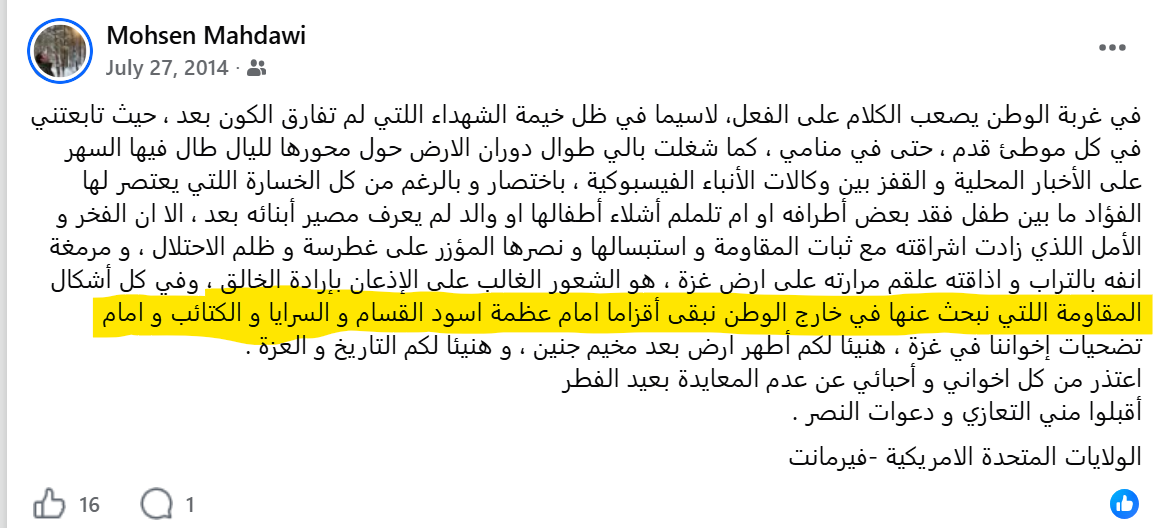
Posted by Mahdawi when on U.S soil: “Compared to the greatness of the lions of Al-Qassam, Al-Saraya, and the Brigades, we – who seek resistance outside the homeland – remain mere dwarves.”
Mahdawi frequently speaks of justice. It is one of the central themes of the identity he presents to American audiences. But justice requires something more fundamental: truth.
After almost one hundred pages examining his words, his history and the stories upon which his public identity was built, that is where the problem with Mohsen Mahdawi ultimately lies.
Too much of the story simply isn’t true.
The full report (V2) can be downloaded here.
Help Me Fight Back Against Antisemitism and Misinformation
For over a decade – and for many years before that behind the scenes – I’ve been researching, documenting, and exposing antisemitism, historical revisionism, and the distortion of truth. My work is hard-hitting, fact-based, and unapologetically independent.
I don’t answer to any organisation or political backer. This website – and everything I produce – is entirely community-funded. That independence is what allows me to speak freely and without compromise.
If you value this work and want to help me continue, please consider making a donation. Your support genuinely makes this possible.
You can donate via PayPal using the button below:
Alternatively, you can donate via my PayPal.me account or support my work through my Patreon page.
Independent work survives only because people choose to support it. Thank you for standing with me.