
In recent years the term anti-Palestinian racism (APR) has moved from activist discourse into the language of public institutions across multiple Western democracies. In the UK it has now been raised in both Houses of Parliament. In the U.S. a group of elected officials turned the phrase into a political weapon. In Canada, the Canadian government provided funding to support the creation of APR educational resources. And in Australia, the public broadcaster recently gave favourable coverage to a report claiming anti-Palestinian racism was “widespread.”
If you are not paying attention, you should be. While APR markets itself as part of serious anti-racist discourse, in reality it functions as a dangerous, antisemitic tool. APR doesn’t just try to name a prejudice. It rewires the moral rules. It turns Zionism into racism, Jewish self-definition into exclusion, and antisemitism safeguards into “censorship” – then demands institutions enforce that inversion as policy.
Once inverted framing takes hold, everything becomes distorted. Neutrality is recast as hostility. Jewish communal safety is treated as an obstacle. And the most aggressive forms of anti-Israel activism are rebranded as “anti-racist” virtue. None of this directly causes violence, but it changes the climate: what can be said, what must be tolerated, and further marginalises a Jewish community that is already under considerable threat.
And the truly scary part of all this? It was designed that way.
The pro-Corbyn network that incubated APR
Today I publish a report (available for download) that traces the origins of the term anti-Palestinian racism, and shows how it evolved from a fringe activist slogan into a deliberately weaponised framework within the global Boycott, Divestment and Sanctions (BDS) movement.
The turning point came on 4 September 2018. The National Executive Committee (NEC) of the Labour Party had just voted to adopt the International Holocaust Remembrance Alliance (IHRA) definition of antisemitism, along with all its examples. The NEC adoption was a major defeat for Jeremy Corbyn and his supporters.
Until then, APR was largely confined to the online activist ecosystem around the Electronic Intifada, a fringe anti-Israel outlet.
Inside a key Corbyn support group there was an immediate reaction. Palestine Live was a Facebook group set to “Secret” visibility. Members included leading figures from Israel-hostile organisations, along with journalists and community organisers. The UK-founded network had an international feel, with representation from groups in North America and beyond.
Since 2015, Palestine Live had operated as a pro-Corbyn network. In early 2018, I published an exposé documenting the high levels of antisemitism and anti-Jewish conspiracy theories circulating inside the group, which triggered complaints and a formal party investigation.
The Invention of Anti-Palestinian Racism
A day after the NEC vote, one of the then administrators of Palestine Live posted a reaction to it. The message was simple and stark: “The Labour Party has an anti-Palestinian racism problem”:
This linkage is at the heart of APR: it suggests that trying to combat antisemitism is itself racist against Palestinians.
Later the same month, a member of Palestine Live posted an anonymously written definition of anti-Palestinian racism. The following day, the pro-Corbyn activist group Jewish Voice for Labour, many of whose leaders were members of Palestine Live, published a slightly refined version on their website. APR, in recognisable form, had arrived.
The Internationalisation and Institutionalisation of Anti-Palestinian Racism
A few weeks later, on 16 October 2018, the U.S.-based anti-Zionist outlet Mondoweiss published an updated version, tightening the JVL version and polishing it for an international audience. There were now ten clauses in the definition, with the author suggesting the examples were absolutes, or “indisputable examples of anti-Palestinian racism.”
Under this definition of APR, denying the (often false) narratives of anti-Israel activism, supporting the right of Israel to exist or even accusing someone of antisemitism could make you a racist.
The framework was now complete. It pushed back against efforts to combat antisemitism, while creating an atmosphere in which activist claims and antisemitic commentary became moral absolutes that could not be challenged.
Once this definition of anti-Palestinian racism had been introduced, it began to be incorporated as a key tool in the Boycott, Divestment and Sanctions (BDS) arsenal:
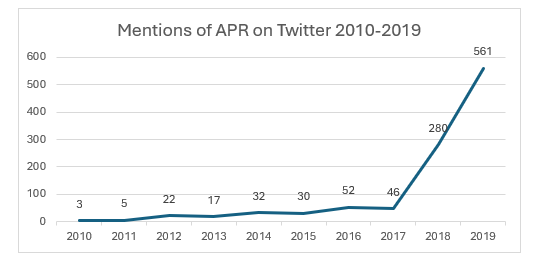
In 2019, the Canadian government introduced a new anti-racism strategy “Building a Foundation for Change.” The policy framework created a pathway for NGOs to propose new conceptualisations of racism and, potentially, to receive public funding.
Anti-Israel activists saw the opening, and launched an intensive campaign in Canada. In 2022, the Arab Canadian Lawyers Association (ACLA) finally introduced a codified definition of anti-Palestinian racism.
The ACLA definition reads as a formal rewrite of the JVL and Mondoweiss versions. It is less concerned with addressing prejudice than with recasting Jewish identity and Jewish self-determination as racist.
The Canadian government has since awarded ACLA a grant of CAN$100,000 to develop educational tools and provide training on the subject of APR.
The deed was done. APR had moved from an activist smear to a government-funded weapon.
The Weaponisation of Anti-Palestinian Racism
Having been incubated in the UK, internationalised in the U.S., and then codified in Canada, the Canadian government’s financial support officially legitimised the concept of anti-Palestinian racism. From this point, the ACLA definition could export itself internationally.
In both the U.S. and Australia, activist NGOs produced official-looking reports claiming APR was a widespread, urgent problem. Both supported the inclusion of educational material in schools as a key recommendation. These documents failed to meet basic academic standards, yet still received favourable treatment.
The term became a political weapon. In one U.S. state, a Senate resolution has been introduced labelling a tragic incident as an act of APR, even though there is no evidence at all to support it.
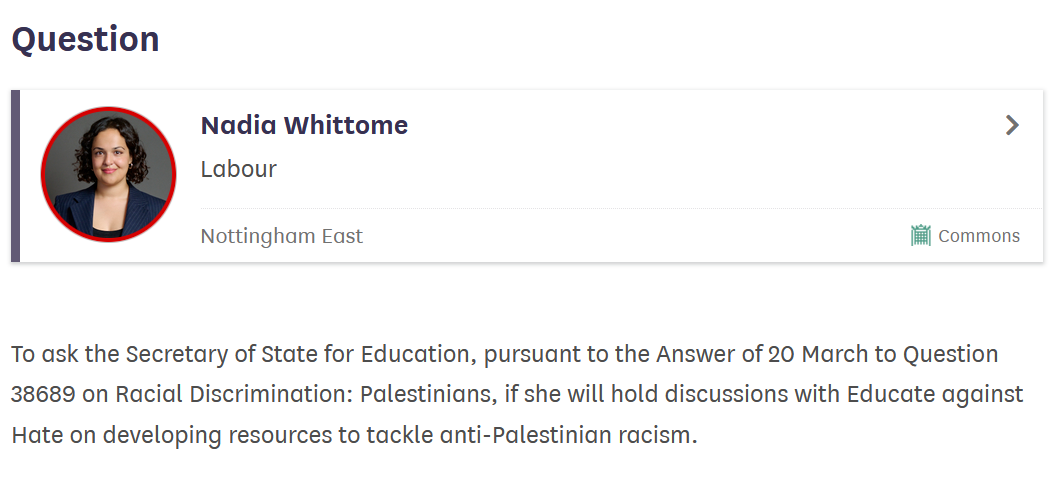
In the UK, Labour MP Nadia Whittome has been campaigning to get the UK government to recognise APR, and in March 2025 tabled a written question asking if the government will introduce educational material to tackle the problem in schools:
 And it gets worse. On 16 July 2025, Manchester City Council adopted a motion recognising the need to challenge anti-Palestinian racism.

What does this mean in practice? It means a sitting MP wants to introduce a framework that functions as an antisemitic propaganda weapon into schools, while Manchester City Council moved to reframe antisemitism safeguards as suspect, and to legitimise unsubstantiated activist narratives. If anyone objects, they could be accused of racism.
Changing the Air People Breathe
Seventy-eight days later, just three miles away from the Town Hall, came the Yom Kippur terrorist attack at the Heaton Park synagogue. Two people were killed.
Manchester was not the only city where APR was being promoted against a backdrop of rising antisemitism. On 26 September there was an event launching a report into APR in Sydney. The venue was the Maritime Union Conference Centre. Just six miles from there, and seventy-nine days later, fifteen people were slaughtered in an antisemitic terror attack during a Chanukah celebration at Bondi Beach.
APR may not be directly responsible for either terrorist attack, but it is still a dangerous ideological weapon. APR reshapes the institutional climate. It is designed to change the air that people breathe.
The Jewish people are vulnerable and under attack around the world. Deliberately problematic concepts such as APR must not be allowed to make things worse than they are already.
The pushback starts here. Download the full report and distribute it to local politicians, councils, journalists, and anyone involved in combating antisemitism.
Help Me Fight Back Against Antisemitism and Misinformation
For over a decade – and for many years before that behind the scenes – I’ve been researching, documenting, and exposing antisemitism, historical revisionism, and the distortion of truth. My work is hard-hitting, fact-based, and unapologetically independent.
I don’t answer to any organisation or political backer. This website – and everything I produce – is entirely community funded. That independence is what allows me to speak freely and without compromise.
If you value this work and want to help me continue, please consider making a donation. Your support genuinely makes this possible.
You can donate via PayPal using the button below:
Alternatively, you can donate via my PayPal.me account or support my work through my Patreon page.
Independent work survives only because people choose to support it. Thank you for standing with me.




the best response is to use their own framework noting that anti iranian rascism is closely related to propalestinainism
note pro aplestinainaism is self destructive because it is based on hate on constructions
note
bbs british labour paART SNP GAZA LEBAANPN IRAN SYRIA CT ECT
The insidious anti Israel (Jewish) industry has its tentacles in every area of UK society. David Collier’s insightful investigative reporting highlights how embedded this malignancy has become.
So who finances all this ? Qatar and the other Arab nations that now prevent the USA from attacking the IRGC Regime that already killed thousands of civilian protesters.
The latter is also backed by China and Russia. So the communists were the enemy after all and they’ve found the perfect tool with the Jihadis.
Since when did grandchikdren of immigrants become a separate “race?”
Arabs are Arabs are Arabs, whether with an Israeli ID or “palestine” paper.
No wonder the same infamous racist ‘iskandar323’ pushes this on Wikipedia and had just removed data from the 30,000 massacred in 1988 Iran. A typical suporter of genocidal Islamists, Hamas or Iran. Just like the ORGSNIZRD gang of 32 wikipedians backing this. All “decide” what is a RS.
Check out the recent debacle of the cancelled South Australian government-funded Writers Week. Claims of Palestinian racism (and misogyny) front and centre