
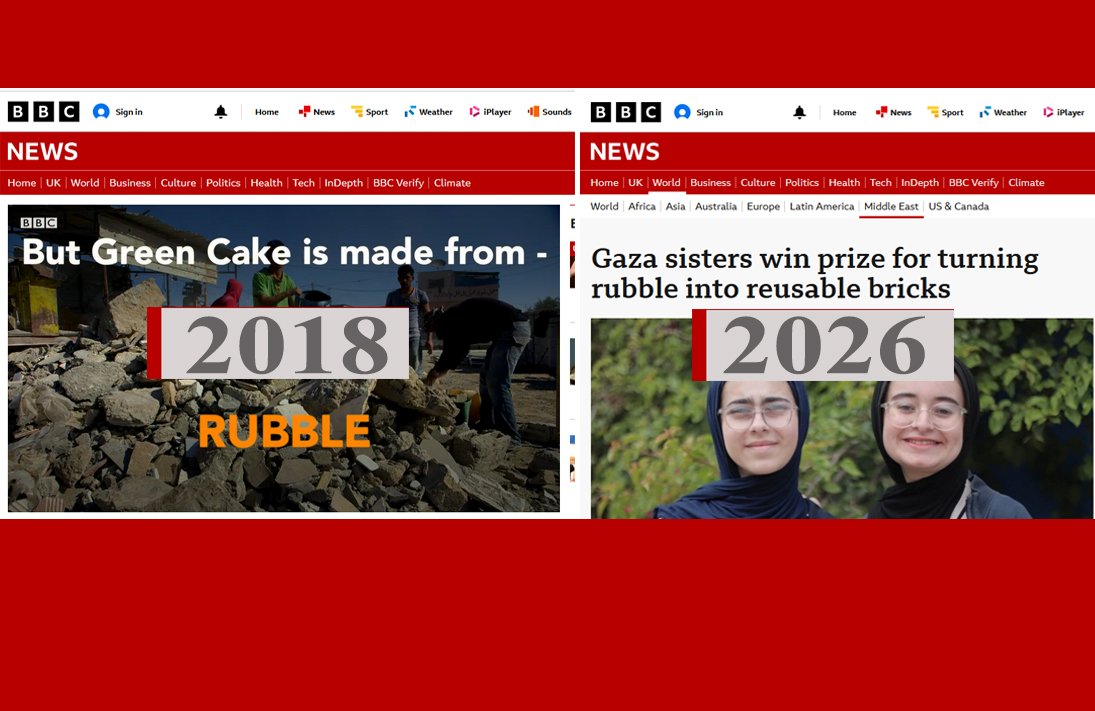
As the latest BBC Palestinian pantomime shows, Palestinian propaganda does not even need to be fresh or original to earn serious coverage in Western media outlets.
Last week, the New York Times ran a cruel, libellous and malicious article about Israeli treatment of Palestinian prisoners. Based on unverified sources tied to Hamas-linked networks, the NYT’s latest antisemitic smear descended into gutter-level accusations, to the point that Nicholas Kristof’s column even entertained surreal conspiracies about Israeli soldiers training dogs to rape Palestinian prisoners.
Kristof’s NYT screed was not produced in a vacuum. Victims of the sexual violence committed by Hamas on October 7 are struggling to be heard, and Palestinian strategy has been to silence them even further by creating a counter-narrative – to arm anti-Israel activists with ammunition to offset the horrific truth of the October 7 atrocities.
It is therefore no coincidence that the NYT column was published just one day before the release of a major report on the October 7 violence, Silenced No More.
Worst still, the underlying assumption behind Kristof’s piece is that he is speaking truth into silence on behalf of an unheard people. This inversion of reality is far from unique to Kristof. Outside the West, false Palestinian narratives dominate the global conversation, while Israeli perspectives are almost entirely absent across large parts of Asia, Africa and South America.
What Kristof is really doing is helping to marginalise the Israeli voice in one of the few spaces where it can be heard – the democratic West. He is helping to completely extinguish the voice of the true victims of this conflict’s sexual violence in the only place where they have an audience – an unforgivable and inexcusable act.
The New York Times piece is a product of the hard-edged Islamist propaganda model: footage from hospitals, the dead children and the collapsing buildings. It is immediate, emotional and confrontational. The engine room behind these narratives lies within Hamas and Islamic Jihad propaganda networks. Their purpose is simple: to demonise Israel through shock, outrage and emotional overload.
A Second Ecosystem
But there is another Gazan narrative ecosystem that receives far less scrutiny, despite arguably being more effective over time.
The Hamas-driven hard-edged propaganda model – the hospital footage, the casualty imagery, the militant rhetoric – at least triggers resistance. Where they can, journalists and researchers actively interrogate the claims, examine the sourcing and often skewer the lies being presented.
The softer NGO-media ecosystem escapes this scrutiny entirely.
Its language is the language of resilience and hope. It arrives wrapped in human interest storytelling.
Stories about innovative students, brave children or inspirational families are not subjected to the same level of forensic examination as atrocity claims or battlefield reporting. The emotional framing acts as a kind of shield.
And that is precisely what makes this ecosystem so effective.
For years, an extensive activist, NGO and media infrastructure has learned how to package Gaza for Western progressive audiences through emotionally compelling narratives that appear entirely benign on the surface, while often emerging from a far deeper ideological environment that receives little or no scrutiny.
It hides the reality of the terror groups and the violent objective of Israel’s destruction, replacing them with human narratives designed to generate emotional identification.
So readily is this material picked up by anti-Israel networks in the West, and funnelled into mainstream reporting by activist-journalists, that an entire ecosystem now exists in Gaza geared towards identifying opportunities and shaping emotionally marketable narratives for international audiences. This is the PFLP-linked propaganda ecosystem.
The infamous BBC documentary emerged from this environment. While the father of Abdullah the narrator, was a Hamas minister – it was his uncle, director of the the PFLP-affiliated NGO al-Dameer who first introduced Abdullah to international audiences in the earlier Channel 4 footage.
The Brick That Will Save The World
The recent BBC article on two sisters from Gaza supposedly transforming war rubble into compressed rubble blocks is the latest example.
The story begins with an identified opportunity: the Earth Prize, a global sustainability competition for students aged between 13 and 19.
Two Gaza-based sisters, Farah (15) and Tala (17) Mousa, entered the competition, were shortlisted in April, and were recently announced as regional winners, placing them in contention for the global public-vote final later this month.
The result is not just widespread coverage across hundreds of activist media outlets, but a wave of amplification that gives the sisters disproportionate visibility in a competition ultimately decided by public vote.
This is exactly the way the system is designed to work.
The strangest aspect of the article is that the BBC journalists themselves never seem entirely sure what the “innovation” actually is. The only concrete example provided is that the blocks were used to help hold down a tent during poor weather – a surprisingly modest application in a landscape already filled with loose rubble, broken masonry and debris. Why not pick up a local bit of debris and use that?
Questions Never Asked
It is difficult to imagine two teenage girls living as refugees in tents in many of the world’s other war zones being seamlessly connected to a niche Swiss-based sustainability competition.
Yet in Gaza, this kind of international NGO and media connectivity appears remarkably developed. Were the BBC journalists curious about how the sisters became aware of the Earth Prize, which networks helped facilitate their entry, or who helped develop the technical concept behind the project in the first place? Did anyone ask?
BBC News is not meant to function as a Palestinian propaganda outlet, so it is reasonable to assume that basic journalistic scrutiny would be applied before such stories are amplified internationally.
Yet while the article contains remarkably little detail about the actual innovation, it devotes extensive space to the surrounding Palestinian conflict narrative.
We are not told whether the sisters are science students, but we are given details about how their homes were destroyed. The chain of discovery is left unexplained, but readers are informed how many Gazans have been killed – both in total and since the October 2025 ceasefire. The BBC journalists do not describe any rigorous testing process, yet they cite UN figures stating that 90% of Gazans have been displaced. There is no explanation of any verification process, or whether specialists were involved, but there is space to place a monetary value ($70 billion) on the damage caused to Gaza during the conflict.
This is a classic propaganda structure. All of the conflict detail is there – but almost none of the substance behind the actual story.
Instead, readers are presented with a simplified narrative in which two girls, living in a tent, supposedly looked out at the surrounding destruction, imagined a solution, and hey-presto produced a prize-worthy construction material.
The 2018 Version
It is not as if this is an original angle. When the NGO-media machinery finds a story that resonates, it searches for new ways to adapt, recycle and resell the same underlying narrative. Had the BBC journalists done their research, even within their own BBC archives, they would have found multiple “Gazan brick” innovation stories recurring throughout the years of conflict.
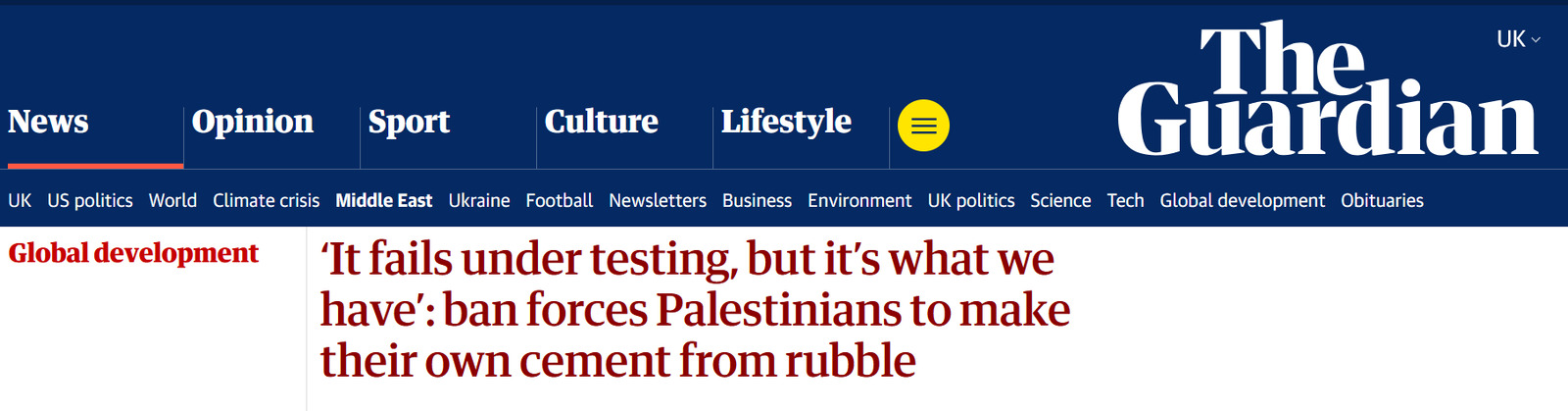
In the Guardian this week there is a story about how a different pair of innovative Palestinians are also making bricks from rubble. The distinguishing feature of this version is that the instability of the bricks is itself woven into the humanitarian narrative.
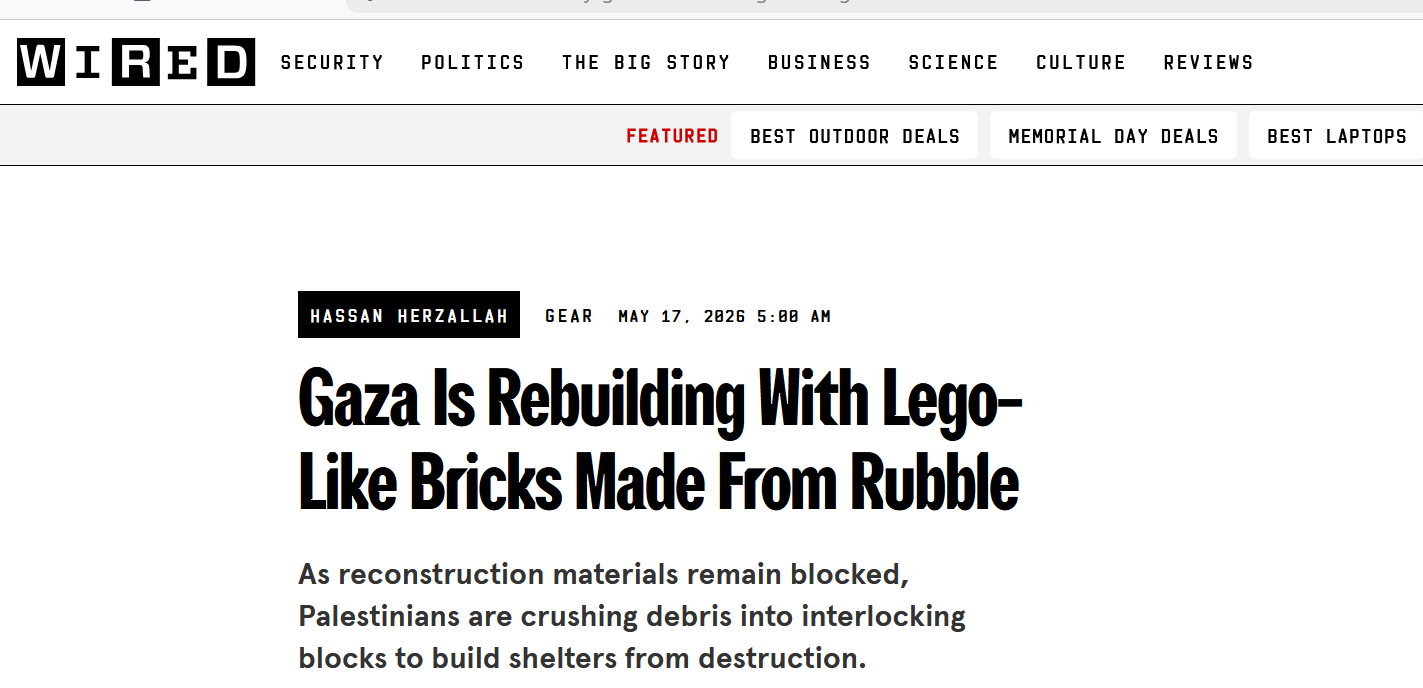
And also this week we have “Green Rock” that work like Lego bricks, with yet more Palestinian innovators also “crushing the debris” to recycle it.
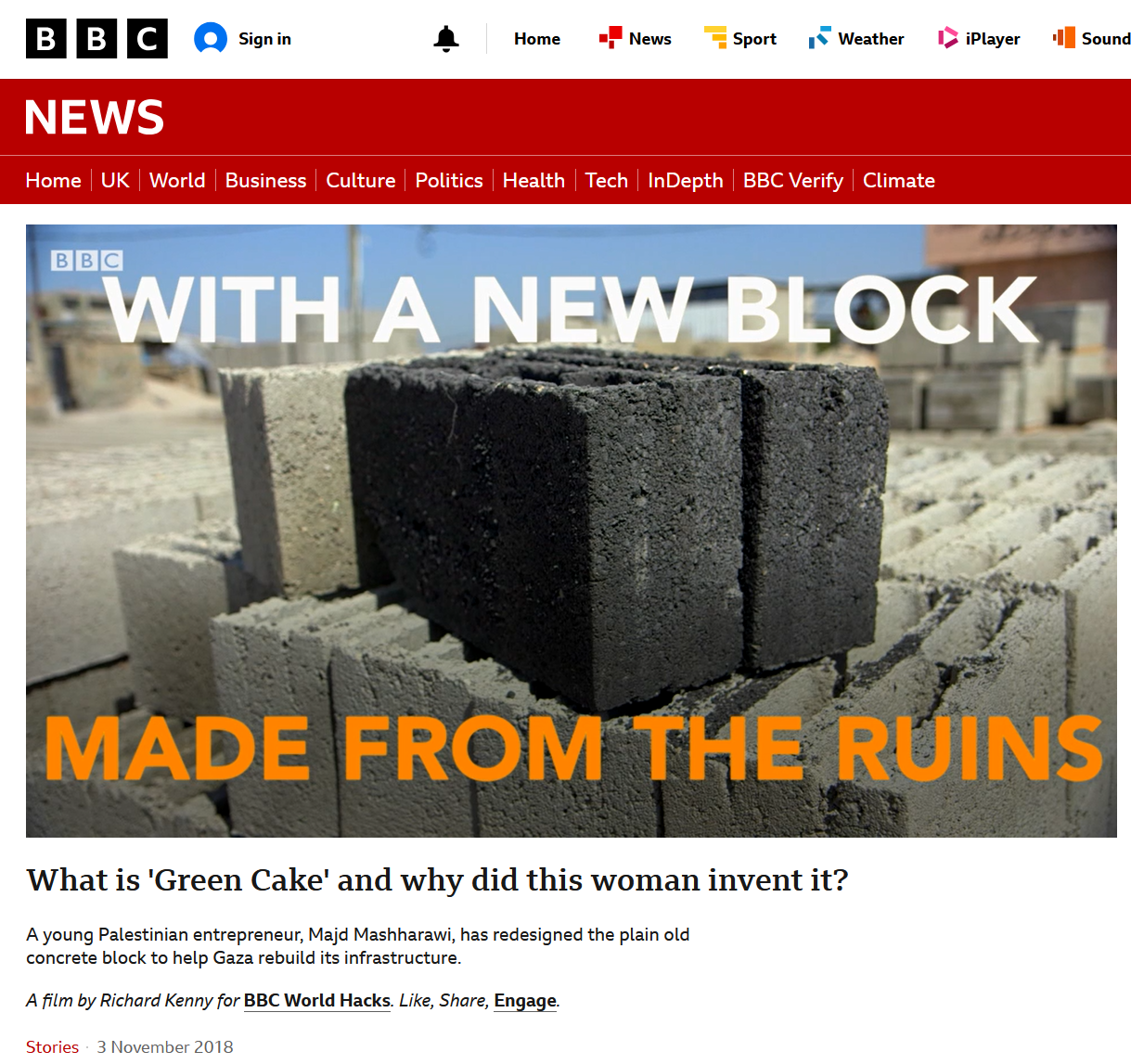
It does appear however, as if this is all reinventing the wheel, and the origins of this rehashed story are a decade old. In 2016, two young Palestinian engineers in Gaza, Rawan Abdulatif and Majd Mashharawi developed environmentally friendly bricks made of coal ash. They called them “Green Cake”.
What is notable about the initial reports, is the absence of any wider conflict narrative. They are simply stories about innovation and science. A few months later, the brick was winning Japanese innovation awards. All talk of rubble and destruction is nowhere to be seen.
As late as June 2018, the project was still being presented primarily as an eco-friendly engineering initiative. The report explicitly states that the concept emerged from brainstorming ideas aimed at tackling Gaza’s high unemployment rate.
By late 2018, the BBC was reporting on her success – but the entire narrative had evolved. The clip tells us wars with Israel have led to “widespread destruction” – which motivated her desire to “help Gaza rebuild.” To complete the picture we are also informed that in 2008 Mashharawi’s house had been “partially destroyed.” The story had been reshaped and was ready to be repackaged and resold at will.
The Girls From Nowhere
Just as it did with the children in the documentary, the BBC tried to present the sisters as random Gazans who, while living in a tent, somehow produced an award-winning eco-innovation. But things in Gaza are rarely random, and the faces elevated to Western audiences are often deeply connected to powerful clans, NGO networks and carefully cultivated media ecosystems.
This case appears no different.
The girls are both still minors, and their father Samer is a Dean at the University of Palestine, a private university in the Gaza Strip. He studied in Algeria in the early 2000s, but recently achieved his PhD in Islamic jurisprudence at the University of the Holy Qur’an and Islamic Sciences, in Sudan.
For nearly two decades Mousa has operated in the hierarchy of Gaza’s NGO propaganda network. By 2016 he even held the title of “acting Executive Director” of al-Dameer.
Al-Dameer is a Gazan-based NGO long associated with the PFLP-linked activist ecosystem.
It is also the same NGO that helped introduce the world to Abdullah, the son of the Hamas minister at the centre of the BBC documentary scandal. In a 2023 Channel 4 report, Khalil Abushammala – one of al-Dameer’s best-known figures – was incorrectly presented as Abdullah’s father. The entire affair was riddled with omissions, misdirection and political concealment.
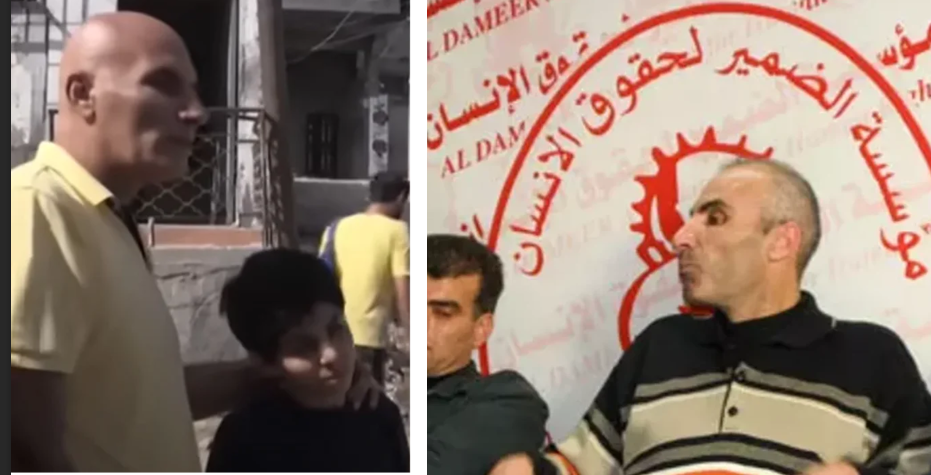
The connections between the two al-Dameer figures are direct. In 2009, Samer Mousa signed a cooperation agreement with the Islamic University of Gaza on behalf of Khalil Abu Shammala, then Executive Director of al-Dameer for Human Rights.
The PFLP-affiliated Democratic Gathering of Lawyers and Jurists even tagged Mousa in a 2013 Facebook post.
Samer Mousa is no random Gazan. And once again the BBC finds itself serving as a vehicle for a Palestinian pantomime, presenting the children of prominent political actors in Gaza as anonymous civilian protagonists crafted to elicit sympathy from Western audiences.
And then there are Mousa’s own explicit calls for terrorist violence.
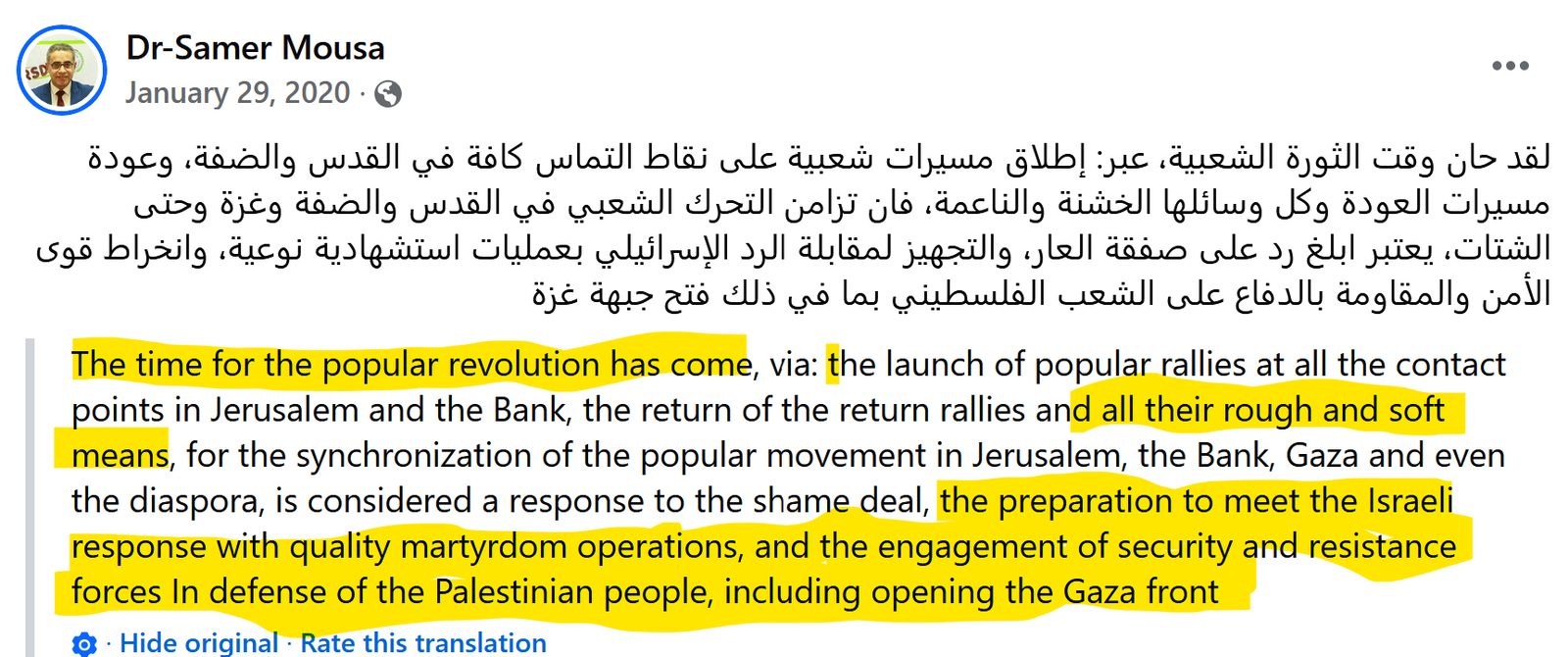
In January 2020, in response to Donald Trump’s peace initiative, the sisters’ father publicly called for “quality martyrdom operations.” This was not retrospective praise for an attack that had already occurred. It was an open call for political violence.
Are children of supporters of Al-Qaeda, ISIS or Al-Shabab routinely elevated by European NGOs and international media as inspirational symbols of hope and resilience? Or is this political whitewashing only reserved for carefully packaged Palestinian narratives emerging from the NGO ecosystem?
Before the BBC chose to elevate it to an international audience, the narrative had circulated largely through prize infrastructure and Palestinian activist networks.
If the BBC genuinely wishes to restore confidence in its coverage, it should examine not only factual accuracy but the sourcing and amplification pathways through which these narratives reach its audiences. Something is clearly very wrong in the current system.
But this ball is already rolling. The girls won the regional round and the public vote is now open. Gaza’s propaganda apparatus has sprung efficiently into action – and the British state broadcaster has amplified their call. By this stage, the ending already feels almost inevitable.
Help Me Fight Back Against Antisemitism and Misinformation
For over a decade – and for many years before that behind the scenes – I’ve been researching, documenting, and exposing antisemitism, historical revisionism, and the distortion of truth. My work is hard-hitting, fact-based, and unapologetically independent.
I don’t answer to any organisation or political backer. This website – and everything I produce – is entirely community funded. That independence is what allows me to speak freely and without compromise.
If you value this work and want to help me continue, please consider making a donation. Your support genuinely makes this possible.
You can donate via PayPal using the button below:
Alternatively, you can donate via my PayPal.me account or support my work through my Patreon page.
Independent work survives only because people choose to support it. Thank you for standing with me.




Well done, again, David. Hope this backfires on the BBC like the last documentary.
[Note: All dates listed below are formatted as Month-Day-Year (e.g., M.D.YY)].
Most “Palestinians” are grandchildren of Arab immigrants (Hamas’ F. Hammad: “Half of the Palestinians are Egyptians and the other half are Saudis”. 3.23.12). 1948: much of Israel’s territory came from former Ottoman, British Mandate public lands (JVL: ‘Israel Society & Culture: Israel Lands – Privatization or National Ownership?’), split between Jews & Arabs, w/ some Arab property abandoned during the war. 1948: ex-Mufti ‘ordered the Arabs of Palestine to abandon their homes so as not to encumber the armies of Egypt, Jordan, Iraq, Syria and Lebanon coming to attack’ the Jews (JPost, 12.20.20); ‘1948 Exodus Uncovered: Arab Media Reveals Leaders Advised Departure’ (JVL, 5.16.24). Arab rejection of a Jewish state was always about Arab racism. This was explained by Nazi helper Jamal Husseini (1941 Iraq coup) in 1947, when he said it would interrupt “Arab race homogeneity” (SAPIR, 4.25.23). The same Islamist-Arab racism pushed almost a million Jews out of Arab lands (T.o.I., 11.30.25).
Most ‘Palestinian’ Arabs cheered Hitler:
“Hitler whom the Arabs admire very much” — Emil Ghuri on 7 Jul, 1934, Arab Federation (Palestine Post, 7.16.34); 1934: calls to boycott Jews, with swastikas (Detroit Jewish Chronicle, 3.23.34); Arab Nazi club founded in 1934 (JTA, 6.3.34); “Red Moon” Arab-Nazi club in Haifa (JTA, 7.1.35); 1936-8: “Nazi flags and pictures of Hitler were prominently displayed in store windows. Booklets explaining Nazi methods of forcing Jews from the Reich were distributed freely… The shout of ‘Heil Hitler’ became a catchword which rang insolently over all Palestine.” (Ziff, 1938:417,430); swastikas expressed “Arab feelings” (Lossin, 1983:221); German Consul in 1937: “Arabs admire Fuhrer” (Ynet, 5.6.06); 1937, “All Arabs Celebrate” Muhammad’s “Birthday.. in Fete Unprecedented in Palestine–Hitler and Duce Cheered” (NYT, 5.23.37); J. Gunther in 1939: “The greatest contemporary Arab hero is — Adolf Hitler” (Inside Asia, 6.29.39); March 16, 1940 – “Palestine’s Arabs admire Hitler for his Jew-baiting” (Pathfinder Magazine, vol. 47. Town Journal, 1940:40] author B. Ziff in 1942: “Throughout the Arab world an unappeasable pro-Hitler rage has existed for years” (S. Joseph Gazette, 9.22.42); Aug-42 report by OSS: “majority of the Arabs in Palestine are fiercely ‘anti-Jewish’… the radicals, who form a majority, see in the approach of Rommel an ideal opportunity to murder all Jews and seize their property” (Herf, 2009:139); Feb/1941 Sari Sakakini poll: 88% pro-Axis (Morris, 2008:21); A. Shuqayri [Shukeiri] wrote in a 1969 book, “our sympathies were with the Axis being led by Hitler”; De Gaulle: “Those Jewish youngsters were wonderful. They fought on our side, while the Arabs… supported the other side” (Cohen, Samy. 1974:30); PLO’s Kaddoumi (RT 12/7/13 interview) said that they supported the Nazis because both were against Zionism; Jaffa Arab activist Muhammad Abu Sarari reacalls: “Most of the Arabs .. were in favor of Nazi Germany” (in his biography in Heb., 2000:19); Arab Palestinian leader said before Six-Day war: “We Arabs supported Hitler to get the British out of Palestine and to keep the Jews from taking it over” (Saturday Review, 1970:32); [referring to Mandatory Palestine] Canadian Institute of International Affairs: “in the darkest moments of 1940-41, a majority of the Arabs.. have supported Hitler on account of his anti-Jewish policy..” (1948, vols. 8-10, pp.15-16).
1946: Jamal Husseini and A. Shukeiri justify the Holocaust: “I met Achmed Shukeiri, chief of the Arab office, who restituted in his conversation the words of Goebbels, justified the murder of six million Jews of Europe because Hitler could not have been all wrong… I met Jamal el-Husseini; he issued the same warning as Shukeiri… and reiterated his justification of the mass murder of six million Jews…” (B’nai B’rith, 6.12.46); 1947–48: Arabs recruit ex-Nazis to fight Palestinian Jews (JTA, 2.22.48, 4.23.48; JCFA, 3.31.16).
Arab admission on general Arab population: 1956: “One should not forget that, in contrast to Europe, Hitler occupied an honoured place in the Arab world. His name awakened in Arab hearts feelings of love and enthusiasm.” ‘Al Manar’, 8.17.56); Pan-Arab leader, creator of PLO, G. A. Nasser on 5.1.64 to neo-Nazi magazine’s editor Frey: “Our sympathies were with the Germans” [adding a ridicule on the Holocaust] (Wiener Library Bulletin, 1978:4; U.S. Congressional Record, 7.8.65); 6.26.74, Syria’s H. Assad says, that the Arabs “remembered Hitler in a positive way”, K. Jumblatt agreed: “At least he saved us from the Zionists… National Socialism should be revered a bit.” [K. Jumblatt = son-in-law of pro-Nazi Shakib Arslan] (Lewis, 1999:162); on 10.9.19, Z. Hamzeh, Jordanian ex-minister said: Arabs supported Hitler because he hated Jews (JPost, 11.12.19);
[Most of the 9,000 Arabs joining the Allies — paid by Jews (Besa Center, 12.9.19) — deserted (Ynet, 5.15.22). Citing their newspapers during the war years means nothing, as they were censored under the British (Kabaha, Caspi 2011:58–59), but up to WWII and immediately after, major newspapers such as Falastin, a-Difaa, and Al Jamia al Islamia, except for the smaller Mirat al-Shark, all praised Hitler and the Nazis (Davar, 5.24.33; Erlich, 2002:80-81), including glorifying hanged Nazis, elevating Nazism ideology (Palestine Post 10.31.45, 10.18.46). Racist G. Achcar, who is promoted on Wikipedia as a supposed “source,” expressed in 2009 wishing Israel would lose to genocidal Hamas, and on Oct. 8, 2023, dared to compare the genocidal-attempt “Palestinian” Oct. 7 attacks to the Warsaw Uprising. (Johnson, Fathom, June/2024)]
Nov. 1945: as the Arab world became aware of the Mufti’s Nazi record, Arab leadership’s and the masses’ enthusiasm only grew: “Haj Amin’s popularity among the Palestinian Arabs and within the Arab states actually increased more than ever during his period with the Nazis. When he returned to the Middle East from Europe, Arab leaders hurried to greet him, and the masses welcomed him enthusiastically.” (Elpeleg, 2012:180); “Husseini’s wartime actions contributed to his appeal in the postwar years” (Herf, 2009:241); “the waves of enthusiasm that shook the Arab world on his arrival in Egypt” (Gensicke, 2011:182); “pro-Nazi past was a source of pride, not shame” (Lewis, 1999:160); Edward Said: “the Arab Higher Committee; it functioned … particularly since 1946… This committee, chaired by Palestine’s national leader, Hajj Amin al-Hussaini, represented the Palestinian Arab national consensus, had the backing of the Palestinian political parties that functioned in Palestine, and recognized in some form by Arab governments as the voice of the Palestinian people, until the P.L.O….” (in his book ‘A profile…’ 1983:7).