
On Monday 2 March, I attended a keynote address by Kemi Badenoch, the current leader of the Conservative opposition. The speech took place at the Westminster offices of Policy Exchange, one of the UK’s most influential policy institutes.
During her talk, Badenoch set out what she described as a new Conservative approach to integration and national identity. She argued that Britain’s multicultural model has failed, warning of the emergence of “parallel societies” and proposing legal, educational and cultural reforms aimed at rebuilding a shared national identity.
She also criticised the government of Keir Starmer for what she described as a weak response to the crisis involving Iran, suggesting that party politics were influencing Labour’s stance.
The speech itself was interesting. But what really caught my attention was the Q&A session that followed.
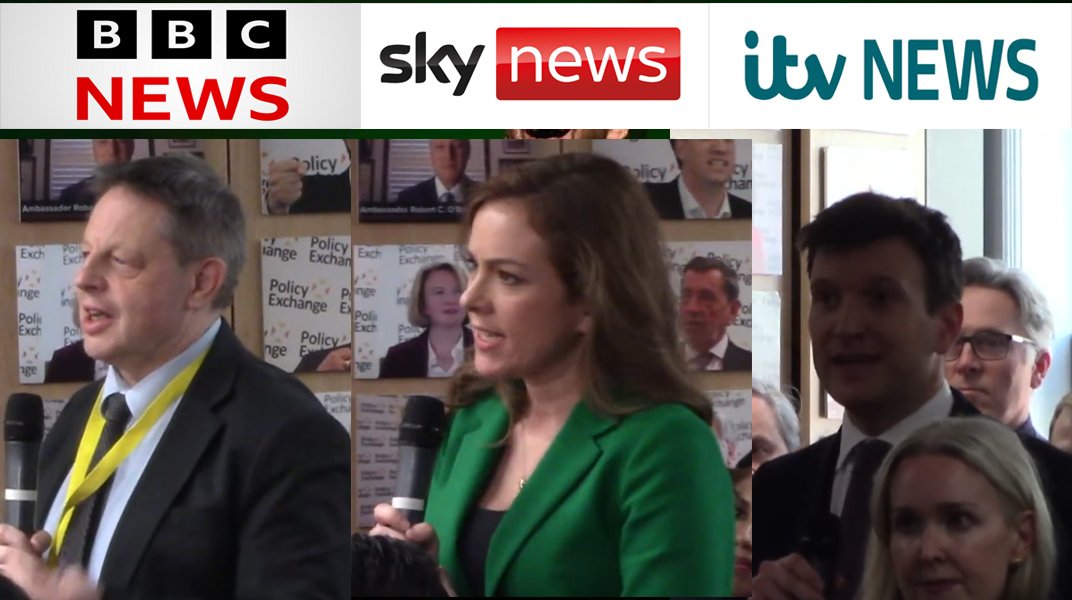
There were just four questions. The first three were asked by journalists from three of Britain’s largest broadcast news organisations: BBC News, Sky News and ITV News.
Despite coming from different outlets, the questions shared a strikingly similar framing.
The first question was from Iain Watson of the BBC. Although he briefly referenced asylum seekers later in his question, he began with Iran:
“Obviously there’s a lot in the speech but let me go back to the beginning of it when you were talking about Iran. More generally, is it your position that you would back political assassinations in order to bring about regime change even if you were told this was against international law?”
The second question came from Amanda Akass of Sky News. She also focused on Iran, asking if the Conservatives had “completely given up the principle of international law”:
When the US and Israel launched their attacks on Iran, they hadn’t made an effort to seek UN Security Council approval and the negotiation process was ongoing. In your speech, you talked about international law being a fig leaf, but also praised the UK as somewhere where law was equally applied. Has the Conservative Party completely given up on the principle of international law and the international rules-based order?
The third question was from Harry Horton of ITV News. His was even more aggressive, asking whether Badenoch had failed to “learn the lessons of Iraq”:
“Yesterday, the Prime Minister said that he’d learnt the lessons of the war in Iraq. What would you say to people who hear what you say and your support for the US and say that you haven’t learnt the lessons of Iraq and believe that you’re too keen to get involved and support a US war that some say has no clear end goal or clear objective?”
Three different outlets. Three different journalists.
Yet the framing was remarkably consistent.
Not one of the opening questions addressed the central theme of Badenoch’s speech: Britain’s integration model, the limits of multiculturalism, or the emergence of parallel societies. Instead, the discussion was immediately redirected toward Iran and international law.
More to the point, the questions could almost have been written by the same person.
That convergence says something about the intellectual framework now dominating parts of the Western media and political class.
All three questions leaned on the same concepts: international law and the so-called “rules-based international order.” They did not engage with Badenoch’s argument. They were clearly pre-prepared. There was almost no daylight between them.
This is groupthink.
The flawed assumption behind these questions is that international law provides a clear and universally applicable framework governing the behaviour of states.
In reality, this narrative has little to do with geopolitical reality. International law was never designed to function as a universal moral code.
Modern international law largely emerged from the trauma of two catastrophic world wars fought primarily among Western states during the first half of the twentieth century. Institutions such as the United Nations and legal frameworks like the UN Charter were created to regulate relations between sovereign states and reduce the risk of another great-power war.
The system assumed that states behaved as rational actors, recognised each other’s sovereignty, and shared an interest in avoiding catastrophic conflict.
Those assumptions do not always hold.
For decades, two nuclear-armed superpowers faced off against each other. Yet the world largely believed those weapons would never actually be used. The doctrine of M.A.D. – mutually assured destruction – assumed that neither side would fire first.
In such a world, international norms are not only understandable; they are necessary.
But when the same legalistic framework is applied to regimes such as the Islamic Republic of Iran – a revolutionary Islamic theocracy whose leadership openly embraces confrontation with the West – the entire paradigm begins to break down.
How does M.A.D. function when one side views death through the lens of religious fulfilment?
Appeasing such a regime, trusting it, or negotiating on the assumption of shared rational interests can become a dangerous strategy.
Decades of passive engagement allowed Iran’s ballistic missile programme to develop largely unhindered.
So when three journalists stand up and parrot nearly identical questions about international law at a press conference, the discussion shifts away from serious analysis and toward something else entirely.
International law becomes a buzzword – a rhetorical framework that restrains those who operate within the system, while having little impact on those who do not.
Seen in that light, the Q&A session was revealing. A speech about domestic integration policy quickly became an interrogation about whether confronting Iran might violate international law.
Is this what our media has been reduced to?
A collection of cloned actors, offering no original thought, aggressively challenging anything that does not fit the narrow assumptions they have been trained to defend.
We deserve much better from our nation’s top journalists.
As Badenoch put it during her response:
“If international law is helping the ayatollahs brutalise their regime and stopping us from doing anything, then perhaps it needs to be looked at again. What we are talking about in the Conservative Party today is common sense. Not ‘it’s written on a piece of paper so we must follow it’ even if it’s clearly stupid.”
She ended by noting that many people struggle to see the difference.
Including, it seems, much of the British media itself.
Help Me Fight Back Against Antisemitism and Disinformation
For over a decade – and for many years before that behind the scenes – I’ve been researching, documenting, and exposing antisemitism, historical revisionism, and the distortion of truth. My work is hard-hitting, fact-based, and unapologetically independent.
I don’t answer to any organisation or political backer. This website – and everything I produce – is entirely community funded. That independence is what allows me to speak freely and without compromise.
If you value this work and want to help me continue, please consider making a donation. Your support genuinely makes this possible.
You can donate via PayPal using the button below:
Alternatively, you can donate via my PayPal.me account or support my work through my Patreon page.
Independent work survives only because people choose to support it. Thank you for standing with me.




Brilliant write-up David!
I smell collusion between the TV journalists. Fleet Street journos, particularly in the regions, share information covering stories to produce similar outcomes because they don’t want to be reprimanded if a rival gets a scoop.
Islamism Dirty Hypocrisy: “Palestine” Genocidal Regime—Raping Male Hostages, Forcing Israeli Teens into Sexual Acts, and Iran’s Supreme Gay Leader While Both Regimes Execute Gays.
Reports emerging from former hostages held in Gaza have revealed deeply disturbing accusations of sexual abuse, torture, and psychological terror carried out by Hamas captors including sexual abuse on males. At the same time, reports about I
Islamic Fascist Republic of Iran’s new supreme leader have reignited glaring hypocrisy within Islamist regimes that harshly punish homosexuality while tolerating it among their own elites.
According to testimonies presented in report to the United Nations, Israeli hostages—including teenagers—were subjected to severe physical abuse and degrading treatment. The report describes beatings, starvation, burns, and systematic humiliation during captivity. Some teens were reportedly forced to perform sexual acts on each other under coercion. Other hostages described witnessing the murder of fellow captives while living in constant fear and deprivation.
Individual testimonies have also surfaced in media interviews. One former hostage said he was sexually assaulted by a captor while imprisoned in Hamas tunnels beneath Gaza and threatened with death if he spoke about it. Another hostage described sexual assault and repeated physical violence during captivity. These accounts contribute to a growing body of allegations that sexual violence and torture were used as tools of control and intimidation.
While such abuses are unfolding under the authority of Hamas, criticism has also turned toward Iran, the movement’s key state backer. Reports published in March 2026 claim that U.S. intelligence briefings suggested Iran’s new Supreme Leader, Mojtaba Khamenei, may be gay and may have maintained a long-term relationship with a former tutor. The report, citing sources familiar with the briefing, said the information was presented to U.S. officials as background intelligence.
The claim has fueled accusations of hypocrisy from critics of the Iranian regime. Iran enforces some of the harshest anti-homosexuality laws in the world, with gay men historically facing execution by hanging under the Islamic Republic’s legal system. Commentators noted that while ordinary Iranians accused of homosexuality have faced brutal punishment, elites inside the regime appear shielded from similar consequences.
Critics point out that the contrast reflects a broader pattern among authoritarian Islamist movements: strict moral codes imposed on society while leaders operate under a different set of rules.
Together, the allegations of abuse in Hamas captivity and the controversy surrounding Iran’s leadership have intensified scrutiny of governments and militant movements that claim religious authority while facing accusations of brutality and double standards.
—
Notes / Sources
* Ron Crissy, “Teens made to commit sexual acts on each other; horrors of Hamas captivity in report to UN,” Ynet, Dec 29, 2024. [https://www.ynetnews.com/article/h1cbi8asje](https://www.ynetnews.com/article/h1cbi8asje)
* “A Hamas Hostage’s Secret Ordeal,” The New York Times, Feb 4, 2026. [https://www.nytimes.com/2026/02/03/world/middleeast/hamas-hostage-abuse.html](https://www.nytimes.com/2026/02/03/world/middleeast/hamas-hostage-abuse.html)
* “Former Israeli hostage says he was sexually assaulted in captivity,” CNN, Nov 5, 2025. [https://www.cnn.com/2025/11/05/world/video/former-israeli-hostage-sexually-assaulted-in-captivity-digvid](https://www.cnn.com/2025/11/05/world/video/former-israeli-hostage-sexually-assaulted-in-captivity-digvid)
* Steven Nelson, “Trump briefed that Iran’s new Supreme Leader Mojtaba Khamenei is probably gay — and president has priceless reaction,” New York Post, Mar 16, 2026. [https://nypost.com/2026/03/16/us-news/trump-briefed-that-irans-new-supreme-leader-mojtaba-khamenei-is-probably-gay/](https://nypost.com/2026/03/16/us-news/trump-briefed-that-irans-new-supreme-leader-mojtaba-khamenei-is-probably-gay/)
* i24NEWS English Facebook post referencing the report. [https://www.facebook.com/i24NEWSEN/posts/president-donald-trump-reportedly-laughed-aloud-when-briefed-that-irans-new-supr/1333489972157640/](https://www.facebook.com/i24NEWSEN/posts/president-donald-trump-reportedly-laughed-aloud-when-briefed-that-irans-new-supr/1333489972157640/)
* Hussain Abdul-Hussain commentary on X. [https://x.com/hahussain/status/2033560589704761415](https://x.com/hahussain/status/2033560589704761415)
No BBC: Islamist Terror Hezbollah’s attacks on Israel were not and are not “Retaliatory.”
BBC reporting [https://archive.org/details/BBCNEWS_20260315_030000_BBC_News/start/180/end/240] on March 15–16, 2026 (e.g., live coverage describing monitoring for “retaliatory strikes” in Israel and similar phrasing by anchors like Caitriona Perry referring to Hezbollah “retaliated”) has characterized Hezbollah’s missile and rocket launches into Israel as “retaliatory.” This framing is misleading and inverts the sequence of escalation in the current conflict.
– Hezbollah, an Islamic fascist Republic of Iran-established and Iran-backed Shia Islamist group designated as a terrorist organization by the U.S., UK, and others, initiated attacks on Israeli territory on March 2, 2026—firing projectiles targeting northern Israel (including near Haifa) for the first time since the 2024 ceasefire.
– Israel’s subsequent airstrikes, ground operations (announced as “limited” on March 15, 2026, after extended evancuation calls to prevent hurting civilians), and incursions into southern Lebanon were responses to these Hezbollah launches, aimed at degrading Hezbollah infrastructure and preventing further attacks on Israeli civilians and border communities.
– This mirrors Hezbollah’s pattern: On October 8, 2023, it began firing on Israel one day after Hamas’s October 7 massacres, framing it as “support” rather than initiation.
Background on Hezbollah’s Origins.
Hezbollah was founded in 1981 [https://hezbollah.org/about-hezbollah] by Iran’s Islamic regime under Ayatollah Ruhollah Khomeini, who appointed Ayatollah Ali Akbar Montazeri to oversee its establishment in Damascus, Syria—before Israel’s 1982 invasion of Lebanon. It operates as a proxy enforcing Iran’s “Wilayat al-Faqih” ideology, not as an organic Lebanese resistance group responding to Israeli actions.
(A year after Hezbollah’s founding, Israel, responding after terror attacks, began taking action in Lebanon against terror infrastructure by “Palestine,” terrorists.
“Operation Peace for Galilee” was immediately prompted by the June 3, 1982, attempted assassination of Shlomo Argov, Israel’s ambassador to the United Kingdom, in London. The shooting, carried out by the Abu Nidal Organization.
And Arafat has already begun the infamous practice of using its own civilians in ways that led to their deaths—methods that are still employed by all “Palestinian” factions and Hezbollah).
This pattern of Hezbollah initiating or escalating attacks—often in solidarity with Iranian or allied interests—undermines narratives portraying its actions as purely defensive or “retaliatory” to Israeli aggression. Media should prioritize chronological accuracy over loaded terms that imply moral equivalence or victimhood reversal.
Selective Silence, Selective Outrage: How BBC America’s War Coverage Distorts Reality
During Operation Epic Fury (U.S.) / Roaring Lion (Israel), BBC America—anchored by Caitriona Perry—has systematically avoided showing any meaningful images of damage, injuries, or deaths inside Israel from Iranian missile and rocket barrages.
Instead, it has aired daily, graphic footage from Lebanon of the aftermath of Israeli strikes, even though Hezbollah’s attacks on Israeli civilians escalated from early March onward.
Only today (3.19.26), for literally a split second, did the network flash any Israeli impact at all: amid weeks of massive Iranian barrages raining down on residential areas across the country—including the killing of four Arab Palestinian women yesterday by falling debris—the coverage briefly showed shrapnel striking a refinery in Haifa. BBC immediately framed it as “just” a “retaliation” for Israel hitting Iranian gas facilities, stripping out the context of the relentless, unprovoked Iranian assault on Israeli civilians.
This selective omission and loaded framing isn’t journalism—it’s editorialising.