
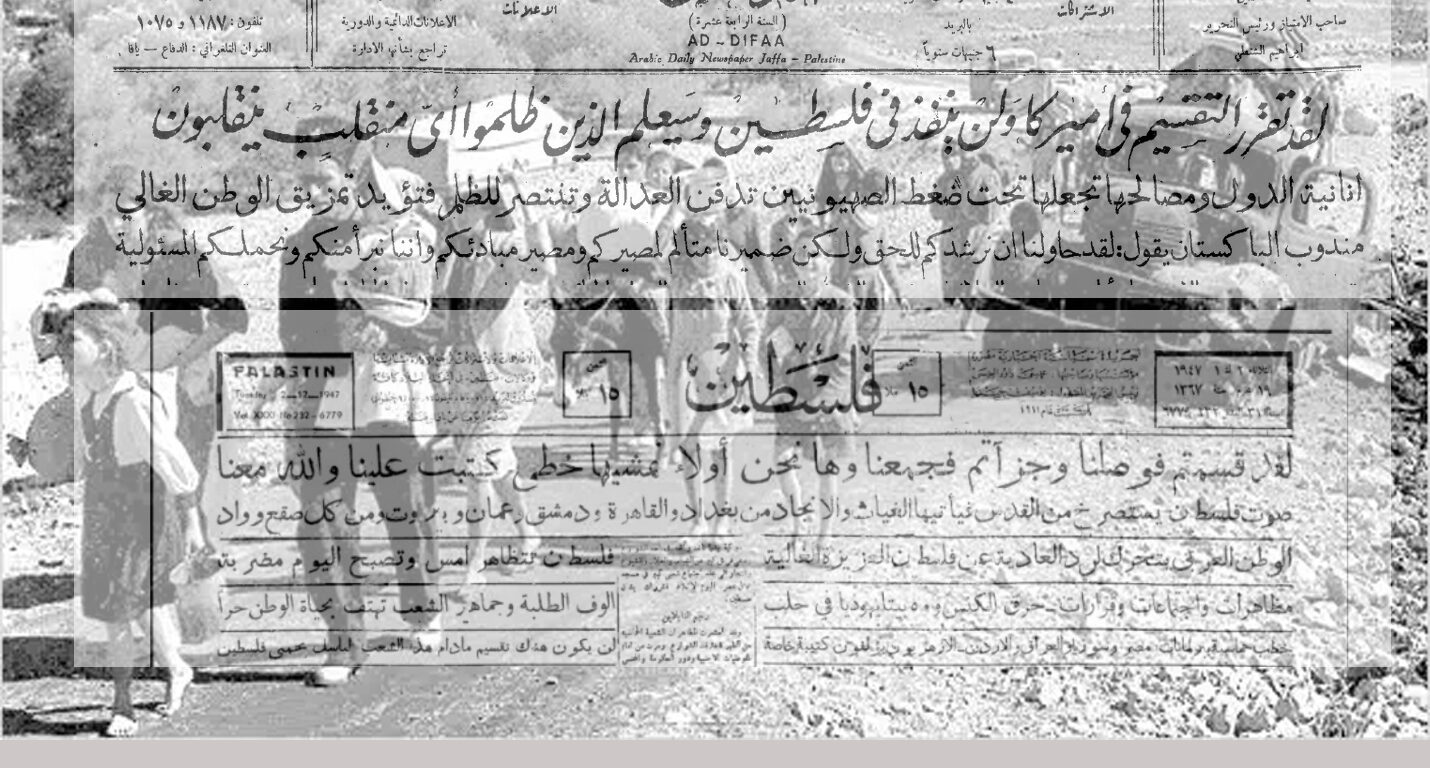
In anti-Israel circles, the dominant narrative of the Palestinian ‘Nakba’ rests on a single, almost unchallenged assumption: That a passive and defenceless Arab population was suddenly overwhelmed by violent Jewish militias determined to expel them and seize their land. From this foundational myth flow all the modern accusations of ethnic cleansing and genocide, repeated by governments, activists, and even the UN. This is the central pillar upon which the entire pro-Palestinian movement is built
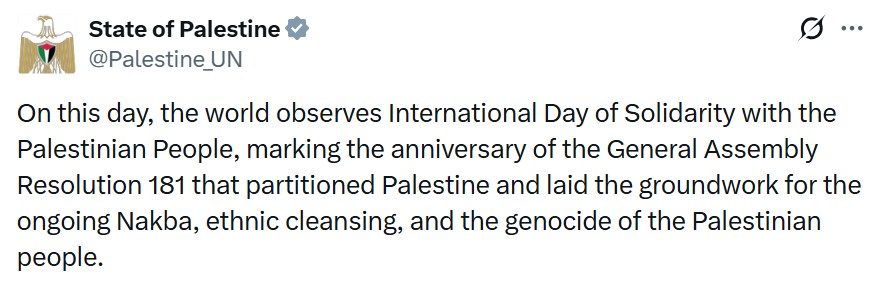
Take this recent post from the UN Palestine account which ties all the different strands together:
But that story collapses the moment you look at what actually happened. Not decades later, not in later stages of the war, but in the very first seven days after the UN partition vote.
Using mostly Arab newspapers of the time, the record is unmistakable: within hours of the UN decision, Arab political factions, militias, and regional actors launched a campaign of violence and mobilisation aimed at preventing the creation of a Jewish state. The civil war that followed – and the refugee crisis it produced – emerged from this aggressive, openly-declared Arab rejectionism, not from a premeditated Jewish plan.
What follows is a look through that history, reconstructed day by day from contemporary Arab and Jewish press.
Day one – November 30 1947
Arab media reacts to partition with mobilisation and incitement.
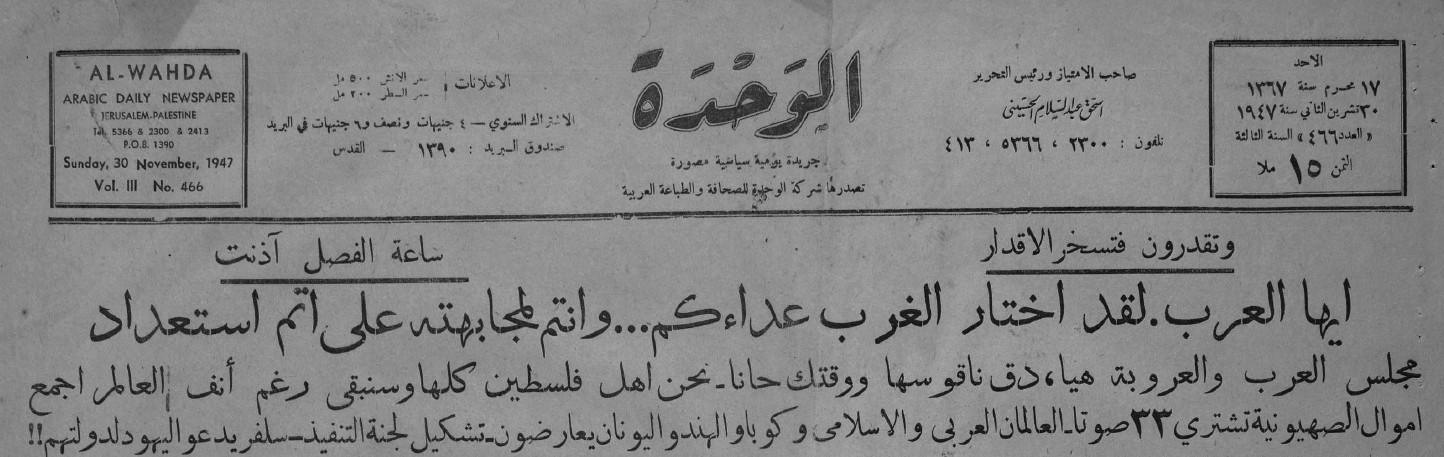
The morning after the UN vote, neither Ad-Difa nor Al-Wahda reported the partition as a political event. Instead, both papers erupted with outrage and calls for Arab mobilisation across the region. The pages were saturated with threats, anti-Jewish invective, and demands for an ‘Islamic Front’ to rise.
Ad-Difa’s lead built explicitly toward violent resistance. Al-Wahda’s headline declared: “O Arabs, the West has chosen your enemies. Will you remain stunned, or will you prepare?”
There is no ambiguity here. Arab media was calling on the Arab people inside the Mandate area and across the region to mobilise.
Day two – 1 December 1947
Violence erupts across the country. The Palestine Post reported seven Jews murdered in multiple attacks on 30 November.
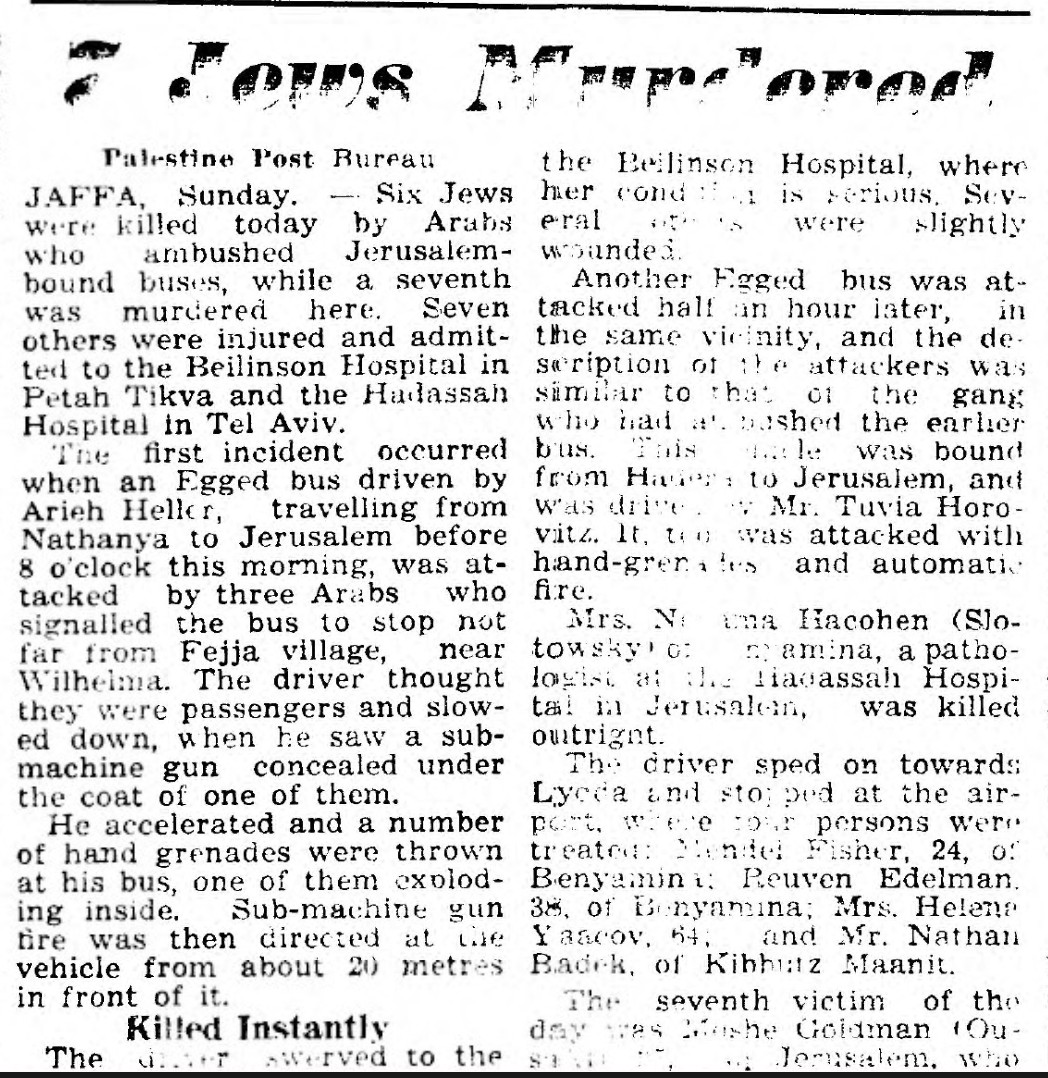
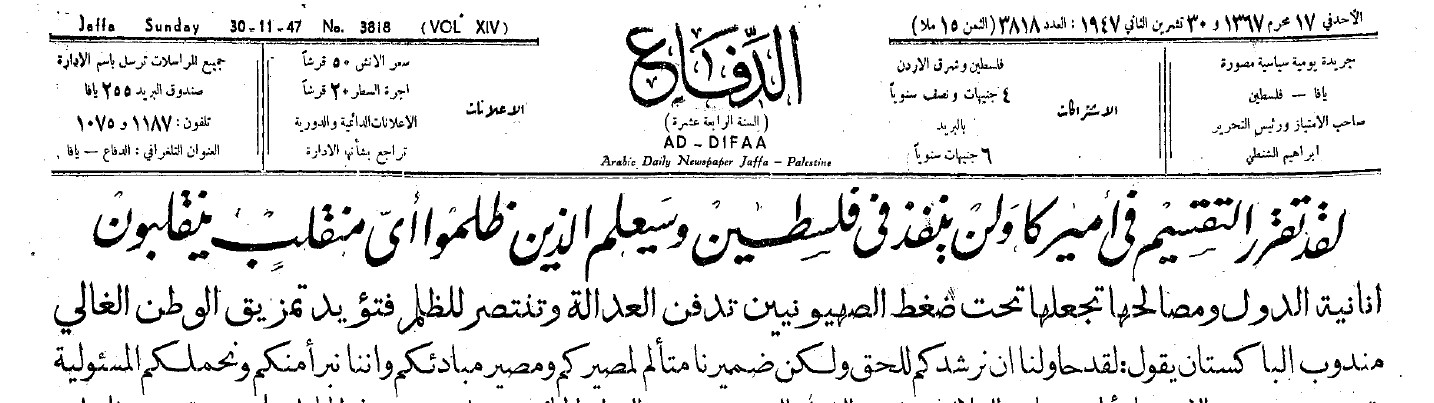
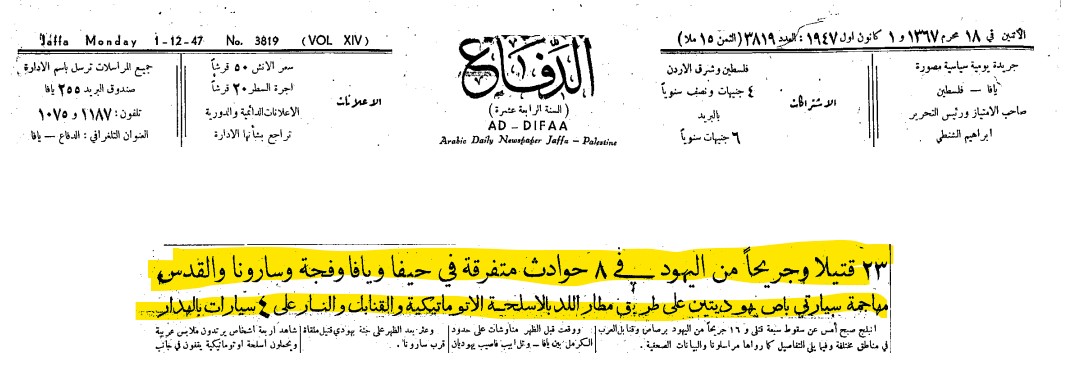
Arab newspapers themselves documented the killings. Look at Ad-Difa’s own front page on the same date. Ad-Difa was a staunchly Pan-Arab media outlet that was aligned with the Husayni, ‘Holy War’ factions in the mandate area. It eventually promoted open support for the Nazis. At the time, the paper was run by Ibrahim al-Shanti.
Its headline read: “23 Jews killed and wounded in 8 separate incidents in Haifa, Jaffa, Beit Ve-Gan, Sarona, and Jerusalem.”
The article described bus ambushes around Jerusalem, attacks in Lod, Tulkarm, Haifa and Jaffa, and other assaults on Jewish civilians.
The war had begun – and it had begun with Arab-initiated violence.
Day Three – 2 December 1947
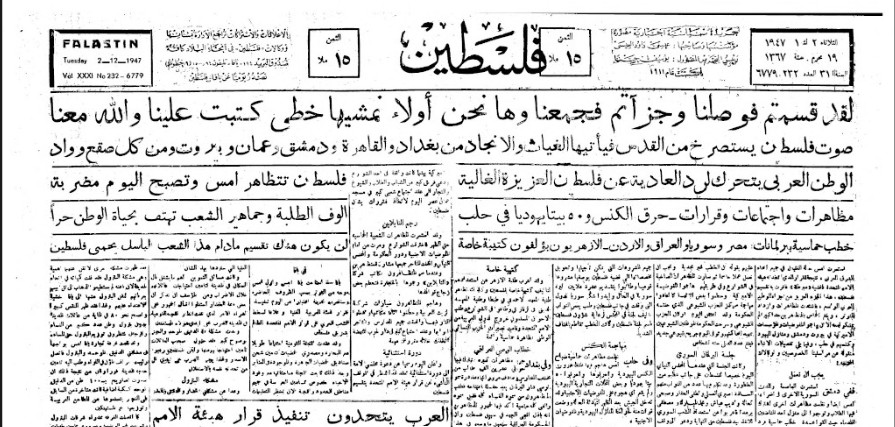
The front page of the Falastin newspaper is entirely about Arab/Islamic mobilisation, outrage, anti-Jewish actions in the region, and calls to resist partition. The newspaper triumphantly boasted about anti-Jewish pogroms not only in the Mandate area but throughout the Middle East:
- synagogues and homes burned in Aleppo,
- attacks in Baghdad and Cairo,
- shootings in Jerusalem, Haifa, and Jaffa,
- bombs thrown at Jewish cars.
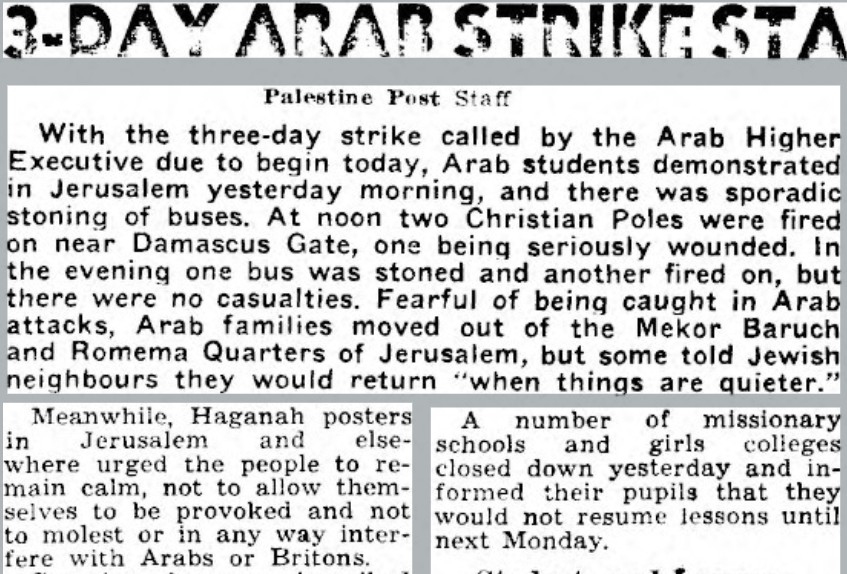
On the same day, the Palestine Post described the beginning of the Arab strike and repeated Jewish calls for restraint. It also reported that Arab families were leaving mixed neighbourhoods to avoid the violence their own side was generating – a detail that matters deeply for later refugee debates.
Day Four – 3 December 1947
Arab newspapers continue to chronicle attacks – and celebrate them. Ad-Difa’s front page led with ongoing Arab violence and noted that 49 Jews had now been killed – a cumulative total reported without any suggestion of regret.

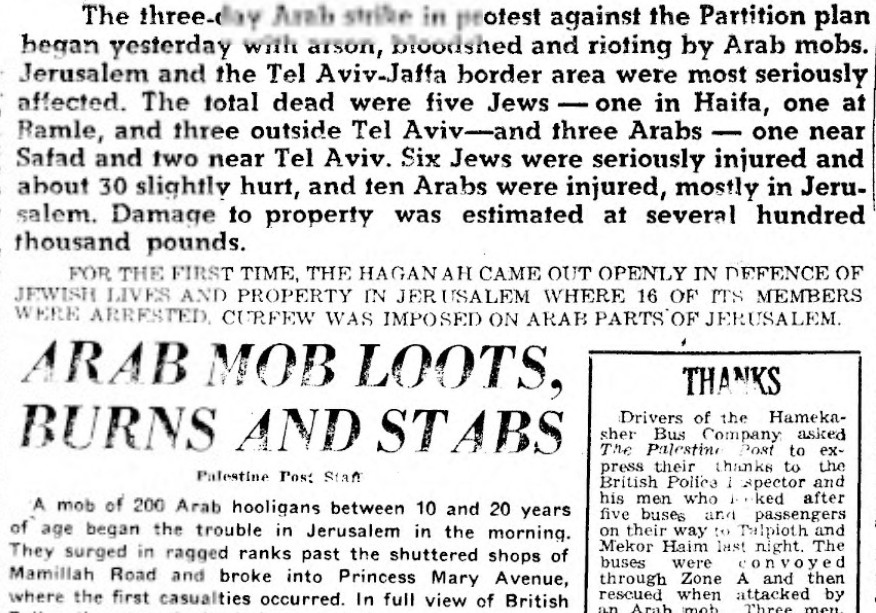
This from the front page of the Palestine Post – detailing multiple attacks against Jews as Arab mobs set about attacking them in cities throughout the mandate area:
Day Five – 4 December 1947
Jewish civilians still remain the primary targets.
HaTsofe reported four Jews killed and dozens injured in what it explicitly called ‘unprovoked attacks.’ It also noted that the Haganah had repelled Arab assaults along the Tel Aviv–Jaffa border with Jewish civilians the primary targets.
The article included striking details:
- residential Jewish streets fired into,
- families trapped in their homes,
- Jewish houses burned,
- snipers targeting rescue workers,
- attempts to infiltrate by sea to attack from behind.
Even at this stage – long before any organised Jewish offensive – the Mandate area had become a battlefield created by Arab militias, not Jewish ones.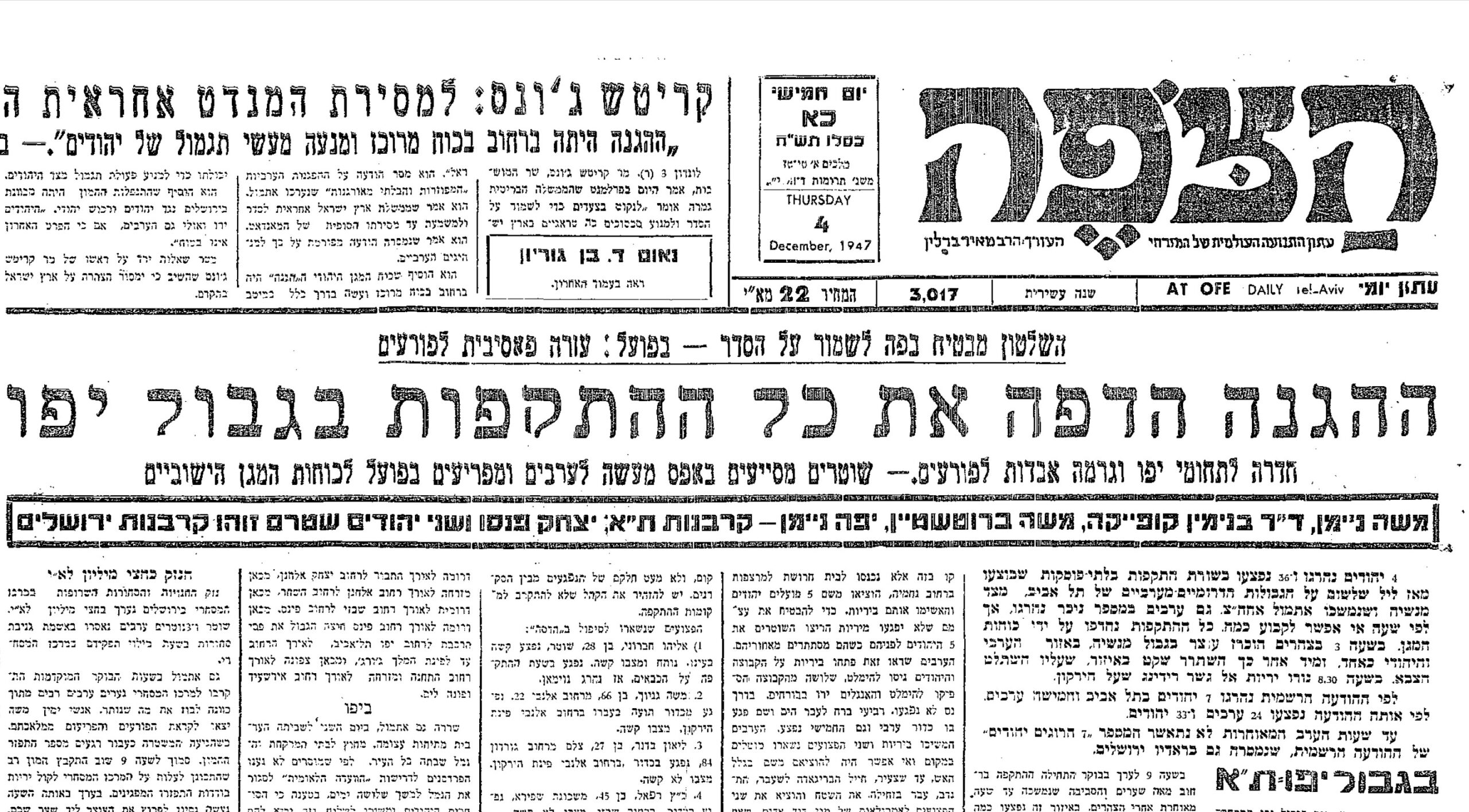
Day Six – 5 December 1947
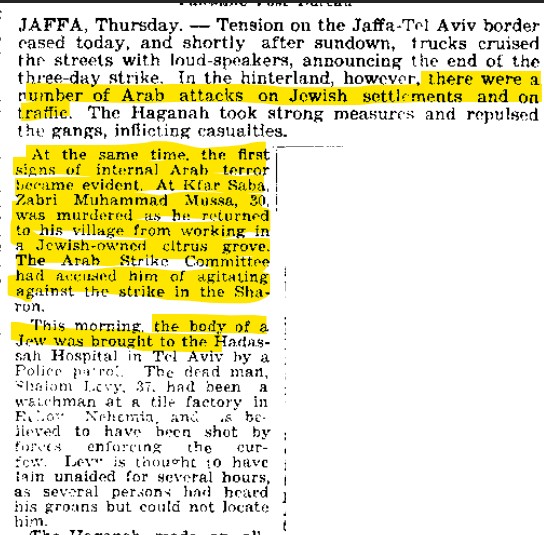
This Palestine Post piece from December 5 describes further attacks on remote Jewish settlements with the Haganah claiming they had successfully ‘repulsed attacks’. In these early days it is impossible to know how much of this was fully accurate and how much was meant simply to calm the nerves of a Jewish community suddenly facing existential threat.
It also noted Arab on Arab violence, including the murder of an Arab man accused by his community of having ‘broken ranks’ by failing to support the uprising. This underscores the coercive atmosphere within Arab society itself – another factor missing from ‘Nakba’ narratives.
Day Seven – 6 December 1947
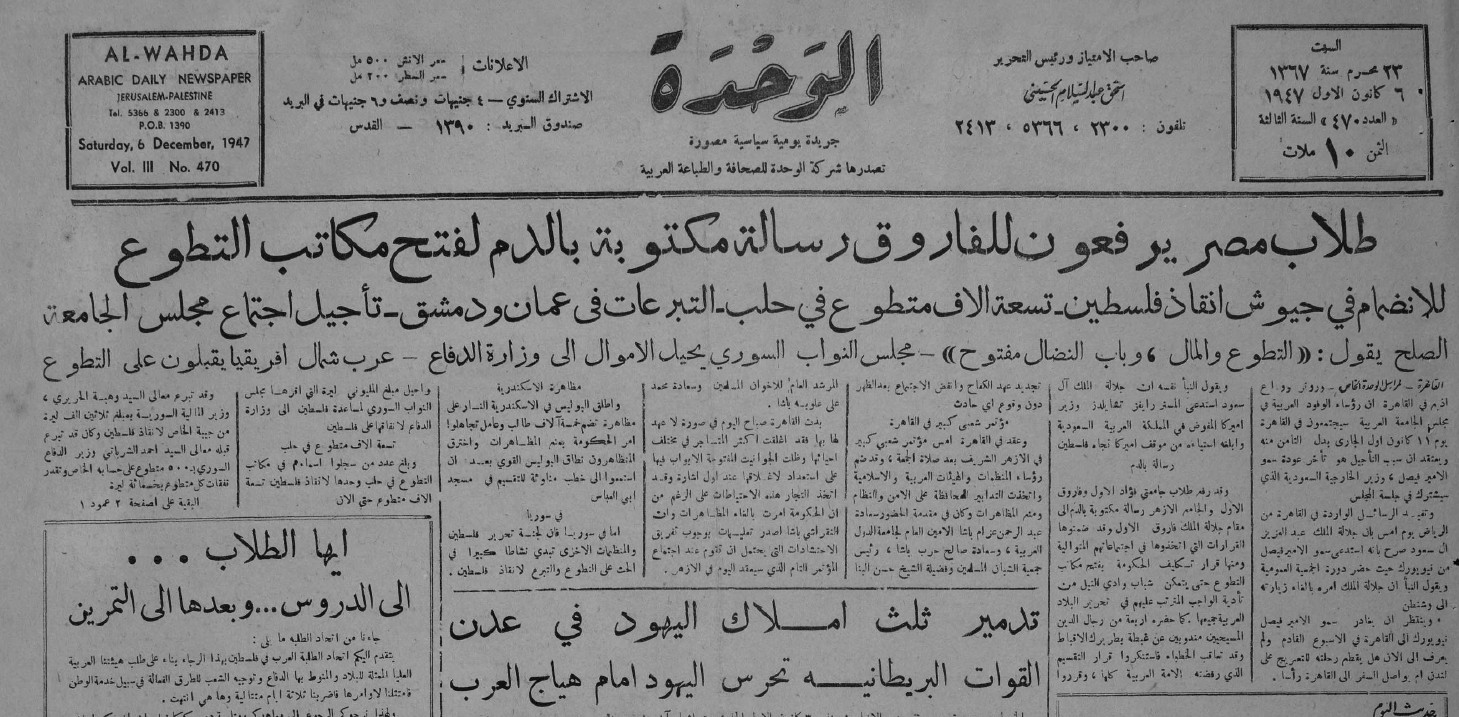
Regional mobilisation intensifies. Al-Wahda led with an extraordinary call from Egyptian students demanding the opening of recruitment offices so they could prepare for battle. Their statement read: ‘The hour has come for action, not words; for sacrifice, not speeches.’
They pledged – in blood – not to return ‘except victorious or as martyrs.’
The paper reported on mobilisation across the Arab world. These are the seeds of the Arab irregular armies, that within weeks would be invading British Palestine and attacking Jewish civilian outposts. Al Wahda also proudly boasted of attacks on innocent Jews in Aden, highlighting the regionalisation of anti-Jewish violence from the earliest days.
Taken together, these first seven days after the UN partition vote tell a story very different from the one embedded in the modern anti-Israel ‘Nakba’ narrative. Arabic newspapers from Jerusalem and Jaffa documented violent outrage, calls for mobilisation, and a rapid chain of attacks on Jews across the Mandate and the wider region. Alongside them, the Jewish Palestine Post recorded the same events from the perspective of a community under siege: bus ambushes, shootings in mixed cities, strikes, pogroms in Aleppo and Aden, and the first Arab families leaving neighbourhoods they feared would become battlefields.
This is not a picture of a peaceful, defenceless Arab society suddenly overwhelmed by a pre-planned Zionist campaign. It is a picture of Arab political and religious leaders choosing rejection over compromise, urging ‘action, not words,’ blessing ‘martyrs,’ and turning a political dispute into a regional war. Jewish defence organisations entered that war in an environment already shaped by Arab-initiated violence and pan-Arab mobilisation, not in a vacuum of calm.
None of this erases that many Arab families experienced 1948 as catastrophe and loss. But it does restore agency and causality to a history that has been deliberately flattened. The refugee crisis did not descend from a clear blue sky. It was the foreseeable consequence of a strategy that gambled everything on preventing a Jewish state by force – and lost.
If there is to be an honest conversation about 1948, it must start here: with what the newspapers of that first week actually reported, not with the comforting myths constructed decades later. The sources have been in plain sight all along. The only real question is why so many continue to ignore them.
Help Me Fight Back Against Antisemitism and Misinformation
For over a decade – and for many years before that behind the scenes – I’ve been researching, documenting, and exposing antisemitism, historical revisionism, and the distortion of truth. My work is hard-hitting, fact-based, and unapologetically independent.
I don’t answer to any organisation or political backer. This website – and everything I produce – is 100% community funded. That independence is what allows me to keep speaking out, without compromise.
If you value this work and want to help me keep going, please consider making a donation. Your support makes it possible.
You can donate via PayPal using the button below:
Or by using my Paypal.,me account.
If you wish to provide regular monthly support you can also do this via my Patreon page
Every contribution is truly appreciated – thank you for standing with me.




ah you are recycling the old 1950 hasbara-narrative, and you are trying to tell that that the IDF orders in 1948 in the Israeli archives are fake? What a wanker you are!
You cheap fascist charlatan!
exactly which part of the Arabic newspaper reports are you disputing?
You actually think this is a telling critical reaction to this well-documented account? Do you think people reading these comments are fools?
You have probably been reading to much nonsense by Pappe and then having wet dreams.
The only fascist charlatan here is you
IDF in 1948?
Slightly different topic, but I caught Dave Rich giving the LCSCA Robert Fine Lecture livestream tonight. Congratulations to you on the honourable mention for the Pete Newbon Award. Well deserved.
Excellent article.
Congratulations on last night; you deserve the recognition
Have you been to the SOAS library where there is a archive of Mandatory Palestine Administration documents.
I spend more time at Kew… Need to check out what is at SOAS
Speaking of history…
_
Clear Eyewitness Testimony vs. Wikipedia Promoted Israel Gershoni’s Sanitized Narrative
https://justsayingitoutloloud.blogspot.com/2025/12/clear-eyewitness-testimony-vs-wikipedia.html
https://archive.is/LzpOI
Truth teller David Collier vs infamous LIAR lan Pappe who respected Benny Morris called him as such . No wonder the biased organized cabal on Wikipedia promote Pappe. Just as rag paper propaganda Haaretz is a supposed RS. A note about Pappe, he cites, about D.Yassin, as a “source”, the neo nazi Holocaust deniar (such as in UN 1972 and inb1978 leyter to Carter, as well as appearing with neo nazis for years) ISSA NAKHLEH who glorified Hitler in his 1950s bulletin while in Argentina working for the Arab league and linked with NZi fugitives, also had contact with Canadian Fuhrer Adrien Arcand.
Speaking of history:
Clear Eyewitness Testimony vs. Wikipedia Promoted Israel Gershoni’s Sanitized Narrative
December 08, 2025
https://justsayingitoutloloud.blogspot.com/2025/12/clear-eyewitness-testimony-vs-wikipedia.html
https://archive.is/LzpOI