
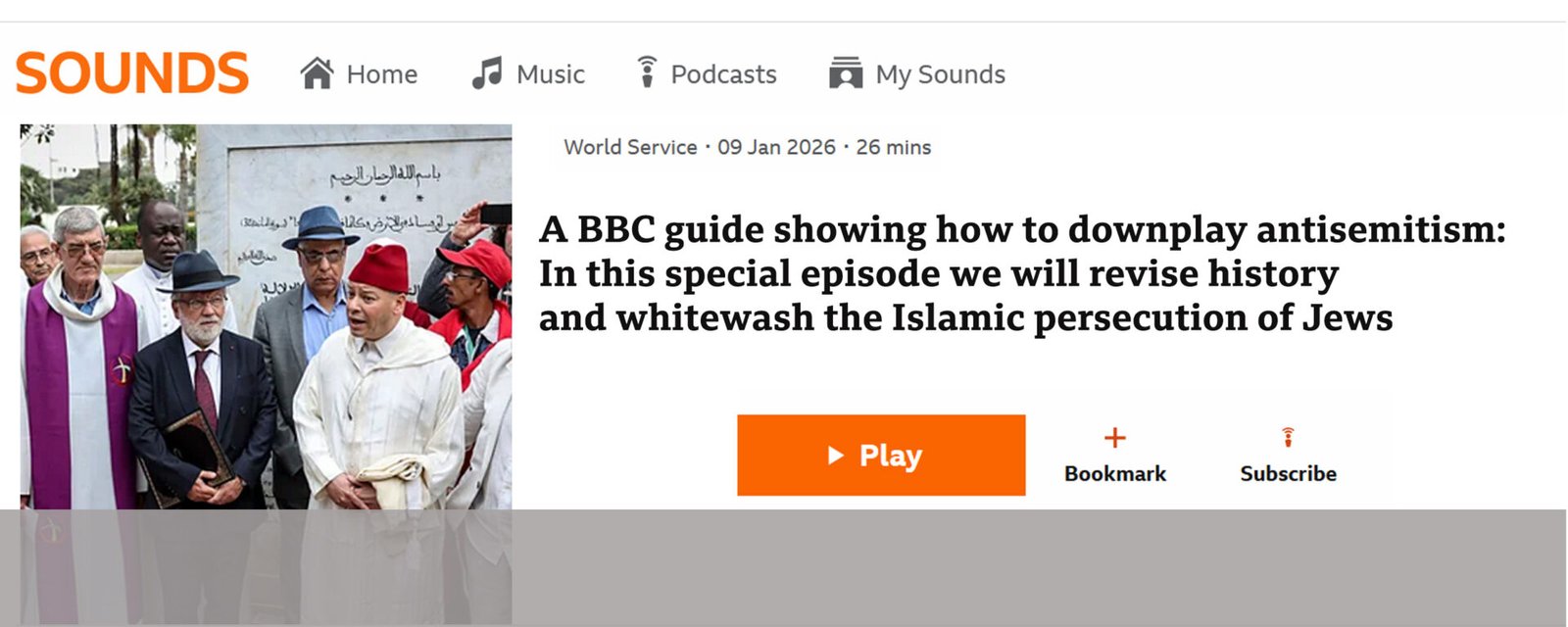
Time after time, BBC News has been caught spreading a demonising image of Zionism or Israel. When challenged, BBC executives typically retreat behind claims of “conflict complexity” to excuse error or bias.
This time, that defence does not apply. There is no Israel, no Zionism, and no contemporary conflict to hide behind.
In a recently published BBC podcast Jewish suffering in Morocco was erased, centuries of persecution were reframed as harmony, and Islamist propaganda was presented as historical fact. Conditions approaching slavery were recast as a “model” of Muslim-Jewish coexistence.
The end product is the BBC engaging in antisemitic historical falsification.
Living side by side: Morocco’s Jews and Muslims
On 9 January, BBC Sounds published a podcast titled Living side by side: Morocco’s Jews and Muslims. The BBC has been conspicuously proud of it, repeatedly promoting it across its social-media channels.
The podcast promises an exploration of “how two Abrahamic faiths in Morocco have embraced peaceful coexistence.” Its introductory text opens with the claim:
“Relations between Jews and Muslims in Morocco have historically been strong, unlike elsewhere in North Africa and the Middle East.”
This assertion is not merely misleading, it is historically false. It reduces centuries of legally enforced Jewish inferiority, periodic violence, Islamic supremacy, and systemic humiliation to a feel-good slogan. And from this introductory act of ahistorical propaganda, the programme itself only makes things even worse.
I am not going to dissect every sentence of the podcast, I could fill a book there are so many problems. A full transcript is available for those who wish to take a more detailed look themselves. Whatever image the producer, Mike Lanshin, carried into this project bears little resemblance to reality. The result is nearly thirty minutes of incoherence, in which even the programme’s own internal logic collapses. Lanshin’s central case study is a fractured family: the parents are divorced, and the child of the mixed Jewish – Muslim marriage is no longer in contact with his Muslim father. This is presented, somehow, as evidence of “coexistence.”
But this sleight of hand is the programme’s central method. It whitewashes centuries of persecution while promoting the familiar and false anti-Zionist trope that, before Zionism, Jews and Muslims “lived side by side” in harmony. The mass departure of Moroccan Jews is attributed to wars involving Israel and the Arab world, rather than the more obvious reality: once a persecuted population had somewhere to go, it left. At one point, Moroccan Jews are even accused of “betrayal” for not informing their Muslim neighbours of their departure – a remarkable inversion that reproaches the persecuted for the manner in which they escaped persecution.
The programme repeatedly puts the cart before the horse. Lanshin asks what will keep the “harmony” he claims to observe intact as conflict spreads elsewhere, before concluding that “in many cases, Morocco is a model, an example.” The entire premise is simply absurd.
The missing images
Before turning to the historical record that exposes these BBC distortions, it is worth addressing something far more immediate: what is visible, in plain sight, in Morocco today.
It is unclear if Mike Lanshin left Casablanca and Rabat, but he cannot have failed to notice what was directly in front of him in the places he did visit. My wife has Moroccan heritage, and we have visited Morocco, focusing in particular on sites of Jewish heritage. For that reason, I know the producer must have seen far more than he chose to show.
Outside every synagogue – even when closed – sit armed police guards. The Jewish cemetery in the heart of Casablanca’s market is unmarked from the outside and hidden behind high walls. The Jewish Museum in Casablanca is guarded by police; another unmarked building, protected by heavy bollards, is a Jewish school that cannot advertise its own presence. During a Jewish festival in Agadir, we required a police escort simply to walk from the synagogue to the home of the local rabbi.
You cannot visit Morocco without seeing this. So why is none of it mentioned?
What follows is not interpretation, but contemporaneous reporting from the 18th, 19th, and 20th centuries – published in British and American newspapers long before modern political disputes.
1790
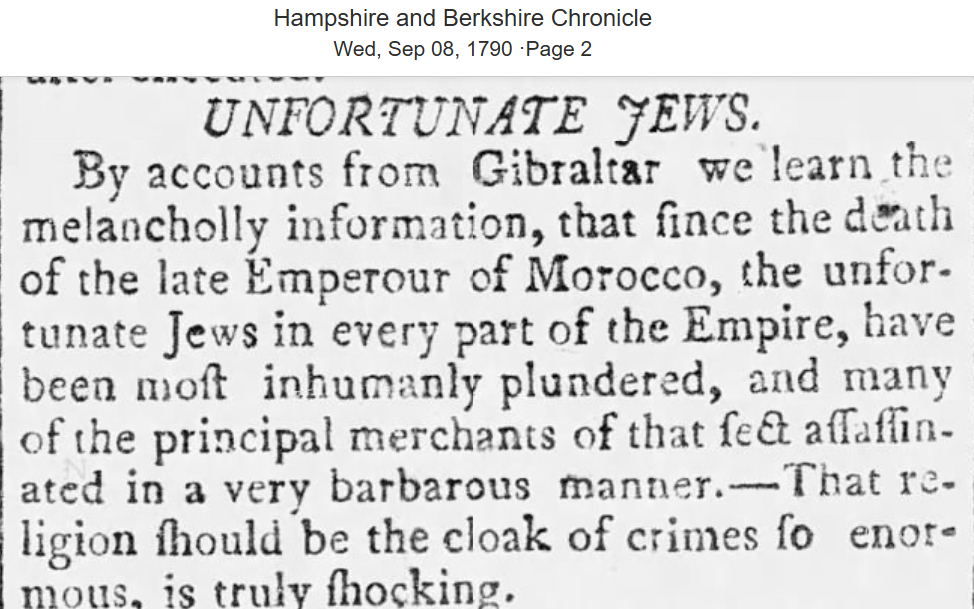
The central pillar of the BBC’s podcast is the claim of historical coexistence. That claim collapses the moment one consults the historical record. We can begin 236 years ago, in 1790.
Following the death of Mohammed bin Abdallah, contemporary reports described the treatment of Morocco’s Jews in stark terms. A British newspaper, citing accounts from Gibraltar, recorded that Jews “in every part of the Empire” were “most inhumanly plundered,” with many leading Jewish merchants “assassinated in a very barbarous manner.”
This is not the language of coexistence. It is the documentary record of persecution.
In the early 1800s
In the early 1800s, An Account of the Empire of Morocco was published by James Grey Jackson, drawing on his years in Morocco as British consul. Jackson describes a society in which Jews were economically indispensable yet heavily taxed, socially degraded, and subject to legal restrictions and ritualised humiliation.
In one passage, describing popular custom and everyday language, Jackson records that Jews in Morocco were treated “somewhat worse than dogs in Christian countries:”

1834: The execution of Solika
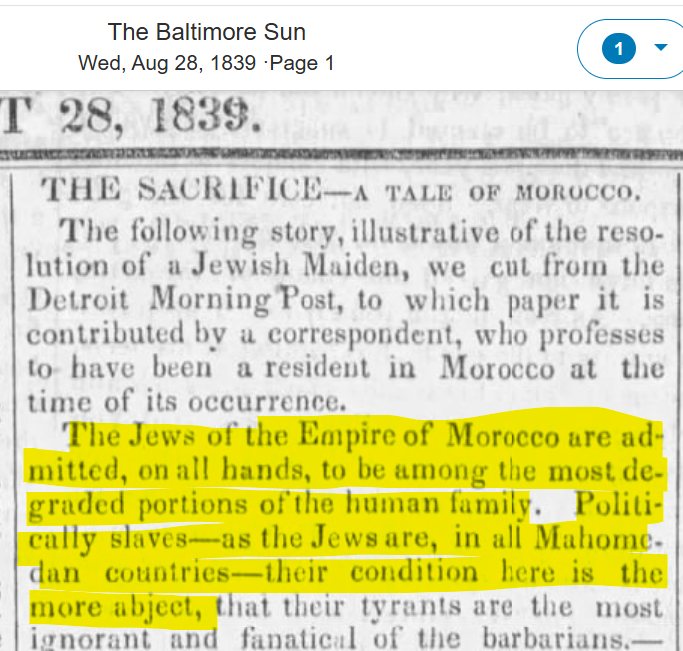
Sol Hachuel (also known as Solika or Lalla Suleika) was a young Jewish woman from Tangier. Accused of converting to Islam and then renouncing it, she denied ever converting and refused repeated demands to accept Islam in exchange for her life. She was imprisoned, transported to Fez, and executed in 1834.
Just five years later, in 1839, The Baltimore Sun, citing a correspondent resident in Morocco retelling the story of Sol, described the Jews of the empire as “among the most degraded portions of the human family,” “politically slaves,” and living under particularly “abject” conditions:
1858: Jews as unclean animals
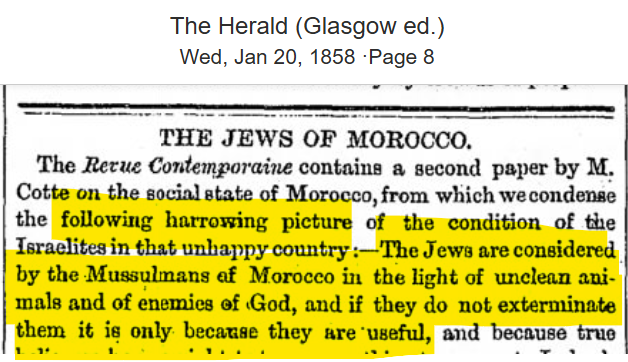
The Herald (Glasgow) citing a report from the French political journal Revue Contemporaine, published what it described as a “harrowing picture” of Jewish life in Morocco. The article states that Jews were regarded by Muslims as unclean animals, and enemies of god, and suggests that they were spared extermination only because they were economically useful. It describes them as bearing the condition and appearance of slaves:
1864: The relief campaign
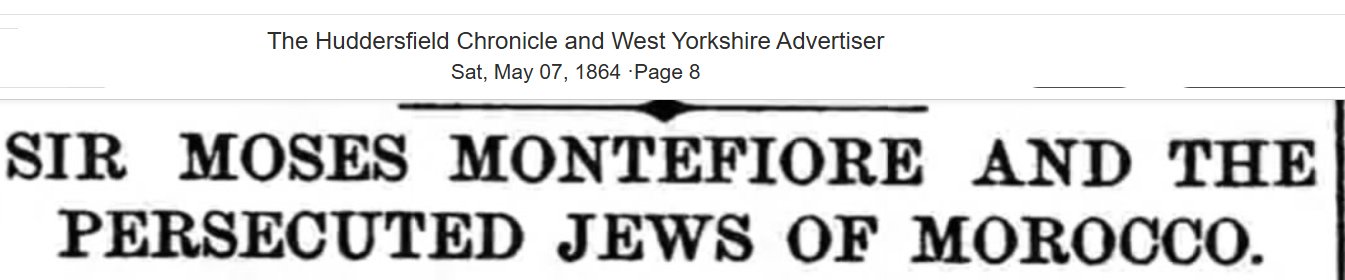
By the 1860s, awareness of the plight of Moroccan Jewry had spread across the British Empire. In 1864, a relief campaign was launched by Sir Moses Montefiore following his visit there. A British newspaper stated that there could be “no doubt that the Jews of Morocco have been most barbarously treated by the masters of that land.” Montefiore received promises from the Sultan that Jews would be protected:
1868: The decree fails
Moses Montefiore’s 1863 visit to Morocco was prompted by a blood-libel case in the city of Safi. His subsequent campaign secured a formal decree from the Sultan affirming protection for Jews.
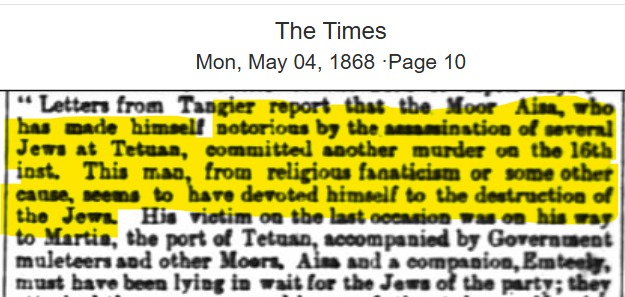
It appears that the decree did little to alter conditions on the ground. In 1868, The Times published correspondence from Tangier describing a religious fanatic in Tetuan who had assassinated several Jews and appeared to have devoted himself to their destruction:
1888: The value of a rat
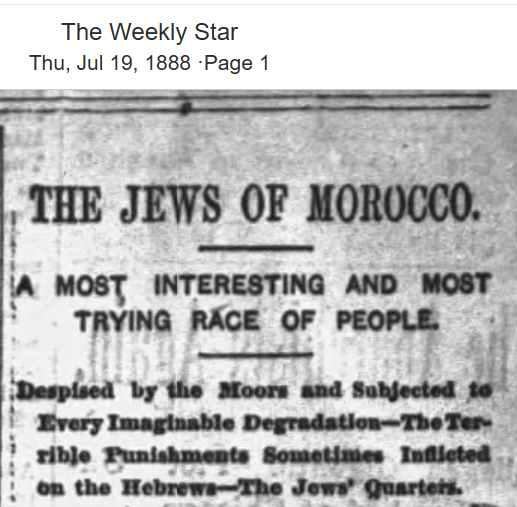
A report on the state of the Jews originally published by the Morocco Correspondent in the Boston Evening Transcript leaves no doubt about the Jews being “despised” and “subjected to every imaginable degradation”. The report states that a local Muslim can “think no more of killing a Jew, if he can do it quietly, than of killing a rat”:
1894: Pogroms
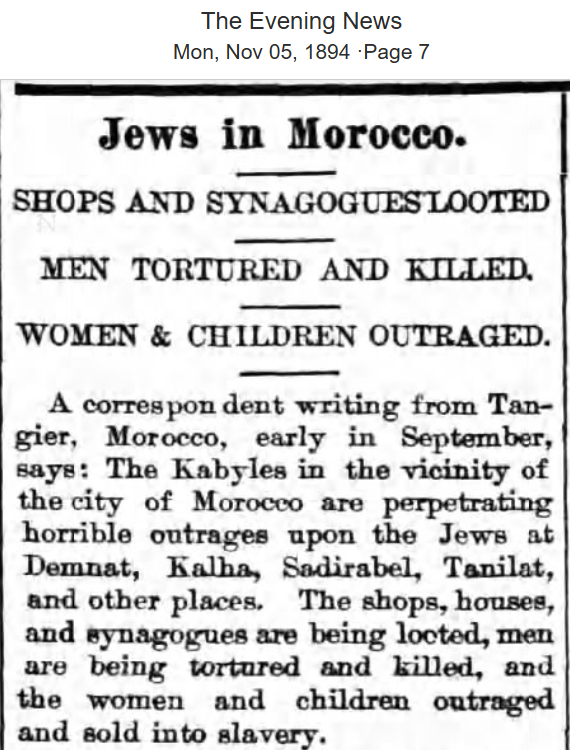
This report from 1894 lays out a description of pogroms taking place at various sites that appear to be in the Atlas mountains around Marrakech:
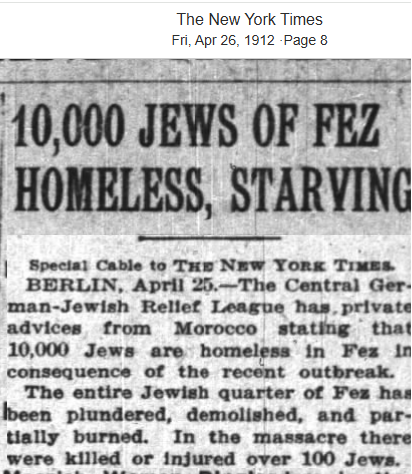
1912: The sacking of the Jewish Quarter of Fez
The results of a pogrom in Fez. 100 dead, 10,000 homeless and the entire Jewish Quarter in Fez had been destroyed:
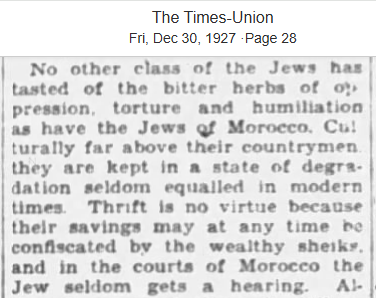
1927: The bitter herbs of oppression
This report from 1927 shows that the “oppression, torture and humiliation” continued in the 1920s. Alongside this, there is no remedy in the courts and their savings stolen at any time:
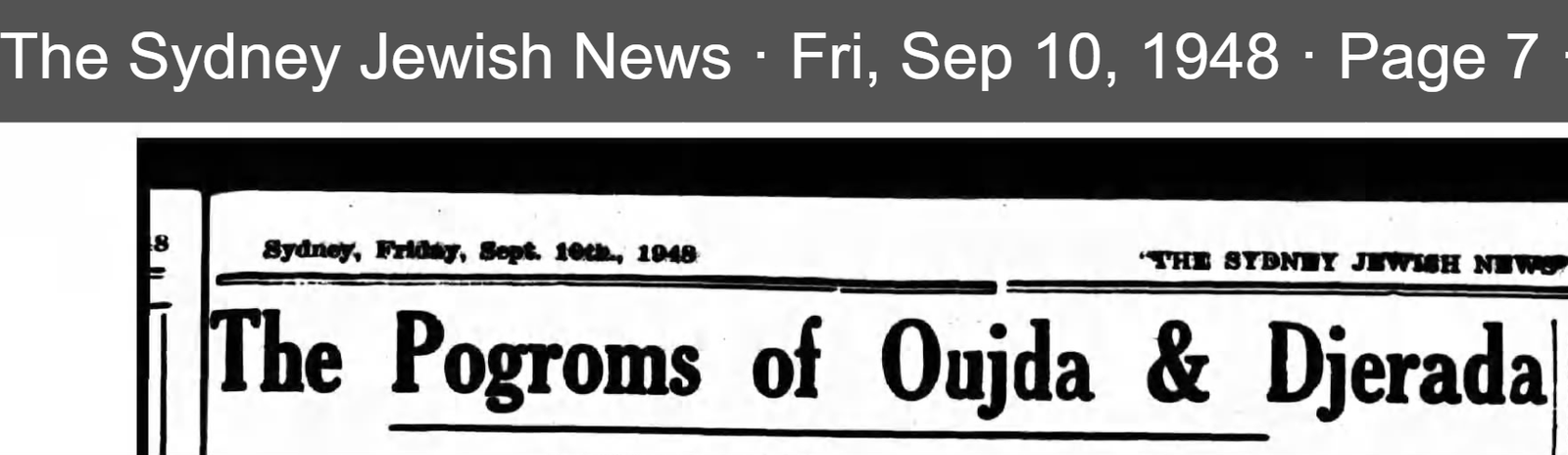
1948: The pogroms of Oujda and Jerada
As the Arab armies tried to destroy the newly declared State of Israel, local Muslims in Morocco continued a well-worn pattern of murdering their Jewish neighbours. Initial reports on Pogroms in Oujda and Djerada tallied 42 Jews murdered.
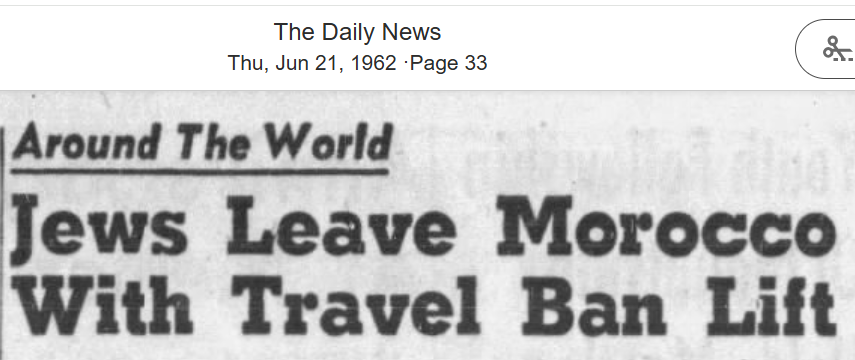
1962: And then it was done
Anti-Zionists like to rewrite the narrative starting from 1948. But the eventual departure of Moroccan Jews was a natural consequence of hundreds of years of documented persecution. Once they had somewhere to go the end was inevitable. The Moroccan leadership initially tried banning them from leaving, but eventually had no choice but to open the gates. Once there were approximately 300,000, now there are just a few left. A model coexistence this never was.
Unleashed bias and ignorance
Anti-Zionist narratives often attempt to reset the clock at 1948, as though Jewish history in the Muslim world began only with the establishment of Israel. The historical record does not permit that fiction.
The departure of Moroccan Jews was not a sudden or inexplicable rupture of a harmonious society. It was the predictable outcome of centuries of legally enforced inferiority, periodic violence, and social degradation, extensively documented by contemporary observers long before modern political conflicts existed. Once Moroccan Jews had somewhere to go, they left.
To stand a single fractured family narrative atop centuries of documented persecution, and present it as evidence of “model coexistence,” is historical falsification – a level of narrative inversion that would not have been out of place in the pages of Pravda.
The BBC did not merely omit context. It inverted it – transforming a record of subjugation into a story of harmony, and erasing Jewish suffering in the process.
That is not public service broadcasting. It is the rewriting of history.
Help Me Fight Back Against Antisemitism and Misinformation
For over a decade – and for many years before that behind the scenes – I’ve been researching, documenting, and exposing antisemitism, historical revisionism, and the distortion of truth. My work is hard-hitting, fact-based, and unapologetically independent.
I don’t answer to any organisation or political backer. This website – and everything I produce – is entirely community funded. That independence is what allows me to speak freely and without compromise.
If you value this work and want to help me continue, please consider making a donation. Your support genuinely makes this possible.
You can donate via PayPal using the button below:
Alternatively, you can donate via my PayPal.me account or support my work through my Patreon page.
Independent work survives only because people choose to support it. Thank you for standing with me.




Keep up your invaluable work, David. I had no idea about this and I’m pretty sure very few people do.
Relating to the straged departure of Jews from Morocco it should be recorded that apart from those who were successfully smuggled out (thanks partly to young British Jew David Littman) the others were only allowed out by Israel having to pay a per head charge of 100$ to the ruler. Relating to the 19th century pogrom I have just completed reading in French the following comprehensive photograpic book: (with local Jewish testimony of the time) “Deaux Destins en Diaspora” by Gérard SILVAIN, Editions Albin Michael SA 1984 and EDDL Paris 2002 (ISBN 23700-567-2) It divulges photos & post cards of the murder of Moroccan Jews and the devastation caused by the rioters. However to be fair & accurate the book is not all doom & gloom from the many post cards of Jewish life in Morocco during the 19th and early 20th Century. It shows the pogroms were episodic as in Russia & other countries. It also records life throughout the Maghreb. Readers might be aware of the excellent book by the deceased author Sir Martin Gilber, “In Ishmael’s House”a history of Jews in Muslim lands” published by Yale University Press 2010/11 which covers without bias the true history in line with the excellent report article herre from David-Collier
Great work again David!
It used to be said that if you wished to see how reliable reporting is read about something you know well. And here we have it.